Last Updated on July 26, 2025 by Brian Beck
Separating the Green from the Garbage Advice
If you’ve owned a lawn for more than five minutes, chances are you’ve been fed a healthy serving of misinformation—usually well-meaning, sometimes wildly wrong, and often downright destructive. So let’s fire up the mower of truth and mulch down the top 10 most persistent myths in lawn care.
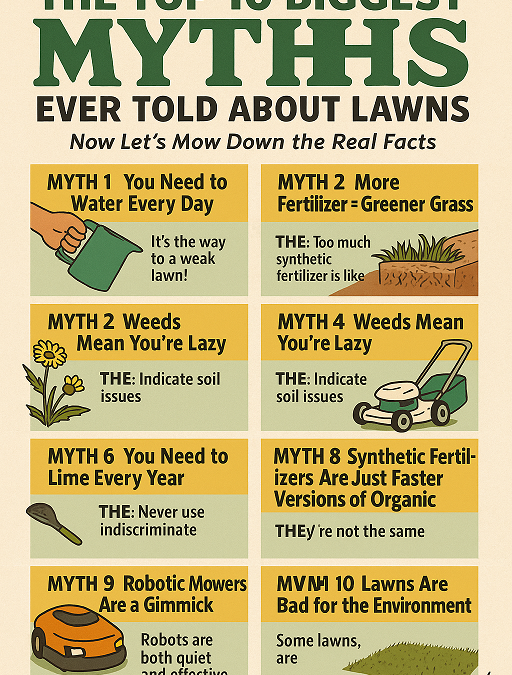
1. You Need to Water Every Day
The Myth: “A lush lawn needs daily watering!”
The Truth: Actually, this is the fastest route to a shallow-rooted, weak, water-addicted lawn. Deep, infrequent watering trains roots to grow deeper, making your lawn more drought-resilient and less needy. Think of it as raising a lawn with grit, not one that wilts at the first sign of sunshine.
2. More Fertilizer = Greener Grass
The Myth: “If your lawn isn’t green enough, you need more fertilizer.”
The Truth: This is like giving fast food to an athlete instead of a balanced diet. Excess fertilizer—especially synthetics—burns roots, disrupts soil biology, and sends nitrogen runoff into waterways. You’re not feeding the lawn—you’re drugging it.
3. Thatch Is Just Dead Grass
The Myth: “Thatch is just a cosmetic issue—rake it up!”
The Truth: Thatch buildup is a symptom, not a cause. It’s the result of poor soil biology—mainly a lack of fungal populations that should be digesting that organic matter. Raking without addressing the root cause is like dusting a broken air filter.
4. You Must Dethatch Every Spring
The Myth: “Annual dethatching is essential for all lawns.”
The Truth: Not if your soil is alive and functioning. In a healthy biological system, microbial life keeps thatch in check naturally. Dethatching every year might make your lawn look tidier—for a few days—but it’s not a sustainable practice for true lawn health.
5. Weeds Mean You’re Lazy
The Myth: “If you have weeds, you’re doing it wrong.”
The Truth: Weeds are messengers from the soil. They tell you something’s out of balance—compaction, poor nutrition, low microbial life. Dousing them in chemicals is like putting duct tape on a warning light. Listen, don’t just spray.
6. You Need to Lime Every Year
The Myth: “Annual liming keeps your soil sweet!”
The Truth: Blanket liming without a soil test is like taking prescription drugs without a diagnosis. Your lawn may not need it—or worse, you could be skewing the pH in the wrong direction and locking out key nutrients.
7. Grass Should Always Be Left Long
The Myth: “Taller grass is always healthier grass.”
The Truth: While taller grass can help shade the soil and retain moisture, it’s not a one-size-fits-all rule. Lawns can be cut shorter—if they’re mowed frequently and maintained at high density. In fact, turf density matters more than turf height when it comes to choking out weeds and enhancing aesthetics. The real key to resilience lies beneath your feet: soil organic matter. It determines how much water your soil can hold, how healthy your microbial life is, and whether your lawn can thrive—regardless of length.
8. Synthetic Fertilizers Are Just Faster Versions of Organic
The Myth: “There’s no real difference—synthetics just work quicker.”
The Truth: That’s like saying processed sugar is just faster broccoli. Synthetic nitrogen feeds the plant—not the soil. Organic inputs feed the soil, which in turn builds a self-sustaining system that feeds the plant naturally and long-term.
9. Robotic Mowers Are a Gimmick
The Myth: “There’s no way a robot can handle real mowing.”
The Truth: Today’s robotic mowers mow daily, eliminate emissions, reduce noise, and actually improve lawn health by micro-mulching clippings back into the soil. Gimmick? More like revolution. Your neighbor’s still mowing at 90 decibels while your robot mows in silence at midnight.
10. Lawns Are Bad for the Environment
The Myth: “Lawns are wasteful, polluting monocultures.”
The Truth: Some lawns are. But a properly managed, biologically active lawn sequesters carbon, cools the air, filters water, reduces erosion, supports microbial biodiversity, and even suppresses weeds without a drop of pesticide. The problem isn’t lawns—it’s how we manage them.
Final Cut
Lawn care has been wrapped in myth and misinformation for decades—often propped up by the chemical industry and outdated landscaping norms. But it’s 2025, and it’s time to cut through the B.S. (bad science). A healthy lawn doesn’t need to be thirsty, chemically dependent, or shallow-rooted.
Feed the soil, raise the blades (or don’t), and water with intention. You don’t need to be a turf scientist to win at this—you just need to ditch the myths and trust biology.