
Last Updated on September 5, 2026 by Brian Beck
The Most Expensive Thing in Lawn Care Is the Mindset
One of the greatest frustrations I have after spending decades in the lawn and landscape industry is realizing just how much unnecessary waste we have accepted as normal.
Waste of water.
Waste of fertilizer.
Waste of chemicals.
Waste of labor.
Waste of money.
And perhaps most importantly, waste of the incredible natural systems that are already beneath our feet.
The frustrating part is that most homeowners aren’t doing anything wrong intentionally.
They are simply participating in the only system they have ever been shown.
For generations, conventional lawn care has essentially taught us the same formula:
The lawn doesn’t look good? Add something.
It isn’t green enough? Fertilize it.
There are weeds? Spray them.
There are insects? Kill them.
The soil is hard? Aerate it.
The lawn is struggling in the heat? Add more water.
Something goes wrong, and the answer almost always comes from a bag, bottle, machine or sprinkler.
And then we repeat it again next year.
And the year after that.
Eventually, dependency becomes lawn care.
We’ve Been Treating Symptoms Instead of Building Systems
What changed my thinking was beginning to understand what was happening underneath the lawn.
The soil isn’t dirt.
It is an ecosystem.
There are bacteria, fungi and countless other organisms interacting with plant roots, organic matter, minerals, oxygen and water.
There is an entire microscopic economy happening beneath every lawn.
Plants capture sunlight.
They produce energy.
They interact with microorganisms.
Microorganisms help cycle nutrients.
Organic matter helps hold moisture.
Soil structure helps regulate air and water movement.
Roots explore the soil.
And when those relationships are functioning correctly, the entire system becomes more efficient.
Nature has been doing this long before fertilizer companies, irrigation controllers and lawn-care trucks existed.
The problem is that almost nobody sees it.
Biology is microscopic.
Soil structure isn’t exciting advertising.
Nobody puts a billboard along the highway saying:
“Your lawn might not need more fertilizer. It might need better soil function.”
Instead, we have been conditioned to believe that the answer is something we need to continuously purchase and apply.
The Dependency Game
That is the part that frustrates me.
Traditional lawn care has unintentionally—or sometimes quite intentionally—created a dependency model.
The lawn needs constant inputs.
More fertilizer.
More irrigation.
More pesticides.
More treatments.
More intervention.
And when the lawn begins struggling, instead of asking why the system isn’t functioning, we increase the inputs.
That is an expensive game.
And homeowners have been playing it for decades.
I played it too.
For many years I operated inside the same system because it was what I had been taught.
But once you begin understanding soil biology, soil structure, mineral balance, carbon and water relationships, it becomes very difficult to look at traditional lawn care the same way.
You start seeing inefficiency everywhere.
You begin asking different questions.
Instead of:
What should I put on the lawn?
You start asking:
Why does the lawn need so much help in the first place?
That single question changes everything.
A Lawn Should Become More Independent, Not More Dependent
My goal isn’t to eliminate every product or every intervention.
That would be unrealistic.
My goal is to build a lawn that needs less rescuing.
Less water.
Less fertilizer.
Less chemical dependency.
Less emergency intervention.
Less wasted money.
A biologically functioning soil should increasingly help the plant do what plants were designed to do.
Capture sunlight.
Build roots.
Cycle nutrients.
Manage water.
Interact with microorganisms.
Recover from stress.
That doesn’t mean neglecting the lawn.
It means managing the lawn differently.
We stop treating the lawn like a patient permanently attached to life support and begin treating the soil like the living system it actually is.
This Is Bigger Than Lawns
And frankly, I don’t believe this conversation should stop at the property line.
Every acre of functioning soil represents an opportunity to manage water better.
Lawns.
Landscapes.
Parks.
Commercial properties.
Agricultural ground.
Open spaces.
Anywhere soil exists, there is an opportunity to improve the relationship between water, carbon, biology, roots and soil structure.
When soil functions better, water has somewhere to go.
When roots grow deeper, plants become more resilient.
When organic matter increases, the soil becomes a better reservoir.
When biology becomes more active, nutrient cycling becomes more efficient.
Multiply those improvements across thousands or millions of acres and suddenly this isn’t just lawn care anymore.
It becomes resource management.
Water management.
Soil stewardship.
And economic efficiency.
The Hardest Part Isn’t the Biology
Ironically, one of the hardest parts of what we do isn’t getting biological systems to work.
It’s getting people to believe there might be another way.
We spend an enormous amount of time deprogramming assumptions that people didn’t even know they had.
People have been taught that a green lawn must be healthy.
Not necessarily.
They’ve been taught that more fertilizer means more growth.
Not necessarily.
They’ve been taught that struggling grass needs more water.
Sometimes it needs better soil.
They’ve been taught weeds are simply enemies invading the lawn.
Sometimes weeds are telling us something about the environment they are growing in.
Once you understand those relationships, the lawn begins telling a story.
And suddenly lawn care becomes less about fighting nature and more about learning how to work with it.
I Want People Out of the Racket
That is ultimately what motivates me.
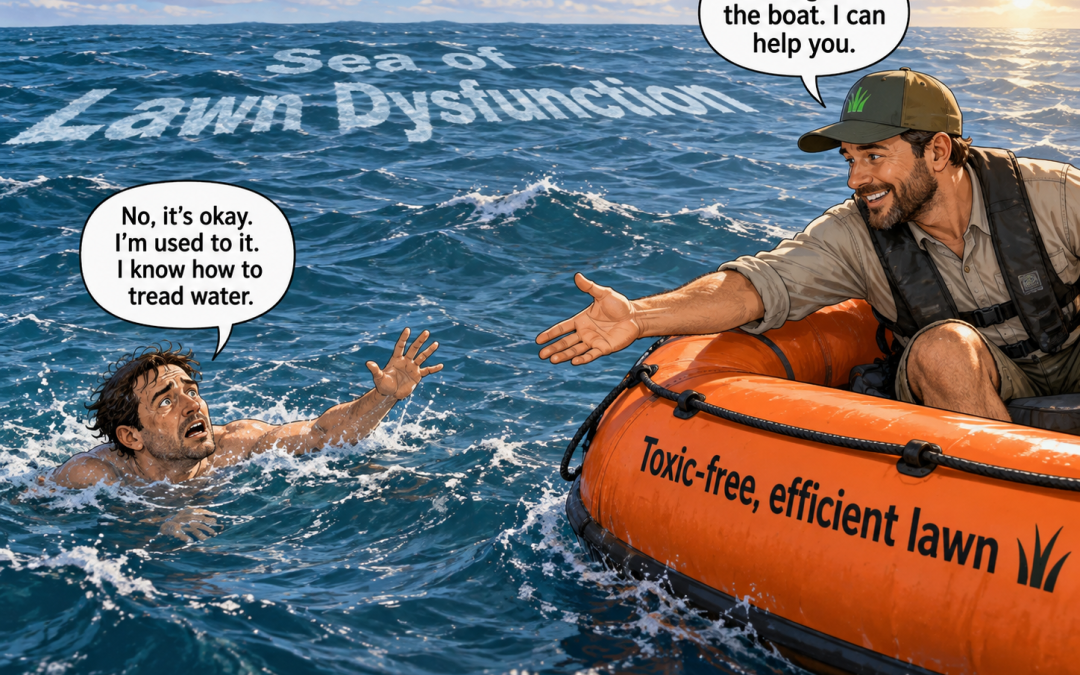
I want homeowners out of the endless dependency cycle.
I want them to understand why their lawn behaves the way it does.
I want them to use less water because their soil manages water better.
I want them to need fewer chemical interventions because the system is more resilient.
I want them to spend money building something instead of repeatedly rescuing something.
And yes, I want them to have a better-looking lawn.
But I want the lawn to look better because it is functioning better.
That is an entirely different goal.
The future of lawn care isn’t about discovering the next miracle product.
It is about rediscovering the system that has been beneath our feet the entire time.
Nature already wrote the operating system.
Maybe it’s time we stopped trying to replace it—and started learning how to work with it.
Stop Paying to Treat the Same Problems Over and Over
If your lawn requires more water, more fertilizer, more chemicals, and more intervention every year just to keep it looking acceptable, it may be time to stop asking what else should I put on it?
Start asking:
Why does it need so much help in the first place?
Our biological approach is designed to identify and improve the underlying conditions that determine how well your lawn actually functions — soil structure, biology, nutrient balance, root performance, and water efficiency.
The goal is not to create a lawn that depends on us forever.
The goal is to help build a lawn that becomes healthier, more resilient, more efficient, and less dependent on constant inputs.
If you are ready to stop renting temporary results and start building a better system beneath your lawn, contact us.
Stop feeding the dependency. Start building the soil.