
Last Updated on September 6, 2026 by Brian Beck
The silver lining may not be conservation alone. It may be strategy.
Colorado has a water problem. I don’t think there is much value in pretending otherwise.
But I also believe there is a silver lining buried inside the problem—because the answer may not be conservation alone. It may be a better strategy for what happens to water after it reaches the ground.
For years, most of the public conversation has focused on what happens above the soil: water fewer days, change sprinkler heads, fix leaks, reduce turf, replace landscapes, or simply tell people to use less.
Those conversations have their place. But I believe we have overlooked one of the most important pieces of water infrastructure in Colorado:
The soil beneath our feet.
Soil Is Infrastructure
When people hear the word infrastructure, they think about reservoirs, pipelines, treatment plants, dams and distribution systems. Maybe we need to expand that definition.
Every lawn sits on another kind of reservoir: the soil. And the condition of that reservoir determines what happens after irrigation begins.
Does water infiltrate? Does it spread through the root zone? Can the soil hold it? Is there enough pore space for both water and oxygen? Can roots move deeply enough to access that moisture later?
Or does the water stay near the surface, run away, evaporate quickly, or remain poorly available to the plant?
After years of studying Colorado lawns and soil tests, I continue to see a troubling pattern: low carbon—especially low humus—along with weak structure, limited pore space and low biological activity. Those conditions matter because they directly influence how efficiently soil can receive, hold and cycle water.
We May Be Conserving Water With a Broken Storage System
Think about the contradiction. Colorado can invest enormous resources in water storage and delivery, only to send that valuable water onto urban soils that may be poorly equipped to absorb and retain it.
We have spent decades asking, “How much water does a lawn need?” I think we also need to ask a second question:
What happens to the water once we put it there?
That question changes the entire conversation. Healthy soil is not simply dirt holding up grass. It is a living physical system made of minerals, organic matter, roots, microorganisms, air and water.
Humus and stable soil carbon help support aggregation. Aggregation helps create pore space. Pore space affects infiltration, oxygen movement and the soil’s ability to store moisture where roots can use it.
Carbon affects structure. Structure affects porosity. Porosity affects infiltration. Infiltration affects water storage. Water storage affects irrigation demand.
This Changes the Conservation Conversation
Conservation cannot only mean telling people to turn the water down. Eventually we have to ask whether we are making the water we do use more productive.
There is a tremendous difference between irrigating a biologically active, well-structured soil and repeatedly watering a compacted, carbon-starved soil with shallow roots and limited pore space.
Both lawns may be green today. That does not mean they are equally healthy—and it certainly does not mean they use water equally well.
That is why I believe the next major advancement in urban water conservation will involve more than sprinkler technology. It will involve soil strategy.
The Information Has Been Hiding in Plain Sight
Much of this information is not new. Soil scientists, agricultural researchers, conservation agencies and universities have studied carbon, soil structure, aggregation, biology, infiltration and water-holding capacity for years.
The problem is that these subjects have often existed in separate conversations. Agriculture talks about soil health. Water providers talk about conservation. Irrigation professionals talk about distribution. Lawn companies talk about fertilizer. Homeowners talk about brown grass.
Almost nobody connects the entire system.
That needs to change. Recent water conditions are forcing us to examine assumptions that were easier to ignore when supply felt less urgent.
And as we continue studying soil data and field performance, a clearer picture is emerging: some of the information we need has not been absent—it has been fragmented, underemphasized, overlooked, or simply hidden in plain sight.
There Is a Silver Lining
This is where I become optimistic. If poor soil function contributes to inefficient water use, then improving soil gives us another conservation tool—and potentially a very powerful one.
We do not necessarily have to choose between lawns and conservation. We may need to choose between poorly functioning lawns and efficiently functioning lawns.
Imagine thousands, and eventually hundreds of thousands, of Colorado landscapes gradually increasing soil carbon, improving aggregation, supporting stronger biology, developing deeper roots and making each gallon of irrigation water work harder.
The improvement on one property may seem small. Across a neighborhood, a city, the Front Range, and eventually the state, the potential becomes something much larger.
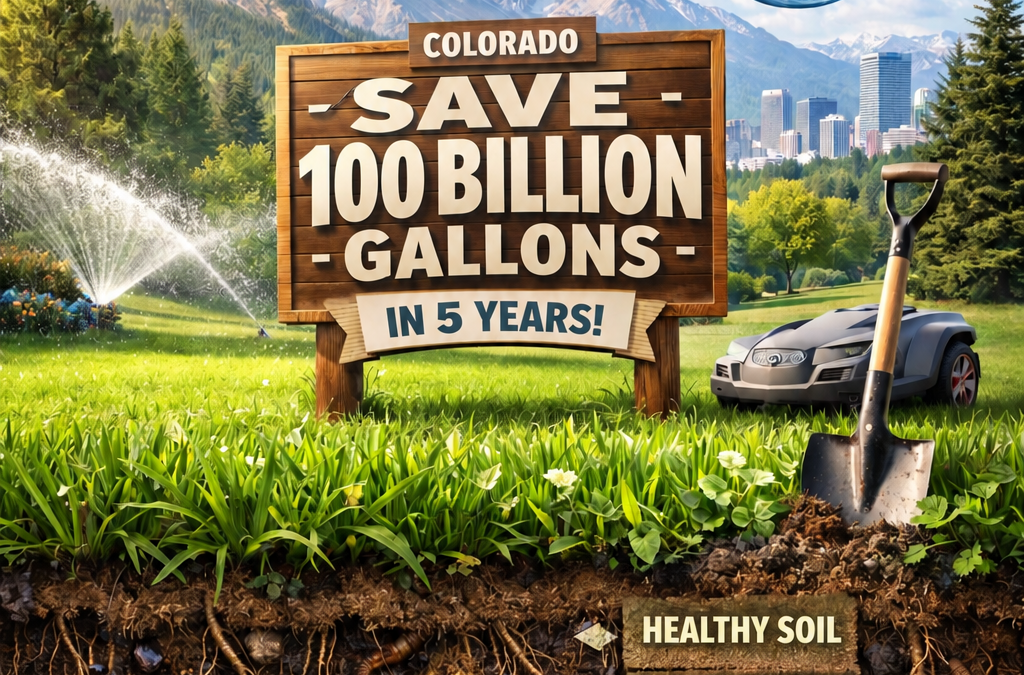
| OUR FIVE-YEAR GOAL: Help Colorado save 100 BILLION GALLONS of water. |
Not simply by turning sprinklers off. By helping build landscapes that require less intervention because the soil underneath them functions better.
Pay Attention. We’re Just Getting Started.
Over the coming months, we are going to talk extensively about soil carbon, humus, biological activity, porosity, compaction, irrigation efficiency, soil testing and the relationship between all of them.
Some of what we are uncovering challenges conventional lawn thinking. Some of it challenges conventional conservation thinking. Much of it has been sitting in research, soil science and field observations for years without being connected to the everyday Colorado lawn.
We are going to connect it. We are going to test it. We are going to measure it. And we are going to talk about what we find.
Colorado’s water situation demands more than conservation slogans. It demands strategy.
Maybe part of Colorado’s most important water infrastructure is the first eight inches of soil beneath our feet.
A Call to Colorado Homeowners
If you care about Colorado’s water future—and you still believe beautiful, functional lawns and landscapes have a place in it—pay attention to this conversation.
Read what we are publishing. Share it. Ask questions. Challenge old assumptions. And most importantly, find out what is actually happening beneath your own lawn.
| YOUR LAWN CAN BECOME PART OF COLORADO’S WATER SOLUTION.
If you want to understand whether low carbon, poor soil structure, compaction or weak biological activity may be working against your irrigation, let us help you begin with information—not guesswork. Request information about our biological lawn and soil programs: Start Here – Front Range Biological Call: 719-380-0136 Prefer to do it yourself? Follow our continuing education as we build out the DIY side of this mission. |
Use less water. Build better soil. Grow a more resilient Colorado.
Front Range Biological & Lawn Automation