
Last Updated on August 1, 2026 by Brian Beck
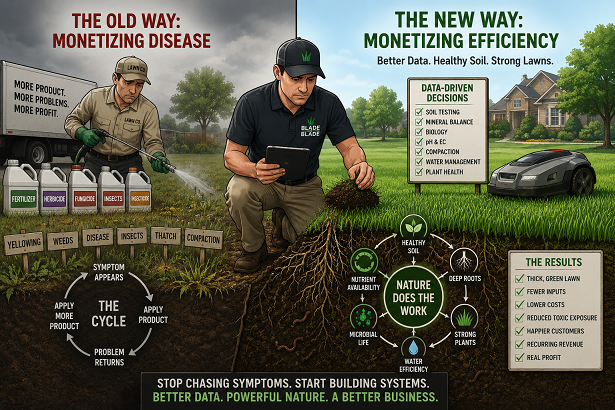
The turf industry has become very good at treating symptoms.
A lawn turns yellow, so we apply fertilizer.
Weeds appear, so we spray herbicide.
Disease shows up, so we apply fungicide.
Insects arrive, so we reach for insecticide.
Every problem creates another product sale. But after decades of following this model, homeowners are still struggling with weak lawns, shallow roots, rising water bills, recurring weeds, summer collapse, and increasing chemical dependency.
Maybe the problem is not that we need more products.
Maybe we need better information.
The Lawn Is Not Asking for More Product
When a lawn begins to fail, it is communicating that something inside the system is no longer working.
The soil may be compacted.
The pH may be interfering with nutrient availability.
Calcium and magnesium may be out of balance.
Salt levels may be suppressing microbial activity.
The soil may lack oxygen, carbon, humus, or biological function.
The roots may be too shallow to access enough water during heat.
Yet many conventional programs respond to almost every problem in the same way: apply another product.
That may improve color temporarily, but temporary color is not the same as health.
A green lawn can still have shallow roots, poor soil structure, weak biological activity, nutrient imbalances, and little ability to tolerate stress.
Better Testing Changes Everything
The transcript behind this article argues that conventional testing often gives us an exact set of numbers without fully explaining whether the soil can actually use what is present.
It encourages us to look beyond basic fertilizer numbers and examine factors such as pH, base saturation, nitrate and ammoniacal nitrogen, electrical conductivity, soil compaction, microbial activity, carbon relationships, photosynthesis, and plant sugar production.
That information allows us to ask a much better question.
Instead of asking, “What should we apply next?” we can ask:
What is preventing this lawn from functioning properly?
That single change in mindset can transform the turf industry.
Find the Limiting Factor
Every struggling lawn has one or more limiting factors.
The soil may contain nutrients, but those nutrients may be chemically bound or biologically unavailable.
The lawn may receive plenty of water, but compaction and poor structure may prevent that water from moving into the root zone.
The homeowner may apply fertilizer regularly, but weak photosynthesis and poor microbial activity may prevent the plant from converting those inputs into lasting health.
More product does not automatically create more progress.
Sometimes it creates greater dependency.
Repeated high-salt applications can increase electrical conductivity, suppress microbes, weaken soil structure, and reduce nutrient efficiency. The lawn then requires even more fertilizer, more water, and more intervention to maintain the same appearance.
The program becomes expensive because the system is inefficient.
Use Nature to Bring Lawns Back
Using the power of nature does not mean abandoning science.
It means using biology, chemistry, physics, and plant physiology together instead of treating them as separate issues.
A functioning turf system needs:
- Balanced minerals
- Adequate oxygen
- Proper soil structure
- Available water
- Carbon and humus
- Active microbial populations
- Deep roots
- Strong photosynthesis
When these pieces work together, the lawn becomes more capable of supporting itself.
Microbes help cycle nutrients already present in the soil.
Humus improves water-holding capacity and nutrient buffering.
Better structure allows water and oxygen to move deeper.
Healthier roots explore more of the soil profile.
Improved photosynthesis produces the sugars that fuel plant growth and biological activity.
The goal is not to force the lawn into temporary performance.
The goal is to remove the obstacles preventing natural performance.
A Better Way to Make Money
Moving away from symptom-chasing does not mean reducing profitability.
It means creating a better and more defensible form of profitability.
Instead of monetizing recurring disease, weeds, stress, and dependency, we can monetize:
- Advanced soil testing
- Professional data interpretation
- Mineral balancing
- Biological restoration
- Humus development
- Compaction correction
- Irrigation efficiency
- Root-depth improvement
- Progress monitoring
- Long-term soil management
The customer is no longer paying us to repeatedly treat the same problem.
They are paying us to identify waste, improve efficiency, reduce ownership costs, and build a lawn that becomes increasingly resilient.
That is real value.
Efficiency Is the Product
The turf company of the future will not be measured by how much fertilizer or chemical it can apply.
It will be measured by how efficiently it can help a lawn use water, nutrients, sunlight, carbon, and biological activity.
Can we reduce unnecessary inputs?
Can we deepen the root system?
Can we improve water retention?
Can we increase stress tolerance?
Can we reduce recurring disease and weed pressure?
Can we document measurable improvement?
Those are the standards that will separate ordinary application companies from true soil and turf professionals.
The future is not about selling more treatments.
It is about understanding the system well enough to require fewer of them.
When we stop monetizing disease and begin monetizing efficiency, everyone wins.
The customer spends less money chasing symptoms.
The lawn becomes healthier and more resilient.
The environment receives fewer unnecessary inputs.
And the turf company earns something more valuable than another application sale:
Trust, authority, and measurable results.
Ready to Understand What Your Lawn Is Telling You?
A struggling lawn does not always need more fertilizer. It needs someone willing to identify what is preventing the soil, roots, microbes, water, and nutrients from working together.
The first step is better testing.
The next step is using that information to rebuild the system—not merely hide the symptoms.
Engage with us and learn what your lawn is really telling you: