
Last Updated on December 10, 2025 by Brian Beck
You don’t have a “bad lawn.”
You have a broken system.
And the solution is not to rip it all out, start over, or double down on the same old bag-of-fertilizer routine that’s already failed you.
This blog is about a fork in the road:
-
Keep doing what the traditional system tells you to do and keep getting the same disappointing results.
Or -
Turn your back on that system, embrace a completely different one, and finally get answers instead of excuses.
Stop Blaming the Lawn
When a lawn struggles, most people assume one of three things:
-
“The sod was bad.”
-
“This yard just sucks. Nothing grows here.”
-
“I guess we just need more fertilizer, more water, more treatments.”
From where I sit, after years of working inside both the traditional and biological worlds, I can tell you:
Your lawn isn’t the real problem.
The system you’ve been sold is.
The conventional lawn-care system is built on a few recurring habits:
-
Shallow, frequent watering
-
Synthetic fertilizers that give fast color but no real resilience
-
Pesticides and herbicides that nuke biology along with the “problem”
-
Infrequent, aggressive mowing that stresses the grass
-
No meaningful soil testing beyond a generic “apply this 4 times a year”
This approach treats your lawn like a surface problem—something you can fix with whatever is on sale in the bright bag at the big-box store.
But your lawn is not a surface.
It’s an ecosystem.
Until you accept that, you’ll always feel like you’re fighting it.
Two Systems, Two Completely Different Outcomes
Here’s the uncomfortable truth:
You can’t keep one foot in the old system and one foot in the new and expect transformation.
At some point, you have to turn your back on one system and embrace another.
System #1: Symptom-Chasing
This is the system most people are stuck in:
-
See weeds → spray herbicide
-
See yellow grass → throw nitrogen at it
-
See dry spots → water more often
-
See disease → spray more chemicals
Every action creates a new side effect:
-
More compaction
-
Less biology
-
More thatch
-
More thatch = more shallow roots
-
Shallow roots = more watering
-
More watering = more disease pressure
Round and round we go.
This system keeps you dependent. Dependent on products. Dependent on constant interventions. Dependent on a schedule you didn’t design and that doesn’t really work for your yard or your life.
System #2: Environment-Building
The system I’m asking you to consider is the opposite.
Instead of asking, “What can I spray on this?” it asks:
“What’s missing from this environment that would allow the lawn to solve its own problems?”
It focuses on:
-
Biology: Microbes that cycle nutrients and protect plants
-
Structure: Aggregated soil that allows air and water to move
-
Moisture Management: Deep, consistent hydration instead of shallow, frequent watering
-
Efficiency: Mowing practices and technologies that support, not punish, the plant
In this system, we’re not trying to force the lawn to behave.
We’re trying to enable it.
It’s the same difference between constantly going to the doctor for pain meds…
versus finally setting the broken bone and letting the body do what it was designed to do.
Step One: Identify What’s Actually Wrong
You cannot build an efficient lawn system while flying blind.
If no one has ever:
-
Run a proper soil test
-
Interpreted it beyond “pH looks okay”
-
Looked at humus/organic matter, base saturation, calcium balance, nitrates, and micronutrients
-
Considered compaction, thatch, root depth, and watering patterns
…then everything you’ve done up to this point has been guesswork dressed up as a “plan.”
In my world, we start with diagnosis, not decoration.
Because until you know:
-
What’s missing
-
What’s excessive
-
What’s blocked or antagonized
you’re not “treating your lawn.” You’re throwing darts in the dark and hoping one of them fixes the headache.
Step Two: Stop Ripping Off Your Lawn
“Ripping off your lawn” doesn’t always mean taking a sod cutter to it.
You can rip off your lawn in more subtle ways:
-
Starving the soil biology with synthetics that burn hot and leave nothing of substance behind.
-
Watering just enough to keep it barely alive, but not enough to build deep, resilient roots.
-
Mowing on a schedule that’s convenient for humans but brutal for plants.
-
Bagging every clipping and sending your organic wealth to the landfill.
You’re essentially pulling value out of the system while demanding more from it every year.
If a business operated like that—no investment, constant withdrawals, no repair—you’d call it what it is:
A system headed for failure.
Your lawn is no different.
Step Three: Create an Environment That Solves Problems For You
A healthy lawn is not just “pretty.”
It’s efficient.
When we rebuild the environment, you start to see:
-
Fewer weeds (because the system doesn’t leave empty real estate for them to exploit)
-
Less need for synthetic fertilizer (because biology is cycling nutrients that are already there)
-
Better water retention (because humus acts like a sponge and structure allows infiltration)
-
Less disease pressure (because a living system is harder to invade and easier to defend)
-
Less labor (because you’re not constantly playing catch-up with mowing, watering, and patching)
This is where automation and smarter practices come in.
-
Biological soil programs support the underground engine.
-
Better irrigation strategies protect that engine with consistent moisture instead of swings between drought and flood.
-
Robotic mowing supports the plant by keeping leaf tissue in a healthy range and gently recycling clippings back into the soil—without demanding more of your time.
You’re not just “maintaining a lawn” anymore.
You’re running a system that quietly works in the background while you live your life.
“But We’ve Always Done It This Way…”
That sentence has probably killed more good ideas than any weed ever could.
Look around:
-
Costs are up.
-
Weather is more erratic.
-
People are busier.
-
Concerns about chemicals and water waste are louder than ever.
The old lawn-care model wasn’t built for this world.
So no, we cannot keep doing what we’ve been doing and expect it to magically start working for us.
We can’t cling to:
-
Shallow watering
-
High-salt synthetics
-
One-size-fits-all treatments
-
Outdated mowing habits
…and then be surprised when lawns are weak, costs are high, and people feel ripped off.
That’s not “bad luck.”
That’s a broken model.
Turning Your Back on the Old System
Here’s what “turning your back” actually looks like in real life:
-
You stop buying lawn care like it’s fast food.
-
You stop asking, “How fast can this green up?” and start asking, “How long will this last?”
-
You stop chasing sales and start demanding strategy.
-
You stop letting your lawn guy treat your yard like every other yard on the route.
Instead, you decide:
“I want a system that makes my lawn more efficient, not more dependent.”
That means:
-
Running a real soil test and basing decisions on data
-
Correcting underlying imbalances instead of masking symptoms
-
Adding biology, not just chemistry
-
Upgrading watering and mowing to support the system instead of stressing it
You move from reaction to intention.
The Payoff: Answers, Not Excuses
When you make that shift, a few things happen:
-
Problems stop “mysteriously” popping up every season. They start to make sense.
-
Your inputs (water, money, time, products) begin to generate actual returns instead of temporary relief.
-
You feel less like a frustrated customer and more like a partner in a working system.
This is what I’m building my businesses around: helping smart, engaged homeowners step out of a failing model and into one that actually aligns with how soil and plants really work—and with how busy, dual-income families actually live.
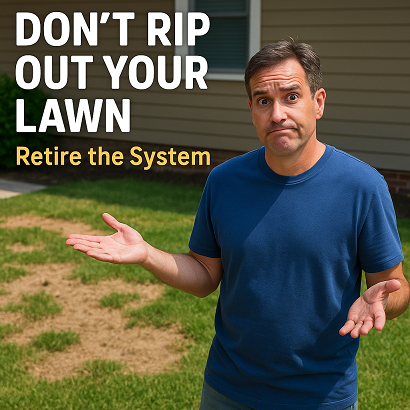
So… Don’t Rip Out Your Lawn. Retire the System.
If your lawn looks tired, patchy, or stubborn, the easy move is to say:
“Let’s just rip it all out and start over.”
But if you put a new lawn into the same broken system, you already know how that story ends.
Instead, ask a better question:
“What would it look like to build a lawn system that solves problems and creates efficiency—without me having to fight it every weekend?”
That’s the pivot.
-
From ripping out lawns…
-
To retiring a failed system.
-
From chasing symptoms…
-
To building an environment that quietly works in your favor.