
Last Updated on February 3, 2026 by Brian Beck
Every spring, core aeration gets sold like a guaranteed upgrade: “Open the soil, get oxygen to the roots, and your lawn will thrive.”
But most lawns don’t need another mechanical event. They need a soil system that can breathe and move water on its own.
First: compaction vs. tightness (this is the missing clarity)
-
Compaction is structural: particles pressed together, fewer pores, poor water/air movement.
-
Tightness is experiential: “this ground is hard as concrete.” Tightness can come from compaction, but also from dry clay, low aggregation, low humus, and poor calcium structure.
That matters because aeration is often marketed as the cure for tightness, even when the real issue is structure + carbon + biology, not “lack of holes.”
Why spring aeration usually underperforms
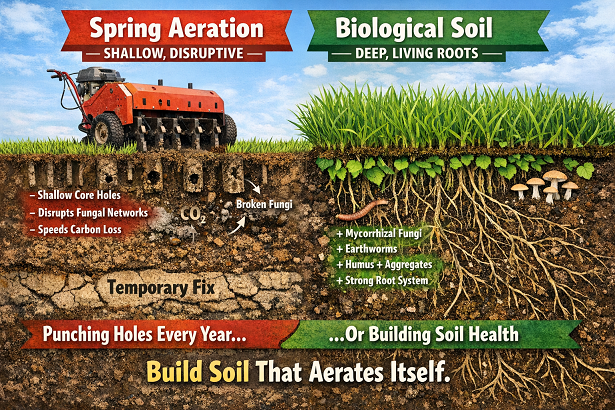
1) Most aeration is too shallow to matter
In early spring, many lawns are aerated before irrigation systems are turned on (and before deep soaking begins). The soil is often tight and reluctant—so the tines bounce, skid, or only penetrate an inch or two.
That’s not “relieving compaction.” That’s surface pock-marking.
If the machine can’t get depth, you don’t get a meaningful change in pore space where roots actually need it.
2) Production beats quality
A lot of aerations are set up for speed: lighter machines, faster passes, and minimal pre-watering. It looks like work was done because you see holes—but the effect is mostly cosmetic.
3) It ignores the soil’s natural ability to self-aerate
A living soil doesn’t rely on metal tines for oxygen pathways.
It builds them through:
-
root channels
-
microbial aggregation
-
fungal hyphae networks
-
earthworm activity
-
humus formation (the sponge + scaffold)
When biology is working, the soil becomes structurally breathable—not “temporarily poked.”
The part nobody talks about: disturbance has a cost
Core holes + oxygen exposure can work against humus building
When you repeatedly punch and disturb soil, you increase exposure and disruption near the surface. More oxygen + more disturbance often means faster breakdown of organic carbon in that zone—exactly the opposite of what you want if your local soils already struggle to build and retain humus.
It also disrupts fungal networks
Fungal systems are one of the quiet engines behind water movement and aggregation. Core aeration doesn’t “kill your biology,” but repeated mechanical disruption does:
-
sever hyphae
-
reset network formation
-
keep the soil more bacterial/annual-weed friendly instead of fungal/perennial-root friendly
So if your goal is water-holding + infiltration + resilience, constant punching is a weird strategy.
What we do instead in a biological system
If the goal is oxygen + infiltration + root depth, biology does it better and longer:
The biological spring priority list:
-
Deep watering behavior (when watering starts) to pull roots down
-
Humus building (carbon + microbe food) to create sponge + structure
-
Calcium-driven structure (when appropriate) to flocculate clays and open pore space
-
Microbial momentum so aggregation becomes the “aeration”
Result: you don’t need a recurring mechanical event to “help the soil breathe.”
The soil starts breathing on its own.
When aeration is appropriate (so you sound honest and credible)
There are times core aeration is a useful surgical tool, like:
-
new construction / heavy equipment traffic
-
severe layering/hardpan
-
extreme runoff/puddling that won’t improve with biology + water management
-
a one-time reset before you immediately topdress compost and begin building structure
But if someone’s selling aeration as an annual spring subscription?
That’s usually a business model—not a diagnosis.
A punchy closer you can use
“If your lawn needs holes every spring to function, you don’t have a lawn problem—you have a soil system problem. Our goal is to build a soil that aerates itself.”