
Last Updated on February 1, 2026 by Brian Beck
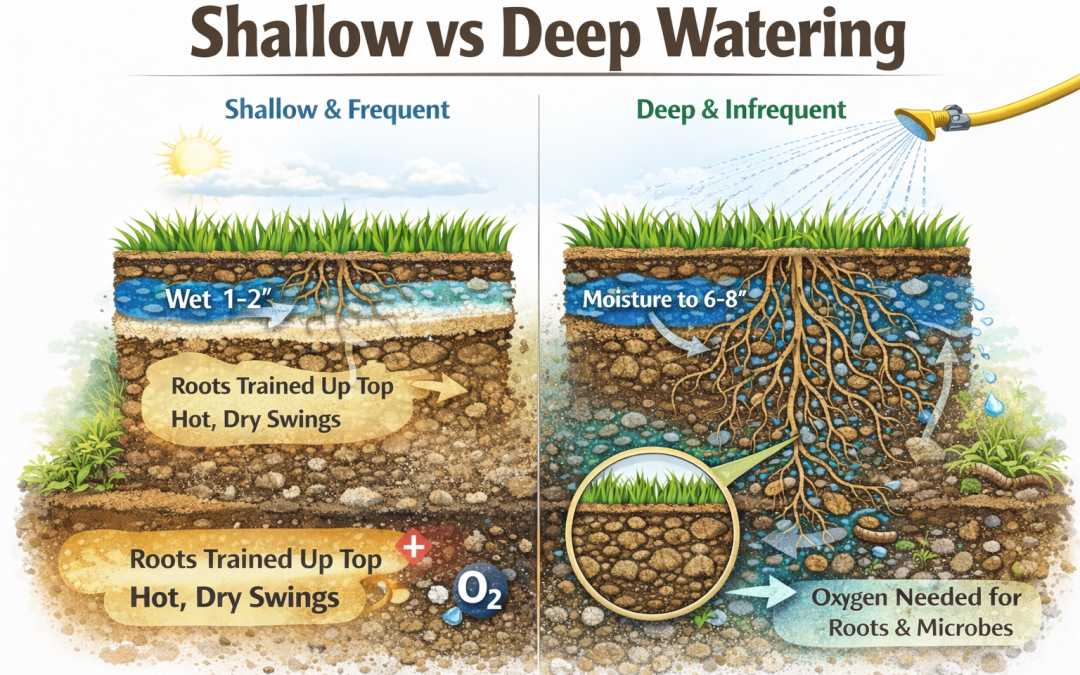
Most people think watering is simple: spray water → grass turns green.
But in real soil, water is more than “wet.” It’s the delivery system for chemistry, the switch that turns biology on, and the gatekeeper for oxygen movement.
When watering is shallow and frequent, you don’t just waste water — you change how carbon, oxygen, and hydrogen behave in your soil, and your grass pays the price.
1) What water actually does when it enters soil
Water doesn’t show up as a passive liquid. It becomes the soil solution — the thin film of water coating particles and filling pores that:
-
Dissolves nutrients and moves them through soil to roots (nutrients must be in solution to be absorbed).
-
Carries dissolved gases (like CO₂) and helps drive reactions that release or mobilize nutrients.
-
Enables microbial life to function (biology slows way down when soils are too dry).
“But what about hydrogen and oxygen in water?”
Here’s the key idea:
-
Water enters as H₂O (hydrogen and oxygen are bonded together).
-
A tiny fraction of water naturally separates into H⁺ and OH⁻ (this is normal and part of how pH works), but soil does not “split water” into free hydrogen gas and oxygen gas.
-
Roots need oxygen as O₂ from air in soil pores, not oxygen “pulled out of H₂O.” When pores are filled with water, oxygen movement slows dramatically.
So water brings hydrogen and oxygen into the system as part of H₂O — but the real oxygen crisis in lawns is about air-filled pore space.
2) Soil needs water and air — and shallow watering breaks the balance
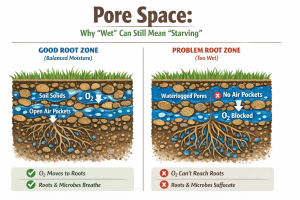
Healthy soil is a balance of solids and pore space — and that pore space needs to be a mix of water + air.
When too much of the pore space is water-filled:
-
Oxygen becomes limited, and respiration (roots + microbes “breathing”) drops.
-
When water-filled pore space gets high enough, soils shift toward anaerobic biology (including processes that can gas-off nitrogen).
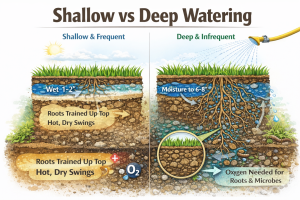
Shallow, frequent watering commonly keeps the top layer near saturation, which can restrict oxygen movement and stress roots.
3) What shallow watering does to roots (and why that matters)
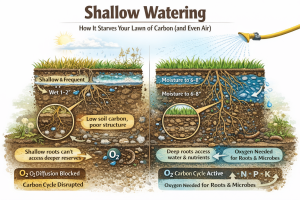
Shallow watering means you’re wetting only the surface layer. That trains the lawn to live at the surface.
Multiple university/extension sources all say the same thing:
-
Frequent, shallow watering moistens the surface and encourages root development close to the surface.
-
Shallow roots make turf more susceptible to drought, and increase issues like weeds and disease pressure.
And there’s an extra twist most people miss:
A shallow, waterlogged surface can still lead to wilt because roots can’t breathe well enough to keep up with demand (called “wet wilt”).
4) The carbon story: why shallow watering disrupts the “humus engine”
Carbon in soil isn’t just “organic matter.” It’s the foundation for:
-
structure (aggregation)
-
water holding
-
nutrient buffering
-
microbial habitat
-
stress tolerance
Step A: Water is tied directly to carbon capture
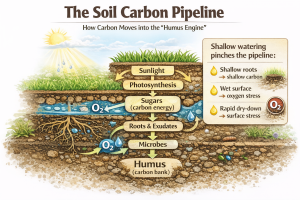
Plants use water in photosynthesis; water supplies hydrogen that helps build sugars (plant energy), which become the building blocks for growth and root activity.
Step B: Roots are a major carbon pipeline into soil
Plants push carbon belowground through roots and rhizosphere processes that feed microbes — which is part of how soil carbon builds over time.
Step C: Soil moisture is a master control knob for carbon cycling
Soil moisture strongly affects photosynthesis, respiration, microbial activity, and soil organic matter dynamics — both drought and excessive wetness can disrupt the system.
So what does shallow watering do to carbon?
It tends to create two bad zones:
-
Surface-zone chaos: repeatedly wet → dry → wet
This amplifies stress, reduces consistent root function, and leads to a “feast/famine” microbial pattern instead of stable humus building. (Wetting/drying cycles strongly influence soil processes and structure development.) -
Deep-zone famine: never enough moisture penetration
Carbon inputs (roots, biology, aggregation) don’t get developed deeper, and the soil stays shallow, hot, and fragile.
In plain English:
Shallow watering keeps your lawn stuck in “surface survival mode,” instead of building a deeper carbon bank.
5) What happens when the soil is deprived of water, oxygen, and the “H/O system”?
Think of it as two different deprivation modes:
A) Too dry (not enough water entering the root zone)
-
Microbial activity slows because moisture is needed for biology.
-
Nutrients don’t move well because they need the soil solution to travel.
-
Grass shows classic drought stress signs: dull color, footprints, rolled leaves, dormancy.
B) Too wet (water fills pore space, oxygen can’t move)
-
Oxygen becomes limited and roots/microbes can’t respire normally.
-
Roots can decline, and the lawn can wilt even when soil looks wet (“wet wilt”).
Shallow watering can cause both: wet surface (low oxygen) + dry beneath (no deep reserves).
6) What it looks like in the grass
If shallow watering is the pattern, the lawn typically trends toward:
-
Shallow roots
-
Lower drought tolerance
-
More disease pressure from consistently wet leaf/base conditions (especially when watering late).
-
Weed advantage, because a damp surface is weed-friendly and many weeds thrive shallow.
-
The cycle of dependence: shallow roots require more frequent watering… which keeps roots shallow.
7) The fix: water for the root system you want
Multiple extension resources agree: water deeper and less often for established turf.
Practical target
-
Aim to wet 6–8 inches deep for turf, then let the surface partially dry before the next irrigation.
Simple method: the screwdriver test
Push a long screwdriver into the soil after watering. It slides easily through moist soil and stops where soil is dry/hard — measure that depth.
If you have runoff or clay: “cycle and soak”
Run shorter cycles with soak time in between so water infiltrates instead of running off.
Engage with us to get your problems solved:
Read more:
https://www.linkedin.com/pulse/rumen-soil-why-1-4-rocky-mountain-bioag-kxyec/