
Last Updated on August 25, 2025 by Brian Beck
A lawn isn’t a carpet you “paint” green with quick fixes. It’s a living system. When the soil is functional—porous, microbially active, and well-balanced—everything else (color, density, resilience) becomes cheaper and easier. When it’s dysfunctional, you end up paying a “dysfunction tax” in the form of higher water bills, repeat chemical applications, and panic mowing.
Below are the top misconceptions in three areas—fertility, mowing, and irrigation—followed by what’s actually true and what to do instead.
Fertility Misconceptions
1) “More nitrogen = more green = better.”
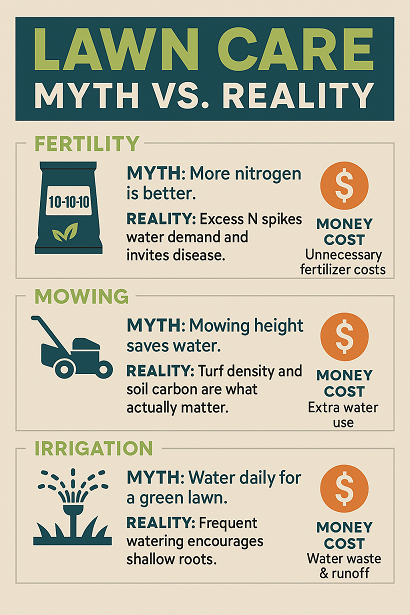
Reality: Excess N forces top growth, thins roots, spikes water demand, and invites disease. It’s like energy drinks for your lawn: flashy now, bill due later.
2) “Fertilizer fixes bad soil.”
Reality: Fertilizer can’t fix compaction, low organic matter, or pH imbalance. If the soil can’t hold or exchange nutrients, you’re literally feeding the street.
3) “My neighbor’s program must be right for me.”
Reality: Two lawns 50 feet apart can have different soil texture, shade, traffic, and irrigation coverage. Copying them is guesswork with your money.
Reframe for Fertility
-
Test first, calibrate second, fertilize last.
-
Build the engine: organic matter, humus, balanced minerals, and microbes that unlock atmospheric N and recycle what’s already there.
-
Use inputs to support biology, not replace it.
Mowing Misconceptions
4) “Mowing height is what saves water.”
Reality: It isn’t the mowing height itself that drives water savings—it’s turf density combined with soil carbon (which boosts water-holding capacity). Cutting short isn’t inherently bad if you mow frequently, because density and soil function are what protect moisture. The real problem is scalping infrequently and stressing the plant. Automated mowing makes shorter, more frequent cuts practical, building a dense canopy that shades the soil and reduces evaporation.
5) “Weekly is the rule.”
Reality: Frequency should follow growth. In peak growth, smaller, more frequent cuts protect the plant’s photosynthesis and reduce stress stripes and tip burn.
6) “Blade sharpness doesn’t matter much.”
Reality: Dull blades shred tips, accelerating moisture loss and disease entry. A $10 sharpening can save far more in water and fungicide.
Reframe for Mowing
-
Water savings come from turf density + soil carbon, not just mowing taller.
-
Cutting short is fine if it’s frequent—the consistency prevents stress.
-
Automation (robotic mowing) is the easiest way to achieve dense turf with consistent height, which in turn lowers water demand.
Irrigation / Hydration Misconceptions
7) “A little water every day keeps it green.”
Reality: Shallow, frequent watering trains shallow roots and bakes your lawn in heat waves. You’re watering the top inch while drought lives at three inches.
8) “Early evening is fine.”
Reality: Water sitting overnight across warm evenings is a fungus party. Late-night to early-morning windows (e.g., 12–6 a.m.) reduce evaporation and leaf-wetness time.
9) “If it looks thirsty, crank the minutes.”
Reality: Dry patches often come from coverage gaps, not total runtime. Fix distribution first; then right-size the depth and frequency.
Reframe for Irrigation
-
Water deep and infrequent to a target depth (e.g., ~6″) so roots chase moisture down.
-
Audit coverage with catch cups or tuna cans; balance runtimes by zone.
-
Shift to late-night/early-morning cycles to reduce loss and disease pressure.
The Real Money Problem (and How to Quantify It)
Water waste adds up—fast.
Example: 5,000 sq ft lawn, overwatering by just 0.3 inches per week in summer:
-
1 inch over 1 sq ft ≈ 0.623 gallons
-
Extra water = 0.3 × 0.623 × 5,000 ≈ 935 gallons/week
-
Over 16 summer weeks ≈ 15,000 gallons
-
If water is ~$6 per 1,000 gallons → ≈ $90 per season for nothing but overrun.
Fertility misuse is a double charge.
-
Uncalibrated N pushes growth → more mowing (labor/time) + more water (shallower roots, higher demand).
-
Soil test (~$30–$80) vs. “guess and spread” → One proper correction (e.g., pH or K) often reduces years of over-application and emergency treatments.
Mowing missteps leak money sideways.
-
Infrequent mowing + poor blade care = higher evapotranspiration → more minutes on the controller.
-
Frequent, light cuts (or automation) maintain density, which shades soil and reduces water need.
What To Do This Week (High-Impact, Low-Drama)
-
Run a soil test (not optional). Set targets for pH, phosphorus/potassium balance, and organic matter.
-
Emphasize turf density—whether through higher mowing frequency or automation. Sharpen blades and keep turf consistent.
-
Audit irrigation with catch cups. Balance zone runtimes to deliver an even 0.75–1.0″ per watering event (adjust to your climate/soil), typically twice per week in peak summer—not daily spritzing.
-
Feed the engine, not the illusion. Add carbon sources (compost/quality humic substances), fix mineral imbalances, and inoculate biology where appropriate.
-
Track one number for 30 days: either gallons used, minutes per zone, or fertilizer pounds applied. If you can’t measure it, you can’t manage it.
The Narrative—Rewritten
Old way: “Green today at any cost.”
New way: “Functional soil → dense turf → lower inputs → stable green.”
Outdated habits aren’t just old-fashioned; they’re expensive. When you move from cosmetic care to system care, you stop paying the dysfunction tax—less water, fewer chemical band-aids, and far less drama in heat waves. The result is real resilience, real savings, and a lawn you don’t have to babysit.