
Last Updated on October 5, 2026 by Brian Beck
A few times a year, Mother Nature gives the lawn care business a good beating.
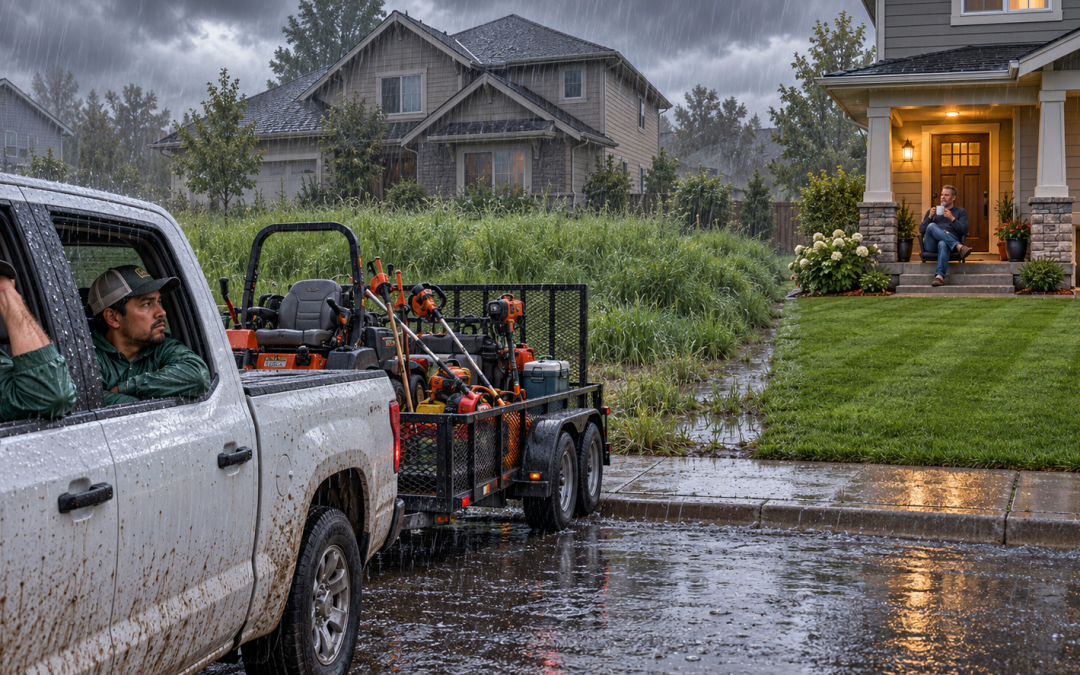
Rain moves in. The ground gets soaked. The grass stays wet. And we face the same miserable choice: take our licking and wait for conditions to improve, or try to mow anyway and risk compromising safety, the appearance of the lawn, and the soil underneath it.
Meanwhile, the grass apparently thinks this is a wonderful arrangement.
We’re falling behind. It’s growing ahead.
After more than 30 years in this business, weather remains our biggest adversary. We can organize routes, maintain equipment, and plan our work carefully. But we cannot schedule a thunderstorm for after business hours.
Believe me, we would if we could.
One Rain Delay Creates a Whole Lot of Catch-Up
For the customer, the frustration is straightforward: the lawn needs mowing, and nobody has arrived.
For the company, that same frustration is multiplied across an entire route.
The work that couldn’t happen yesterday still needs to happen today. But today already had a full schedule. Tomorrow does too. One lost day can create several days of disruption, especially when more rain follows.
And while everyone waits, the lawn keeps growing.
We understand why customers get frustrated. We get frustrated too. Over the years, we’ve even lost business because of weather delays—despite those delays often being the responsible choice for the property.
Showing up at any cost isn’t necessarily good service.
Wet grass can leave clumps that mat down over the lawn. Wet soil is more vulnerable to compaction, and repeated mower traffic can leave ruts. A freshly cut lawn loses some of its appeal when tire tracks become its most noticeable feature.
There are days when waiting is the right decision.
Unfortunately, waiting doesn’t stop the grass.
Then I Looked at Our Robotic Mowing Properties
I was out on a lawn recently, thinking about this familiar cycle, when something struck me.
Our robotic mowing properties were handling the disruption differently.
Those lawns were being maintained frequently before the rain arrived. They hadn’t spent nearly a week growing toward their next appointment. Consequently, they entered the weather delay with much less accumulated growth.
And when conditions improved, the mower was already there.
No truck to dispatch. No delayed route to work through. No waiting for us to finish the properties ahead of it.
That changes the whole recovery process.
The Advantage Is Being Ready When the Lawn Is Ready
Robotic mowing still requires judgment about weather and ground conditions. Saturated soil needs time to recover, regardless of what kind of mower you own. Depending on the model, robotic mowers can use rain sensing or weather information to pause work and resume according to configured delays.
The advantage is that a suitable mowing window can be used without waiting for a crew to return.
A traditional service has to coordinate your lawn’s readiness with the availability of people, equipment, and transportation. A robotic mower stationed at your property removes much of that scheduling problem.
Frequent mowing also means there is generally less growth to catch up on after a short interruption. A prolonged wet spell can still create a backlog, but the lawn starts from a better position.
That’s a meaningful difference.
Less Drama. More Continuity.
For decades, we’ve worked within a system where weather interrupts the route, the route delays the mowing, and the delayed mowing makes the next visit more difficult.
Automation gives us a way to reduce that recurring problem.
It means fewer stretches of watching your lawn get shaggy while everyone waits for the schedule to recover. It means more opportunities to maintain a consistent appearance. And it means less pressure to force a mowing visit into conditions that don’t justify it.
We’ll always respect the weather.
But after 30-plus years of taking our licking, I’m happy to have a system that gets back to work without waiting for the truck.
Ready for a lawn that spends less time waiting for its next mow?
At Front Range Biological & Lawn Automation, we combine robotic mowing, biological soil care, and smarter irrigation to address the recurring frustrations of conventional lawn maintenance.
Discover our Trinity system and ask whether robotic mowing is right for your property.
Own your grass. Don’t rent it.