
Last Updated on October 5, 2026 by Brian Beck
What our soil tests are revealing—and why organic matter and humus matter more than most homeowners realize.
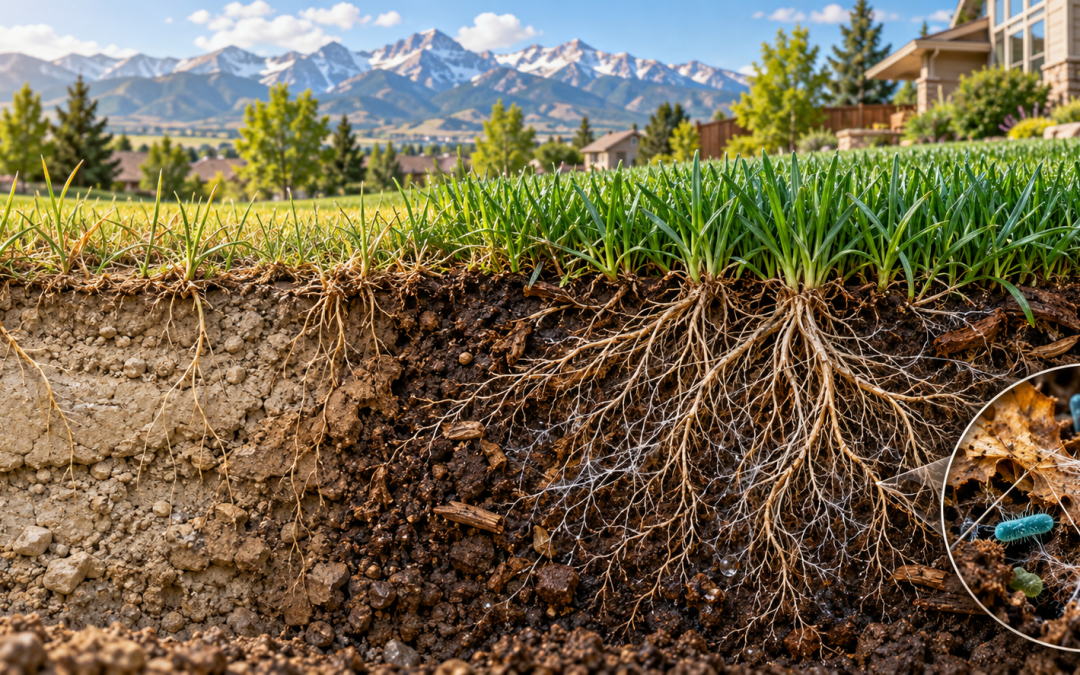
Through soil testing on lawns here along the Front Range, I keep finding a troubling pattern: low organic matter, with lab-reported humus levels that are lower still.
That helps explain why some lawns struggle between watering cycles. The irrigation system supplies water, but the soil has limited ability to capture it, retain it, and support the living processes that keep grass healthy.
You can keep filling a poorly equipped reservoir. Eventually, it makes sense to improve the reservoir.
Organic matter gives water somewhere to stay
Soil organic matter includes plant residues, roots, living organisms, and material in various stages of decomposition. Although it represents a relatively small portion of soil, it has an outsized influence on how that soil functions.
Organic matter helps soil particles form stable aggregates—the small crumbs that create a useful network of pores. Larger pores allow water to enter and excess water to drain. Smaller pores hold moisture that roots can use between irrigation cycles.
This is what homeowners need from their soil: the ability to accept water and keep an accessible reserve.
Increasing organic matter can improve that capacity, particularly in sandy soils. The size of the improvement depends on soil texture, structure, and existing conditions. There is no universal percentage increase that guarantees a particular amount of water savings.
For a struggling lawn, that means we should investigate what happens after the sprinkler turns off. Does water enter the root zone? Does it remain accessible? Can roots reach it?
Humus is part of the soil’s long-term investment
Organic matter and humus are related, but they are not interchangeable measurements.
“Humus” traditionally describes the more decomposed, persistent portion of organic matter. Modern soil science increasingly describes this material in terms of how it is protected within aggregates or attached to minerals. Much of that protected material originates from microbial remains and the compounds microbes produce.
Think of fresh organic inputs as money coming into the system. Some gets spent immediately supporting life. Some becomes part of the soil’s longer-term reserve.
Both matter.
Fresh carbon helps fuel biological activity. More persistent organic matter supports lasting soil function. A humus result also needs to be interpreted using the laboratory’s method and reference range; it is not simply a second organic-matter percentage.
Microbes need energy to do their work
We often discuss soil as though its only job is to hold fertilizer.
But soil is a living workplace. Its organisms help decompose residues, cycle nutrients, and maintain the structure that allows roots, water, and air to move.
Those workers need fuel.
For many soil microbes, that fuel comes from energy-rich organic compounds. Living roots release carbon compounds into the surrounding soil, while roots, clippings, and other residues provide additional food as they decompose. Moisture and oxygen help determine whether microbes can use that food effectively.
When I talk about the “energy of the soil,” this is what I mean: the chemical energy available to sustain its biological workforce.
A mineral nutrient application can address a nutrient shortage. It does not, by itself, provide the organic carbon that many microbes need.
You cannot expect a productive workforce when the pantry is nearly empty.
Water and biology support each other
The connection runs both ways.
Organic matter helps create a better environment for soil life. Roots and microbes, in turn, produce substances that help bind soil particles into stable aggregates. That structure supports the movement and storage of water and air.
When conditions improve, the lawn can begin reinforcing its own foundation:
- Healthy plants supply carbon through roots and residues.
- Soil organisms process those inputs.
- Some carbon becomes protected in the soil.
- Better structure supports roots and more useful water storage.
This is why our biological approach begins with soil function. We examine structure and gas exchange, support biology, address mineral balance, and then use fertility inputs according to need.
The grass reflects the conditions we build beneath it.
How a biological program builds the foundation
A practical biological program creates conditions that favor carbon inputs and retention.
That can include maintaining healthy roots, returning appropriate amounts of grass clippings, adding suitable organic amendments when needed, managing compaction, and maintaining moisture without keeping the soil saturated.
Microbial products may have a role, but organisms need a suitable habitat and food supply to establish and function. Adding microbes to an environment that cannot support them leaves the underlying problem unresolved.
The carbon-building process starts with photosynthesis: plants take carbon from the atmosphere and turn it into organic compounds. Roots and residues bring that carbon into the soil, where organisms transform it.
Our job is to support that process and improve the conditions that allow some of the carbon to remain.
For the homeowner, these practices can become a straightforward part of an ongoing service program. Meaningful increases in organic matter and persistent carbon, however, take time and should be tracked through consistent testing.
What about synthetic lawn programs?
A lawn program focused mainly on repeated greening can leave carbon supply, compaction, rooting, and water storage inadequately addressed.
That is a real limitation. But saying synthetic fertilizer usually reduces soil carbon goes beyond what research consistently shows. Fertilization can also increase plant growth and the residues entering soil. Outcomes depend on the inputs, rates, soil, climate, and management practices.
Research comparing organic and inorganic fertilization supports the potential of organic amendments to build soil carbon, while also showing that results vary by ecosystem and treatment. Those findings do not establish a guaranteed rate for an individual lawn program.
The useful question for a homeowner is:
Is your lawn program deliberately building the soil’s ability to function—and measuring the progress?
That is the standard we want to meet.
Build a lawn with a reserve
Low organic matter is a reason to improve the foundation.
A lawn with better soil structure, a continuing supply of organic inputs, and functioning biology has a stronger basis for handling the intervals between rain and irrigation. Watering still matters. So do weather, soil texture, rooting depth, and irrigation efficiency.
But the long-term goal is to make each watering more useful by improving the soil receiving it.
At Front Range Biological & Lawn Automation, we use soil testing to identify limitations and guide a biological program that supports roots, soil life, and lasting soil improvement.
Ready to find out what your soil is missing? Contact us to discuss soil testing and our Biological Soil Program.
Learn more about our approach to biology, robotic mowing, and advanced irrigation.
Own your grass. Don’t rent it.