
Last Updated on February 28, 2026 by Brian Beck
When people hear “immune system,” they usually think of superheroes inside your body—white blood cells, antibodies, and all the amazing things your body does to fight germs.
Plants don’t have that kind of immune system.
But don’t let that fool you.
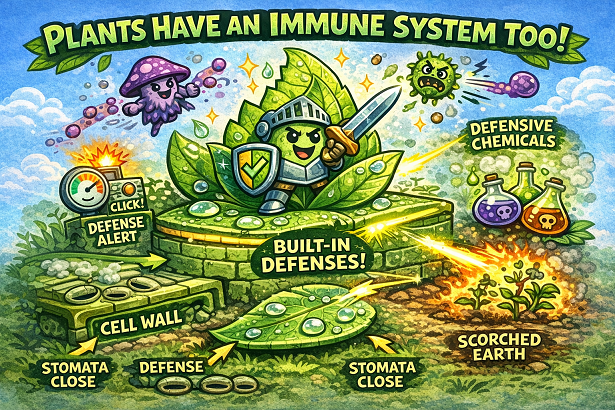
Plants are not defenseless. In fact, every plant is built like a living fortress—packed with security systems that detect invaders, sound alarms, and fight back using chemistry, walls, and even “scorched earth” tactics.
Let’s break it down in a way that’s easy to picture.
1) The Plant’s First Defense: Armor
Before the plant ever has to “fight,” it tries to block the enemy.
Plants have built-in armor like:
-
A waxy coat on leaves (like a rain jacket) that makes it hard for germs to stick
-
Thick cell walls (like a fence around every cell)
-
Hairs and tough outer layers (on some plants)
-
Tiny pores (stomata) that can close when danger is nearby
A lot of attacks fail right here.
The invader can’t stick.
Can’t get in.
Can’t start trouble.
2) Motion Detectors: The Plant’s Early-Warning System (PTI)
If a fungus or bacteria makes it past the armor, the plant has sensors on the outside of its cells that act like motion detectors.
These sensors recognize common “germ fingerprints” (tiny pieces of microbes that show up again and again).
When the plant detects those fingerprints, it triggers a fast defense response:
-
A quick chemical burst (like a flash-bang) that stresses the invader
-
Extra wall-building to block entry
-
Defensive proteins that slow the attack
This first layer is called PAMP-triggered immunity (PTI).
In plain English:
“Something suspicious is here—lock the doors and reinforce the walls.”
3) The Big Alarm: When the Plant Knows It’s Under Attack (ETI)
Some pathogens are sneaky.
They bring “tools” called effectors—special molecules meant to shut down the plant’s early defenses.
But plants have another system: internal sensors that can detect those tricks.
When that happens, the plant goes into a much stronger defense mode called effector-triggered immunity (ETI).
This can trigger something intense:
The “Scorched Earth” Strategy (HR)
Plants can kill off a small patch of their own cells to stop the invader from spreading.
That’s called the hypersensitive response—basically:
“If the enemy is in this room, burn the room.”
It sounds extreme… but it works.
4) Chemical Weapons: The Plant’s Built-In Arsenal
Plants make chemical weapons the same way a skunk makes spray.
Some are stored ahead of time.
Others are built only when needed.
These include:
-
Phytoalexins (chemicals made during an attack that slow or kill microbes)
-
Natural antimicrobials (phenolics, terpenes, alkaloids—plants have a lot of chemistry)
-
Proteins that attack fungi (some can break down fungal walls)
So even without blood or antibodies, plants can still “fight” using chemistry.
5) The Neighborhood Watch: Whole-Plant Alerts
Here’s one of the coolest parts:
If one leaf gets attacked, the plant can warn the rest of the plant.
It sends chemical messages so other areas “get ready.”
Two big alert systems:
SAR: Systemic Acquired Resistance
Think of it like:
“An attack happened over there. Everyone prepare.”
ISR: Induced Systemic Resistance
Often triggered by friendly microbes in the soil—like beneficial bacteria and fungi.
It’s like the plant says:
“My allies trained me. I’m ready.”
6) The Command Center: Hormones That Control Defense
Plants use hormones like a military command system.
The big three are:
-
Salicylic acid (SA) – often used against invaders that feed on living tissue
-
Jasmonic acid (JA) – often used against chewing insects and tissue killers
-
Ethylene (ET) – often works with JA in defense responses
Plants “choose” different defense strategies depending on the enemy.
7) Special Defense for Viruses: RNA Silencing
Viruses are a different kind of invader.
Plants can recognize viral genetic messages and cut them up before the virus can spread.
That defense is called RNA silencing, and it’s one of the reasons plants can survive viral pressure better than you’d expect.
Why This Matters (Especially for Weeds vs Grass)
This is where things get really interesting:
A fungus might destroy a weed but barely touch grass because:
-
Grass has a different waxy “surface code”
-
Grass immune sensors recognize the fungus faster
-
Grass chemistry blocks the fungus’s enzymes or toxins
-
The fungus simply can’t get traction in grass tissue
In other words…
Plants are not passive.
They are active defenders.
And the differences between plant defenses are part of what makes some biological controls work on one plant but not another.
The Big Takeaway
Plants don’t have an immune system like humans.
They have something different—but just as impressive:
✅ Armor
✅ Motion detectors
✅ Internal alarms
✅ Chemical weapons
✅ Whole-plant warning systems
✅ A hormone-controlled command center
✅ Virus defense systems
The next time someone says, “Plants just sit there,” remember this:
They sit there… armed to the teeth.