
Last Updated on January 27, 2026 by Brian Beck
One of the most confusing parts of robotic mowing for homeowners isn’t the mower itself—it’s the navigation system.
That’s usually where people get stuck:
“Do I need wires?”
“Is wire-free better?”
“Is one outdated?”
“Why are there two options at all?”
Let’s slow this down and clear it up—because both systems work, but they solve different problems.
First: What These Systems Are Actually Doing
Every robotic mower needs to answer two questions:
-
Where am I allowed to mow?
-
How do I know where I am inside that space?
Perimeter-wire and wire-free systems answer those questions in different ways.
Neither is “good” or “bad” by default.
They are tools, and tools need to match the job.
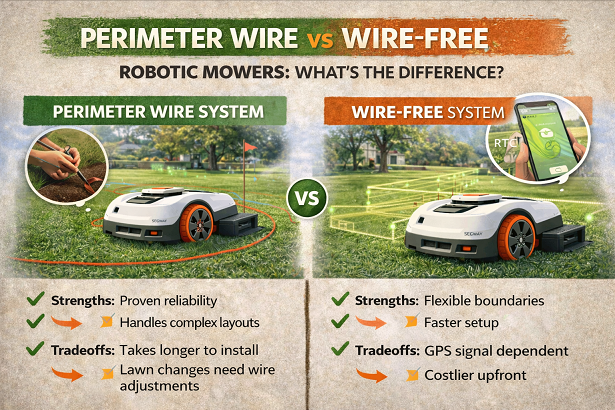
Perimeter Wire Systems (The Proven Workhorse)
How they work
A low-voltage wire is installed around the mowing area (and around no-go zones).
The mower detects the signal and stays inside that boundary.
Think of it like an invisible fence, but for a mower.
Strengths
-
Extremely reliable once installed
-
Not dependent on GPS signal quality
-
Handles trees, shade, and tight spaces very well
-
Proven over many years in real-world conditions
-
Lower upfront cost in many cases
Tradeoffs
-
Installation takes more time upfront
-
Changes to the lawn layout may require wire adjustments
-
Repairs are occasionally needed if the wire is damaged (rare, but possible)
Best fit for:
-
Established landscapes
-
Yards with lots of trees or shade
-
Narrow passages and complex shapes
-
Homeowners who want rock-solid reliability over “new tech appeal”
Important truth:
Perimeter wire is not “old tech.” It’s mature tech—and maturity matters.
Wire-Free Systems (RTK / GPS / Vision-Based)
How they work
These systems use combinations of:
-
GPS / RTK correction
-
Cameras and vision mapping
-
Sensors and onboard processing
Boundaries are created digitally instead of physically.
Strengths
-
Faster initial setup (no buried wire)
-
Easy boundary changes via app
-
Clean installation look
-
Excellent for open, modern properties
Tradeoffs
-
Requires good satellite and/or visual conditions
-
Performance can be affected by heavy tree cover, tall buildings, or terrain
-
Higher upfront cost
-
More sensitive to placement and calibration
Best fit for:
-
Open yards with clear sky view
-
Minimal tree canopy
-
Homeowners who value flexibility and clean installs
-
Properties where future changes are likely
Key insight:
Wire-free systems shine in the right environment—and struggle in the wrong one.
The Mistake People Make
Many homeowners ask:
“Which one is better?”
That’s the wrong question.
The correct question is:
“Which one fits my property and expectations?”
Choosing based on marketing instead of qualification is how people end up disappointed.
Reliability vs. Flexibility (The Real Tradeoff)
Here’s the honest comparison:
-
Perimeter wire:
“Set it up right once, and it just works.” -
Wire-free:
“Easier to change and adjust, but more sensitive to environment.”
Neither is superior in all situations.
Cost: Short-Term vs Long-Term Thinking
Perimeter wire systems often:
-
Cost less upfront
-
Cost less to maintain long term
-
Provide predictable performance
Wire-free systems often:
-
Cost more upfront
-
Save installation labor
-
Add flexibility value
The real cost difference shows up when:
-
the system struggles
-
expectations aren’t aligned
-
the lawn wasn’t properly qualified
That’s why we focus on system fit, not just features.
What We Actually Do (and Why It Matters)
We don’t start with:
“Which mower do you want?”
We start with:
-
lawn layout
-
slope
-
trees and shade
-
narrow passages
-
future plans
-
expectations for perfection vs simplicity
Only then do we recommend:
-
perimeter wire
-
wire-free
-
or, in some cases, not robotic mowing yet
That honesty saves everyone time and money.
The Bottom Line
-
Perimeter wire is not obsolete
-
Wire-free is not magic
-
Both can deliver excellent results
-
Poor matching creates frustration—not technology failure
Robotic mowing works best when:
The system matches the property, and the expectations match reality.
Want to Know Which One Fits Your Yard?
A quick qualification—photos, layout, and goals—usually makes the answer obvious.
If you’re in our service area, we’re happy to walk through it with you and recommend the option that actually works long-term.
No hype. No pressure. Just clarity.
—Brian
Blade to Blade / Front Range Autmow