
Last Updated on July 1, 2025 by Brian Beck
The Sick Lawn Syndrome: Why That “Perfect” Grass Might Be Dying Inside
At first glance, it looks immaculate.
Thick. Green. Manicured.
The envy of the neighborhood.
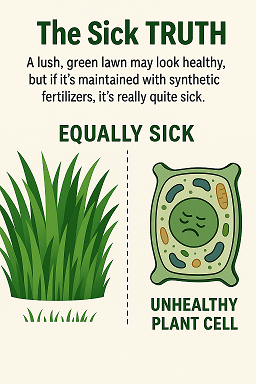
But beneath the surface—at the root, the cell, and the soil—something very different is happening. That picture-perfect lawn, fueled by synthetic fertilizers and a narrow menu of elements, is not healthy.
In fact, it’s quietly sick.
🌱 The Illusion of Health
Most synthetic lawn programs rely on a limited set of ingredients: nitrogen, phosphorus, potassium—maybe iron or magnesium if they’re feeling generous.
These inputs are delivered in high concentrations, giving the grass an instant jolt of energy. The lawn explodes in color, grows fast, and looks impressive from the street.
But what you’re really seeing isn’t health.
You’re seeing stress chemistry.
-
Fast, weak growth
-
Shallow, surface-level roots
-
Sugar-depleted cells
-
Nutrient imbalances the eye can’t detect
It’s the horticultural equivalent of chugging energy drinks and calling it fitness.
🔬 What Happens at the Cellular Level
A truly healthy plant is built cell by cell, layer by layer, with a full spectrum of nutrients and a functioning soil biome.
Synthetic-fed lawns short-circuit this process. Here’s what really goes wrong inside the plant:
-
Nitrogen overdose causes thin cell walls that are prone to disease and insect attack
-
Lack of micronutrients leads to cellular dysfunction in photosynthesis, respiration, and sugar production
-
Inhibited root signaling reduces microbial partnerships that bring in trace minerals
-
Overly lush growth invites fungus and pests—not because the lawn is weak, but because it’s imbalanced
To the untrained eye, it looks green.
To the trained eye, it looks bloated, sugar-deficient, and defenseless.
🌿 The Role of Microbiology and Balance
Healthy lawns are made in the soil—not in a bottle.
Soil is supposed to act as a living pharmacy:
-
Bacteria and fungi break down organic matter
-
Nutrients are chelated and delivered to roots
-
Roots exude sugars that attract and direct soil life
-
The plant and soil talk to each other in a constant exchange
But synthetic fertilizer bypasses all of that.
It cuts out the biology and treats the plant like a machine.
And that, ironically, creates a system that can’t function without constant external input.
💡 What True Health Looks Like
A biologically fed lawn may not green up in 24 hours.
It may not look as neon as the synthetic-fed turf next door.
But here’s what it will have:
-
Thick, resilient roots
-
Dense cellular structure
-
Internal sugar reserves
-
Natural pest resistance
-
A thriving, living soil beneath it
Over time, this lawn uses less water, requires fewer treatments, and becomes self-sustaining.
It doesn’t just look healthy—it is healthy.
🚫 Beauty Isn’t Always Truth
We’ve been conditioned to see a green lawn and assume success. But that’s like judging someone’s health by how much makeup they wear.
So next time you see a chemically lush lawn, don’t be fooled.
Look deeper. Ask what’s feeding it. Ask what’s missing.
Because in the world of plants, real health is quiet, complex, and invisible to the naked eye—until it isn’t.
Want to grow a lawn that thrives from the inside out?
We can help you make the switch—from illusion to integrity. From chemical dependence to natural resilience.
Let’s grow something real.