
Last Updated on January 27, 2026 by Brian Beck
One of the biggest unspoken concerns homeowners have about robotic mowing isn’t the mower itself.
It’s this question:
“What actually happens on installation day?”
People imagine chaos:
-
wires everywhere
-
torn-up lawns
-
hours of disruption
-
complicated explanations
-
something going wrong
The reality is far calmer—and far more structured.
This blog walks you through exactly what installation day looks like, so there are no surprises.
Before Installation Day (This Is Where Success Is Really Set)
A smooth install doesn’t start on install day.
It starts with qualification and planning.
Before we ever show up, we’ve already evaluated:
-
lawn layout
-
square footage
-
slope
-
obstacles
-
tree cover
-
narrow passages
-
irrigation layout
-
perimeter-wire vs wire-free fit
This upfront work is why installs don’t feel experimental.
By the time installation day arrives, we already know:
what system is being installed
where it will live
how it will operate
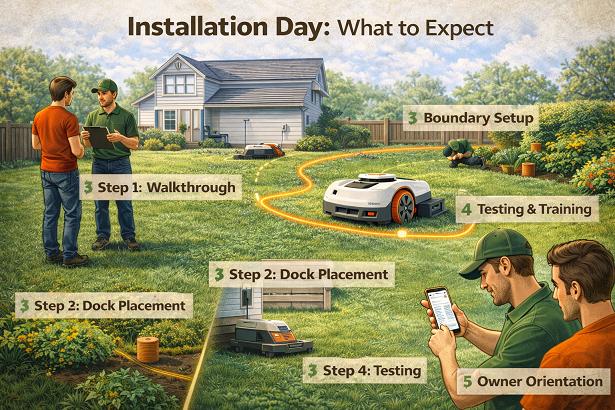
Step 1: Arrival & Property Walkthrough
On installation day, the first thing we do is a quick walkthrough.
This isn’t a sales meeting—it’s a final confirmation:
-
boundaries
-
no-go zones
-
dock location
-
special considerations (pets, gates, tight areas)
If something changed since evaluation, this is when we address it.
Nothing gets installed blindly.
Step 2: Dock & Base Station Placement
The dock is the “home base” of the mower.
We place it based on:
-
protection from direct exposure when possible
-
clean approach and exit paths
-
reliable power access
-
signal quality (for wire-free systems)
Good dock placement is invisible when done right—and critical to long-term reliability.
Step 3: Boundary Setup (Wire or Digital)
For perimeter wire systems:
-
wire is installed around the lawn edge and no-go zones
-
depth is shallow and minimally invasive
-
edges are clean and precise
Within days, the wire is visually undetectable.
For wire-free systems:
-
digital boundaries are mapped
-
zones are defined in software
-
transitions and passages are configured
This is where experience matters.
Small setup decisions here affect daily performance later.
Step 4: Mower Configuration & Testing
Before we leave, the mower is:
-
paired to the app
-
scheduled
-
tested through key areas
-
observed during live operation
We don’t just turn it on—we watch it work.
This is how we catch small adjustments before they become future annoyances.
Step 5: Owner Orientation (Simple, Not Overwhelming)
You don’t get a tech lecture.
You get:
-
how to start/stop
-
what to expect day-to-day
-
how often to check the yard
-
what not to worry about
-
when to call us
Most homeowners are surprised by how little there is to manage.
The goal is confidence, not complexity.
What Installation Day Is Not
Let’s be clear about a few things:
-
❌ It’s not destructive
-
❌ It’s not loud
-
❌ It’s not chaotic
-
❌ It’s not an all-day ordeal (most installs are very manageable)
And it’s definitely not something that leaves your property worse than it started.
The First Week: What You’ll Notice
During the first week, most people notice:
-
the lawn looks “even” all the time
-
no big clipping piles
-
no obvious mow-day disruption
-
the mower becomes background noise (or invisible)
The biggest adjustment is psychological:
“Wait… it already mowed?”
The Most Important Thing to Understand
Robotic mowing is not about a perfect first hour.
It’s about:
-
consistency
-
small, frequent cuts
-
stress reduction
-
system stability
That’s why we focus so much on doing the install correctly, not quickly.
Installation Done Right = Years of Low Friction
When robotic mowing fails, it’s almost always due to:
-
poor qualification
-
rushed setup
-
wrong system for the property
-
unmanaged expectations
When it’s done right, it fades into the background of your life—in the best way possible.
Thinking About Installation? Start With Qualification
The best installs are boring.
The boring installs are the best ones.
If you’re considering robotic mowing, the smartest first step isn’t buying a mower—it’s making sure the system fits your lawn and lifestyle.
If it does, installation day is just the beginning of a much easier relationship with your lawn.
—Brian
Blade to Blade / Front Range Autmow
If you want, next I can:
-
Put this into a Word doc
-
Create a simple, calm install-day image
-
Or move on to Blog #7: What Maintenance Actually Looks Like (And What It Doesn’t)