
Last Updated on December 11, 2025 by Brian Beck
Some people love the smell of diesel in the morning.
They say it “smells like productivity.”
Sure it does — in the same way lighting your money on fire “smells like heating your home.”
Welcome to the great comedy of effectiveness versus efficiency in lawn care.
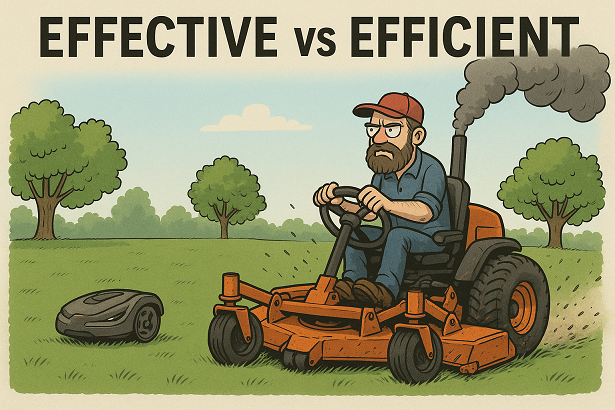
Let’s talk about the bat-wing mower, that glorious, roaring, 20-foot-wide piece of industrial machinery designed to annihilate grass the way a woodchipper annihilates a Christmas tree.
And let’s compare it to a robotic mower, which quietly hums around the lawn like a tiny green Roomba, doing the exact same job… without requiring a CDL, chiropractor visits, diesel bills, or a worker who was five minutes late because he “had to get an energy drink.”
The Bat-Wing: Effective? Yes. Efficient? Absolutely Not.
The commercial diesel bat-wing mower is the perfect example of something that is effective but catastrophically inefficient.
Does it cut grass?
Yes — with all the subtlety of a freight train driving through a field of daisies.
But here’s what else it does:
-
Burns enough diesel to power a small village.
-
Requires a full-time human (who occasionally remembers to show up).
-
Pounds soil into concrete one compaction pass at a time.
-
Produces enough noise to trigger PTSD in anyone who’s ever worked near an airport runway.
-
Costs so much to maintain that you start calculating your life choices at 3 a.m.
It’s the king of mechanical overkill.
A monument to the human belief that if a little horsepower is good, then 75 horsepower is probably better.
It’s basically the lawn version of swatting a fly with a Buick.
The Robotic Mower: Efficiency on Wheels (and Non-Human Leverage)
Now contrast that with a robotic mower:
-
Runs on pennies of electricity.
-
Works 24/7, never calls in sick, never files HR complaints.
-
Doesn’t compact the soil, destroy carbon, or stress the turf.
-
Actually improves turf health by cutting frequently and gently.
-
Costs less to maintain than the snacks in a crew truck.
-
Creates non-human leverage, something a bat-wing could never dream of.
Put simply:
A robotic mower is like having an employee who works all day, every day, never complains, never takes lunch breaks, and never has an attitude problem. It just does the job — quietly, consistently, and with surgical precision.
Meanwhile, the bat-wing needs fuel, filters, belts, blades, grease, and the occasional emotional support pep talk from the mechanic who hates it as much as you do.
Effectiveness vs Efficiency in One Sentence
The bat-wing is effective because it cuts a lot of grass at once.
The robot is efficient because it eliminates the need for a human to do it.
The bat-wing solves a problem with brute force.
The robot solves the same problem with strategy.
One gives you a “big moment” of mowing.
The other gives you a lawn that never stops improving.
One demands labor.
The other creates leverage.
One is a tool.
The other is a system.
Let’s Visualize the Absurdity
Picture this:
A bat-wing mower, sweating diesel fumes, growling like a mechanical T-Rex, with a human bouncing around on top like a rodeo contestant trying not to lose their spine.
Now picture… a robot.
Calm. Silent. Unbothered.
Working like it’s building a retirement account.
The robot is the Zen monk of lawn care.
The bat-wing is the aging heavyweight boxer who still thinks he’s got “one more round” in him.
The Real Punchline?
Your bat-wing mower will never:
-
Increase your capacity without adding labor
-
Multiply how many sites you can maintain
-
Run overnight
-
Improve lawn health with micro-clippings
-
Reduce soil compaction
-
Lower customer ownership costs
-
Free you from the human bottleneck you identified in your Personal DNA
Personal-dna
personal_dna
But a robot will.
Because effectiveness is doing the job. Efficiency is getting the job done with leverage.
And leverage — true, scalable, non-human, compounding leverage — only exists on one side of this comparison.
Spoiler:
It’s not the diesel dinosaur.
Final Thought
If you enjoy:
-
burning fuel
-
paying labor
-
fixing equipment
-
compacting soil
-
and pretending that “louder equals better”
…stick with the bat-wing.
But if you want:
-
scalability
-
precision
-
lower cost of ownership
-
turf health
-
leverage
-
and a future where you aren’t chained to old methods