

Do You Enjoy What You Do?
A couple of decades ago, I ran into someone I hadn’t seen in years at a high school reunion. We did the usual small talk — family, life, time passing faster than any of us expected. Then, mid-conversation, she asked me a question that completely caught me off guard:...
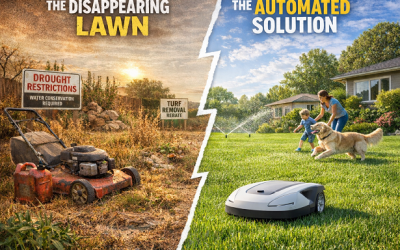
The Disappearing American Lawn (and the Automation Lifeline)
For most of modern American history, the lawn has been the great green handshake. It’s the first thing your neighbor sees. It’s where your kids learn to run. It’s where you throw a football, grill on a Friday night, and feel—however briefly—like you’ve got your life...

No Glory in Suffering for Suffering’s Sake
My Dear Grandson, I take pen in hand with a tenderness that surprises an old man, for though my hair has turned to snow and my joints speak plainly of the passing years, my heart is still stirred when I think of you—so young, so earnest, and so given to strong notions...

“Atoms Aren’t Real”: Why Old-Guard Lawn Care Mocks Soil Biology (and Why That’s a Red Flag)
Picture this: A scientist is bent over a viewing port on a giant particle accelerator. A brilliant beam lights up the tunnel. The machine is humming. The data is flowing. And from behind him, someone yells: “Atoms are not real, that is snake oil!” The scientist...
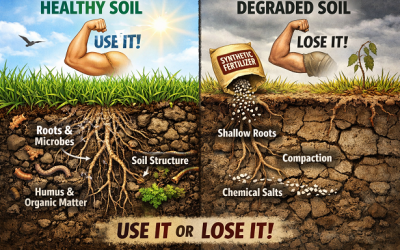
Synthetics and Soil Structure: “Use It or Lose It” for Your Lawn’s Underground Muscle
If you want a lawn that’s easy to own, not just “green for a minute,” you have to understand one uncomfortable truth: Synthetic, salt-based fertility can create short-term visual results while quietly training your soil to become weak and dependent. Not because...

EFFECTIVE vs. EFFICIENT: Why Your Diesel Bat-Wing Mower Is Basically a Gym Membership You Never Asked For
Some people love the smell of diesel in the morning.They say it “smells like productivity.” Sure it does — in the same way lighting your money on fire “smells like heating your home.” Welcome to the great comedy of effectiveness versus efficiency in lawn care. Let’s...
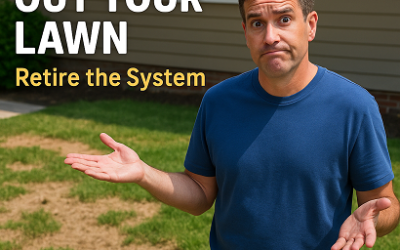
Stop Blaming the Lawn
You don’t have a “bad lawn.”You have a broken system. And the solution is not to rip it all out, start over, or double down on the same old bag-of-fertilizer routine that’s already failed you. This blog is about a fork in the road: Keep doing what the traditional...

The Decline of Service in America — and Why Small Businesses Are the Last Line of Defense
By Brian Beck, Lawn & Soil Expert There’s a growing frustration in America that almost everyone between the ages of 35 and 55 can feel — even if they don’t always say it out loud. It’s the sense that we’re paying more than ever, yet getting less than ever in...

How Microbes Are the Real Immune System for Your Plants
When we think about keeping plants healthy, we often jump straight to nutrients, fertilizers, or even pest control. But here’s the surprising truth: plants themselves don’t have an immune system like we do. Instead, they rely on a hidden army of beneficial microbes to...
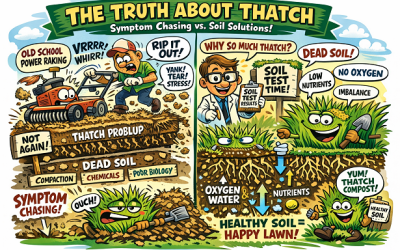
Thatch: What It Is, What Causes It, and Why Power Raking Misses the Point
If you’ve ever peeled back the green canopy of your lawn and found a spongy, brown layer that feels like an old welcome mat, you’ve met thatch. Thatch is the intermediate layer that forms between the green grass blades and the actual soil. It’s made up of slowly...

The 1 A.M. Moisture Check: Why Winter Watering Matters (and What Humus Proves)
A personal note from Brian Beck Every Sunday I do the same thing: I walk my yard and take soil-moisture readings. Not because I’m bored, and not because I’m trying to cosplay as a turf scientist… but because data keeps me honest. The last couple of weeks, I couldn’t...

The Fertilizer Matrix: The Day I Started Seeing the Code
I listened to a Rocky Mountain BioAg “Soil Talks” episode with Dr. Kurt Livy… and I don’t think I can go back to the way I used to think. There’s that moment in The Matrix where Neo realizes the world he’s living in isn’t real—it’s a system. A script. A loop. It’s...