
Last Updated on July 13, 2025 by Brian Beck
Why the Future of Lawn Care Lies in Biology, Not Chemistry
For decades, we’ve been told that the path to a green, lush lawn runs through a bag of synthetic fertilizer. Fast, easy, and instant gratification—just sprinkle some chemicals, and boom—green grass. But behind the scenes, something more subtle and sinister is at work. You’re not just feeding your lawn—you’re addicting it to a chemical fix.
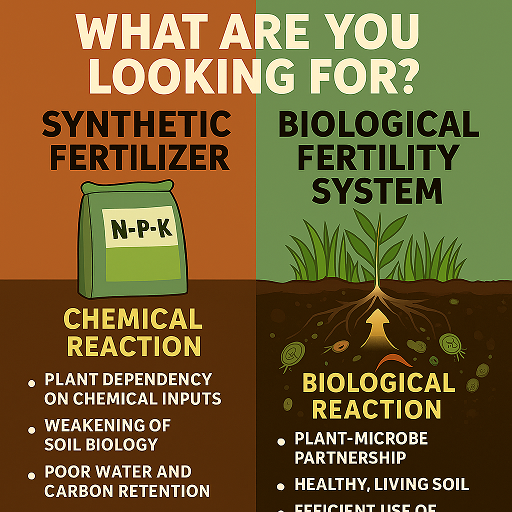
Let’s be clear: synthetic fertilizers are designed for chemical reactions, not biological ones. That’s a problem. Because while a chemical reaction can push your lawn to look good temporarily, it’s not helping your soil work for you. It’s bypassing the natural system of nutrient exchange, undermining the very biology that makes plants thrive long term.
The Chemical Route: Fast, Fragile, and Fading
Synthetic fertilizers work by force-feeding plants water-soluble nutrients—mostly nitrogen, phosphorus, and potassium (NPK). This shortcut ignores the thousands of other interactions that take place in a healthy soil ecosystem. Worse, it kills off the microbial life that makes natural nutrient cycling possible.
The result? A soil system that becomes dependent on repeated chemical applications. Roots shrink, microbial diversity collapses, organic matter vanishes—and your lawn becomes more fragile, more thirsty, and more expensive to maintain. It’s like growing crops in concrete.
The Biological Route: Alive, Resilient, and Self-Sustaining
Now contrast that with a biological fertility system. This approach embraces the power of biology—the living engine of your soil. When you feed the soil, not just the plant, you’re building an ecosystem below the surface that supports long-term plant health.
We’re talking about microbial consortia, fungi, beneficial bacteria, and organic carbon—all working together to unlock nutrients that are already in the soil and make them bioavailable to the plant through natural processes. That’s a biological reaction—and that’s the secret to resilient, efficient, and sustainable turf.
Biology vs. Chemistry: What’s the Real Goal?
Ask yourself: What are you trying to achieve? If you’re looking for short-term color, synthetics can do that. But it comes at a cost—poor soil health, higher water bills, increased inputs, and rising maintenance.
But if you’re after a system that reduces waste, lowers dependency, and improves soil health over time, then you’re looking for a biological reaction—a living system that gets better the longer it’s in place.
What Does a Biological Reaction Look Like?
-
Microbes breaking down organic matter into plant-available nutrients.
-
Fungi building networks that transport water and minerals directly to roots.
-
Carbon retention that boosts water-holding capacity and drought resilience.
-
Reduced need for inputs, because the soil begins to take care of itself.
In Summary: Don’t Just Feed Your Lawn. Empower It.
It’s time to stop fighting nature with chemistry and start collaborating with it through biology. We’re not chasing a chemical reaction—we’re cultivating a living, breathing system that improves itself with every season.
Your lawn doesn’t need more nitrogen. It needs life in the soil.