
Last Updated on July 19, 2025 by Brian Beck
A Tale of Two Lawns: Traditional Maintenance vs. Trinity System
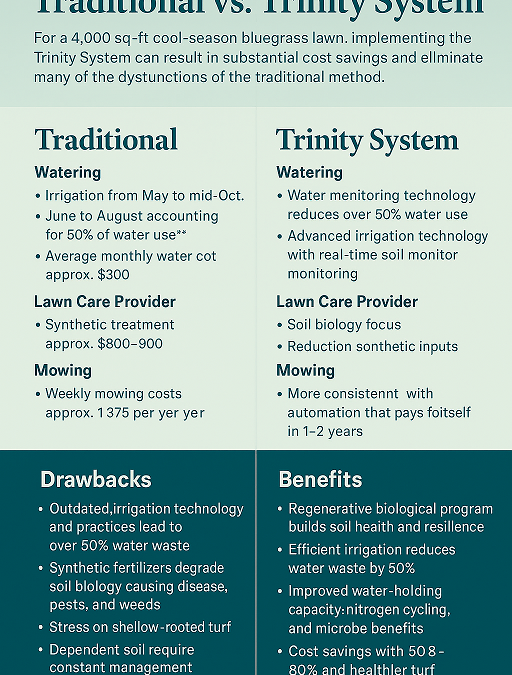
Scenario Overview: A 4,000 sq. ft. residential cool-season bluegrass lawn is maintained from May through mid-October. The majority of water is used from June through August, accounting for 50% of the annual water budget. Monthly water costs average $300. The property currently pays $800 to $900 annually for synthetic fertilization and $1,875 for weekly mowing.
Traditional System: A Cycle of Dependency and Waste
Irrigation: The lawn relies on an outdated irrigation system with no rain sensor. It is typically turned on too late in spring and shut off too early in fall, missing critical cool-season root development windows. The system is manually operated and reactive, correcting problems only after stress or damage has occurred. This leads to severe inefficiencies and over 50% water waste, shallow roots, and increased vulnerability to drought, disease, and winter kill.
Fertilization: Annual synthetic treatments suppress soil biology, preventing the development of microbial life necessary for disease resistance, nutrient cycling, and pest suppression. These chemicals create a dependent, sterile soil profile that demands continuous reapplication and chemical intervention.
Mowing: Mowing is performed weekly using gas-powered equipment—an outdated, post-WWII model that stresses turf through infrequent, high-volume cutting. This route-based system suffers from labor shortages, weather delays, mechanical failures, and increasing costs, all while leaving turf in a continuous state of stress and disrepair.
Costs:
-
Water: $1,500 (5 months @ $300/month)
-
Fertilization: $850 (average)
-
Mowing: $1,875
-
Total: $4,225 annually
Trinity System: Regeneration, Automation, and Optimization
Biological Fertility Program: This system eliminates synthetic inputs and focuses on soil regeneration. It identifies and corrects mineral deficiencies, supplies microbial food sources, and reinoculates soil biology. These microbes digest organic matter, convert inorganics to bioavailable nutrients, and naturally suppress pests, diseases, and weeds. The outcome: a living soil engine that builds humus, holds more water, and can fix nitrogen from the atmosphere.
Smart Irrigation: Trinity employs soil moisture sensors to monitor real-time conditions and automatically irrigate only when necessary. Watering is deep, infrequent, and highly precise, eliminating human error and seasonal guesswork. This approach can save customers approximately 50% on water costs by eliminating waste.
Robotic Mowing: Robotic mowers maintain the turf at a constant optimal height daily, reducing stress and promoting denser, healthier grass. They eliminate the noise, labor, gas use, clippings, scheduling conflicts, and intrusions of the traditional mowing model. Though an upfront investment is required, robotic mowers typically pay for themselves in 12–18 months depending on property size.
Costs:
-
Water: $750 (estimated 50% savings)
-
Fertilization: $600 (biological program)
-
Mowing: $0–$1,000 (robot investment amortized or DIY)
-
Total: $1,350–$2,350 annually
Outcome Comparison:
Feature |
Traditional System |
Trinity System |
|---|---|---|
Watering Cost |
$1,500/year |
$750/year |
Fertilization Cost |
$850/year |
$600/year (biological) |
Mowing Cost |
$1,875/year |
$0–$1,000/year (robot investment) |
Soil Health |
Poor, chemically dependent |
Regenerative, biologically active |
Turf Stress |
High (infrequent mowing, drought) |
Low (daily clipping, deep watering) |
Consistency |
Low (delays, mechanical issues) |
High (automated, weatherproof) |
Overall Appearance |
Moderate, chemically propped |
Rich color, dense, naturally resilient |
Environmental Impact |
High (emissions, chemicals) |
Low (electric, organic, automated) |