
Last Updated on May 10, 2026 by Brian Beck
I want to be candid about something.
We do lose customers.
That may sound like a strange thing for a business owner to admit publicly, but I believe honesty is more valuable than pretending every customer relationship ends with a trophy, a handshake, and a glowing lawn photo.
Sometimes people quit.
Sometimes they get frustrated. Sometimes they get impatient. Sometimes they look across the street at the neighbor’s temporarily green lawn and start questioning everything. Sometimes they panic because their lawn does not look the way they want it to look fast enough.
And sometimes they go back to the very thing they were trying to escape.
That is the hard part to watch.
Because in our biological lawn care program, the failure usually does not happen because the plan failed.
It happens because the customer gave up before the soil had enough time to become functional.
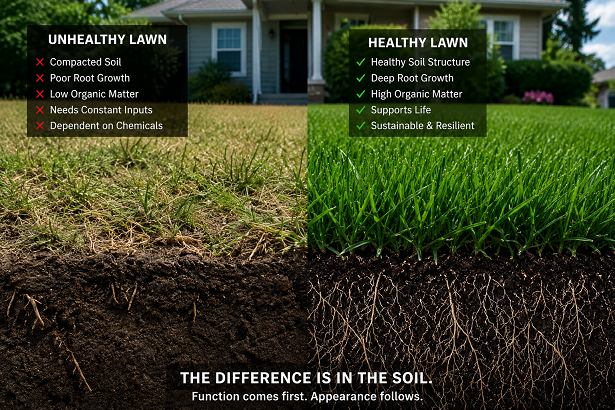
The Lawn Is Not the Starting Point. The Soil Is.
Most people judge a lawn by what they see above ground.
Color. Density. Uniformity. How it compares to the neighbor’s lawn. Whether it looks “good” when they pull into the driveway.
I understand that. Nobody wants an ugly lawn. Nobody wants to feel embarrassed. Nobody wants to be the house on the block that looks like it is losing the neighborhood lawn Olympics.
But here is the uncomfortable truth:
A lawn can look good and still be unhealthy.
And a lawn can be in the process of becoming healthy while not yet looking the way you want it to look.
That is where people get into trouble.
They confuse visible reaction with success.
Synthetic fertilizers are very good at producing a fast reaction. You put down the product, the lawn greens up, and everyone feels better for a few days or a few weeks. It looks like success.
But that does not mean the soil was repaired.
That does not mean the lawn became more resilient.
That does not mean the roots improved, the biology woke up, the soil structure changed, the water started infiltrating better, or the plant became less dependent.
It means a chemical reaction happened.
That is not the same thing as building a biological engine.
The Biological Engine Takes Time
We recently worked with a customer who had one of the worst soils we have ever seen.
There was almost no humus. The biology was barely present. The soil had very little ability to store, cycle, buffer, or support the plant properly.
In plain English, the engine was not just weak.
The engine was barely assembled.
And we only had about four months to work on it last year.
Four months is not a lot of time when you are trying to rebuild soil that has been neglected, depleted, compacted, chemically manipulated, and biologically starved for years.
Did we fail?
No.
We just had not arrived yet.
That is an important distinction.
There is a massive difference between a failed plan and an unfinished process.
When soil has almost no humus and very little biology, we are not just trying to make grass green. We are trying to rebuild the system that allows the grass to function. That means improving structure, water movement, nutrient cycling, biological activity, and the soil’s ability to feed the plant naturally.
That does not happen overnight.
And it definitely does not happen on the same timeline as a synthetic fertilizer reaction.
Going Back to the Old System
This is where the analogy gets uncomfortable, but it is accurate.
When a customer gives up on the biological process because it is hard, slow, or uncomfortable, it can look a lot like someone going through rehab and then going back to the old dealer because the recovery process was too difficult.
The old system is familiar.
It gives a fast response.
It makes you feel better quickly.
But it also keeps you dependent.
That is exactly what synthetic fertilizer dependency does to a lawn.
It creates a system where the lawn constantly needs to be pushed, stimulated, rescued, and propped up. The lawn becomes dependent on outside inputs because the soil underneath it has not been rebuilt to do its job.
A biological program is different.
We are not trying to create dependency.
We are trying to build independence.
We want the lawn to reach a point where it can draw more effectively from the soil, the atmosphere, the microbial system, and the natural nutrient cycle. We want water to go into the soil instead of running off. We want the plant to access nutrients instead of constantly begging for another synthetic push.
That is the difference.
One system creates a reaction.
The other builds capacity.
The Four Types of Customers
Over time, we have noticed that customers tend to fall into four categories.
1. The Compliant Customer
This is the customer we love working with.
They listen. They follow directions. They ask good questions. They understand that if we are trying to repair the soil, their participation matters.
They water correctly. They communicate. They do not panic every time the lawn does something imperfect. They understand that progress does not always look dramatic in the beginning.
These customers usually win.
Not because they are lucky.
Because they cooperate with the process.
2. The Good Skeptic
The good skeptic is also a great customer.
They are not gullible. They do not just believe everything because we said it. They want to understand. They ask questions because they are trying to learn.
That kind of skepticism is healthy.
In fact, I respect it.
A good skeptic is looking for answers. They want the truth. They want to know why the soil is struggling, why the lawn is not responding, why water is not moving, why nutrients are not flowing, and why the traditional approach has not solved the problem.
Those are productive questions.
The good skeptic can become one of the strongest believers in the program because once they understand the logic, they are not just following instructions.
They are bought in.
3. The Bad Skeptic
The bad skeptic is different.
The bad skeptic is not looking for answers.
They are looking to perpetuate questions.
They do not ask questions to learn. They ask questions to avoid commitment. They constantly move the goalpost. They want proof before patience, results before cooperation, and guarantees before trust.
That is a difficult customer to help.
Because they are not really participating in the process. They are standing outside of it, judging it, while refusing to fully engage.
And then when the process does not move fast enough, they call it failure.
That is not honest.
You cannot refuse to build the engine and then complain that the engine is not running.
4. The Impatient Customer
The impatient customer may actually want the program to work.
But they want it to work now.
They are used to the synthetic timeline. They are used to seeing something happen in a few days or a week and calling that success.
So when the biological process takes longer, they become uncomfortable.
They start comparing. They start second guessing. They start wondering what the neighbors think. They may even start feeling embarrassed.
And this is where people have to decide what matters more:
The long-term functionality of the lawn?
Or the short-term approval of someone driving by at 25 miles per hour?
That sounds harsh, but it is real.
If the opinion of the neighbor is more important than the actual condition of the soil, then the customer is going to struggle in a biological program.
This process requires patience and a little backbone.
5. The Unwilling Customer
The unwilling customer is the hardest one.
They say they want a better lawn, but they do not really want to change anything.
They do not want to water differently. They do not want to think differently. They do not want to soil test. They do not want to follow the plan. They do not want to stop chasing quick fixes.
They want biological results with traditional behavior.
That does not work.
At some point, we have to be honest: we cannot want the result more than the customer does.
We can provide the plan. We can explain the science. We can guide the process. We can correct the soil. We can help build the biological engine.
But we cannot force someone to be patient.
We cannot force someone to trust the process.
We cannot force someone to stop running back to the old system every time they feel uncomfortable.
The Results Come Through Functionality
This is the main point.
The real results are not primarily in the aesthetics.
The real results are in the functionality of the soil.
When the soil begins to function, the lawn changes.
Water moves better. Roots perform better. Nutrients cycle better. The plant becomes more resilient. Stress becomes less dramatic. Recovery improves. Inputs can often be reduced. The entire system becomes less fragile.
But the visible turf response is usually the last thing to fully show up.
That is hard for people to accept.
They want the lawn to look better first so they can feel confident.
But the process works the other way around.
First, we have to improve the soil’s ability to function.
Then the lawn has a reason to improve.
You cannot build a strong plant on a broken foundation and expect miracles.
We Are Not Interested in Creating Addicts
The traditional lawn care model often creates dependency.
Apply product. Get reaction. Lawn fades. Apply more product. Get another reaction. Lawn fades again.
Round and round it goes.
The customer keeps paying. The lawn keeps needing help. The soil never really becomes capable of doing the job it was designed to do.
That is not liberation.
That is dependency with stripes in the grass.
Our goal is different.
We are trying to help people escape that system.
We want to build lawns that are more functional, more resilient, less chemically dependent, and less expensive to own over time.
That does not happen by chasing the fastest green-up.
It happens by repairing what is broken.
This Program Is Not for Everyone
That is another thing I am willing to say plainly.
This program is not for everyone.
It is for people who are willing to learn.
It is for people who are willing to be patient.
It is for people who care more about truth than appearances.
It is for people who understand that the lawn they want may require them to stop doing the things that created the lawn they currently have.
If someone needs instant gratification, we may not be the right fit.
If someone is controlled by neighbor pressure, we may not be the right fit.
If someone wants to keep one foot in the old system while demanding the benefits of the new one, we may not be the right fit.
That is okay.
We are not trying to serve everyone.
We are trying to serve the people who are ready.
The Customers Who Stick With It Win
Here is what we have seen over and over again:
When customers stick to the plan, the process works.
We have not seen failure when the customer truly follows the program and gives the soil time to respond.
What we have seen is people quitting before the process matures.
That is not the same thing.
A lawn with almost no humus, poor biology, weak structure, poor infiltration, and low nutrient flow is not going to become a self-sustaining biological system in a few weeks.
It has to be rebuilt.
That takes time.
But when it starts working, it is a completely different kind of success.
It is not the cheap thrill of a quick green-up.
It is the satisfaction of knowing the lawn is becoming stronger from the ground up.
The Bottom Line
Yes, we lose customers.
But not because the biological approach failed.
We lose customers because some people are not ready for the process.
They want the result without the timeline. They want the benefit without the discipline. They want the appearance without the functionality.
And that is not how soil works.
The lawn you see on the surface is only the expression of what is happening underneath.
If the soil is broken, the lawn will eventually tell the truth.
Our job is to help rebuild that truth from the ground up.
And for the customers who are willing to stay the course, ignore the noise, follow the plan, and let the soil become functional again, the reward is not just a better-looking lawn.
It is a lawn that finally starts working the way it was supposed to.