
Last Updated on February 8, 2026 by Brian Beck
A personal note from Brian Beck
Every Sunday I do the same thing: I walk my yard and take soil-moisture readings. Not because I’m bored, and not because I’m trying to cosplay as a turf scientist… but because data keeps me honest.
The last couple of weeks, I couldn’t do it. Snow on the ground. Patches I couldn’t reliably access. The whole “guess and hope” season.
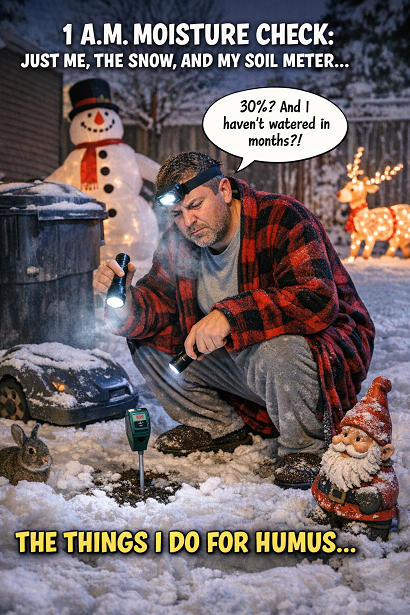
Then last night, I took the trash out at 1 o’clock in the morning. Everything was quiet, cold, dead still — the kind of winter moment that feels like the world hit pause. I thought, “I’m out here anyway. Let’s check.”
So I grabbed my meter and took readings across the yard.
30%. Across the board.
And here’s the part that made me stop and grin:
I haven’t watered in probably a couple of months.
That moisture wasn’t from sprinklers. It wasn’t from some miracle product. That was snowfall — slowly delivered, slowly absorbed — actually infiltrating and staying in the soil.
What 30% Really Means
A lot of lawns look “fine” in winter because we’re not staring at them every day. The grass is dormant, the color fades, and we assume nothing is happening.
But soil doesn’t stop living just because the blades stop growing.
Moisture in winter still matters because:
-
Roots can dry out even when the lawn looks asleep
-
Wind + sun can pull water out of the soil (especially exposed areas)
-
Dry soil is colder soil — moisture helps buffer temperature swings
-
If the root zone dries, spring starts weak long before you see it above ground
My 30% reading told me something simple: my soil is functioning like a reservoir, not a sieve.
Winter Watering Isn’t About Green — It’s About Survival
Let’s clear this up: winter watering isn’t about forcing growth. It’s about preventing desiccation — keeping the root zone from turning into dry powder during long, dry stretches.
Here on the Front Range, winter can be sunny, windy, low humidity, and sometimes we go weeks between meaningful moisture. In that world, winter watering can be the difference between a lawn that wakes up in spring… and one that limps.
A solid guideline: water during prolonged dry spells only when conditions allow — generally when temps are above ~40°F, the soil isn’t frozen, and you can water midday so it soaks in before night refreeze.
Why My Yard Held Snowmelt Without Irrigation
So why did my yard still have 30% moisture after months without irrigation?
Two words: humus buffer.
Humus is the stable, dark, “finished” organic matter in soil — what you get after biology does its work. It’s what’s left when microbes turn raw inputs into something durable and functional.
Humus behaves like a sponge with a battery attached:
-
It helps the soil hold water longer
-
It supports better structure, so water moves down instead of running off
-
It helps the soil store and cycle nutrients instead of flushing them away
That’s why you’ll hear claims like “humus can hold 80–90% of its weight in water.” Whether you measure it as percent or multiples, the point is the same: humus changes the water economy of your lawn.
And it’s not just “nice to have.” Soil organic matter (and humus as the stable end-product) affects infiltration and moisture holding — it’s a real lever in how your soil performs.
Applying Organic Matter vs. Building the Humus Engine
Yes — you can apply compost and organic matter.
But the real long-term win is getting your soil to generate its own humus.
That’s one of the aims of our biological program: jump-start the humus engine — the microbial system that turns inputs into stable carbon, aggregation, and resilience.
When that engine is humming:
-
infiltration improves
-
moisture retention improves
-
nutrient movement improves
-
roots explore deeper
-
the lawn becomes less dependent on constant intervention
Your lawn stops living paycheck-to-paycheck.
A Practical Winter Watering Checklist
If you’re wondering what to do with this, here’s a simple checklist:
-
Water only when conditions allow
Choose a day above ~40°F with unfrozen soil and minimal snow/ice cover. Water midday so it can soak in before nighttime temps drop. -
Don’t water “often.” Water “enough.”
You’re trying to wet the root zone — not the sidewalk. Slow and steady beats runoff. -
Target the vulnerable zones
South-facing areas, windy corners, slopes, and turf near hardscape dries first. -
Don’t create an ice rink
Keep water off sidewalks/driveways and shaded spots that won’t dry. -
Measure instead of guessing
Even occasional moisture checks teach you more than lawn myths ever will.
Many Colorado-area resources also suggest winter watering can be as little as 1–2 times per month during November–April depending on snow and exposure — not a weekly habit, just a prevention tool when it’s been dry.
The Bigger Point
My 1 A.M. moisture check wasn’t just a nerd moment. It was proof of concept.
When you build soil biology and humus, you don’t just get “a nicer lawn.”
You get a different system — one that can take what nature gives it and actually store it.
That’s resilience.
So if you’re winter watering this year, don’t do it out of fear. Do it with intention: protect the root zone, protect your spring start, and keep building the soil that makes watering less necessary in the first place.
Want Help Building That Kind of Soil?
If you want your yard to hold moisture like mine did — without living on a sprinkler schedule — this is exactly what our biology-first approach is built for.
If you’re local and want a plan, reach out for a soil review and a correction roadmap.
If you’re DIY, follow along and learn the process — because once you understand how the humus engine works, you’ll never look at watering the same way again.
Engage with us: