
Last Updated on January 30, 2026 by Brian Beck
Most people can rattle off the “big three” nutrients—Nitrogen, Phosphorus, Potassium—like they’re the holy trinity of plant health.
But the truth is: your lawn doesn’t fail because it’s missing one more bag of something.
It fails because the soil environment fails.
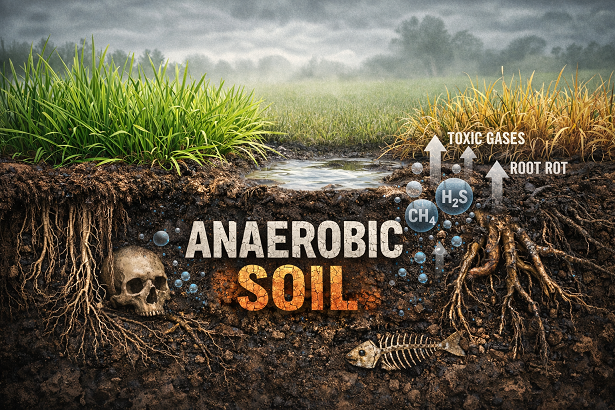
And the fastest way to crash the whole system is when soil goes anaerobic—meaning oxygen drops so low that the biology shifts into a mode that produces plant-toxic compounds and nutrient-loss gases.
Let’s break down what this really means, and why anaerobic soil is more than “a little stinky.”
Soil Health Isn’t Chemistry First — It’s Habitat First
The core message is simple:
Build the habitat, and the biology will do the work.
A healthy soil isn’t just “dirt with nutrients.” It’s a living, structured ecosystem—a soil food web—where organisms build structure, cycle nutrients, and make life difficult for weeds and disease.
The soil food web in plain English
-
Bacteria and fungi are the workforce: they build structure and hold nutrients.
-
Protozoa, nematodes, and microarthropods are the recyclers: they eat microbes and release nutrients right where roots need them.
-
The plant fuels it all with root exudates—basically carbon “snacks” pumped into the soil to feed the right organisms.
When that system is thriving, the soil stays aerobic (oxygen-rich), roots grow deeper, nutrients cycle faster, and plants become harder to kill.
“Dirt” vs “Soil” — One Is Dead, One Is Alive
Here’s a distinction that matters:
-
Dirt is sand + silt + clay. Period.
-
Soil is minerals plus organic matter plus biology plus structure.
A useful comparison:
-
You can’t build a house out of loose sand and straw.
-
You need bricks, and you need mortar, and you need a framework.
That’s what biology does.
Who Builds Soil Structure?
1) Bacteria build the “bricks” (microaggregates)
Bacteria create sticky “glues” that bind mineral particles and organic matter into tiny building blocks called microaggregates.
Think: bricks.
No bricks = no structure.
2) Fungi build the “walls and hallways” (macrostructure)
Fungi grow long strands (hyphae) that connect those microaggregates into larger structures with pore space—the channels that hold:
-
oxygen
-
water
-
roots
Think: walls, hallways, and rooms.
That pore space is everything. Without it, soil becomes a sealed sponge… and oxygen can’t move.
Why Nutrients Don’t “Just Diffuse” Into Roots
A common myth sounds like this:
“Plants just pull nutrients in from the soil water.”
Okay… but who keeps nutrients available in the first place?
Here’s the real cycle:
-
Plants photosynthesize and pump sugars into the soil as exudates (carbon-rich “cakes and cookies”).
-
Those exudates feed bacteria and fungi.
-
Bacteria and fungi hold nutrients in their bodies so they don’t leach away.
-
Protozoa, nematodes, and microarthropods eat them…
-
…and release nutrients back into plant-available forms right near the root zone.
That’s nutrient cycling the way nature designed it.
No biology? No cycling.
The Anaerobic Shift: Where Everything Goes Sideways
Now we hit the part that matters most for lawns, gardens, compost piles, and compost tea.
When soil goes anaerobic, oxygen drops so low that:
-
beneficial organisms lose the competition
-
disease/pest organisms gain ground
-
nutrients start leaving the system as gases
-
toxic byproducts are created
Anaerobic conditions are not neutral—they are destructive.
This is why anaerobic compost or anaerobic “tea” isn’t a harmless mistake. It’s a biological flip into the wrong neighborhood.
The Gases Produced When Soil Goes Anaerobic (Itemized)
Primary gases (nutrient losses + toxicity)
-
Ammonia (NH₃)
-
Nitrogen loss as a gas
-
Often tied to sharp, harsh “ammonia” odors and fertility escaping into the air
-
-
Phosphine (PH₃)
-
Phosphorus loss as a gas
-
A sign of severely reduced (oxygen-depleted) conditions
-
-
Hydrogen sulfide (H₂S)
-
Sulfur loss as a gas
-
Classic rotten egg smell
-
Strong indicator your system is oxygen-starved and shifting into toxic chemistry
-
Additional gases common in anaerobic soils (depending on conditions)
-
Nitrous oxide (N₂O) and nitrogen gas (N₂) from denitrification (nitrogen loss)
-
Methane (CH₄) in heavily reduced, carbon-rich zones
-
Carbon dioxide (CO₂) spikes during intense decomposition (aerobic or anaerobic)
Other anaerobic byproducts that matter
-
Alcohols and fermentation compounds (VOCs) — often responsible for sour/putrid odors and direct plant stress
The big picture stays the same: oxygen loss = chemistry shift = biological collapse.
How to Tell If You’ve Got Anaerobic Trouble
You don’t need a lab to notice anaerobic conditions. Your senses work fine.
Red flags in soil or compost
-
Rotten egg smell (H₂S)
-
Sour/putrid/fermented smell (alcohols/VOCs)
-
Black, slimy, sticky material in compost
-
Water that puddles and sits
-
Roots that look chewed, pinched, or rotted instead of smooth and uniform
-
Compaction: soil feels “sealed,” hard, or crusted
A healthy soil smells earthy and sweet, not sour or sulfuric.
What Causes Anaerobic Soil in Lawns?
Anaerobic doesn’t require a swamp. It just needs microsites—tiny pockets with poor oxygen.
Common causes:
-
Compaction (foot traffic, equipment, heavy mowing, vehicles)
-
Overwatering or frequent shallow watering
-
Clay soils with poor structure
-
Thatch layers trapping moisture and restricting gas exchange
-
Inorganic fertilizer dependency (encourages shallow roots and unstable biology)
-
Burying big volumes of green material in soil (oxygen demand spikes during breakdown)
Here’s the uncomfortable truth:
If you feed the soil without building structure, you can increase oxygen demand faster than oxygen supply.
That’s how people “do organic” and still create anaerobic conditions.
How to Keep Soil Aerobic (Practical Fixes That Actually Matter)
1) Build structure first
Structure is the oxygen delivery system.
-
feed biology with real organic inputs
-
reduce compaction pressure
-
encourage deeper roots
2) Water like you mean it
Shallow frequent watering creates shallow roots and low oxygen cycling.
-
water deeper, less often
-
allow time for gas exchange
-
avoid watering when soil is already saturated
3) Stop suffocating the system
-
avoid heavy traffic when soil is wet
-
reduce aggressive disturbance (constant tilling, harsh chemistry, repeated “nukes”)
-
don’t bury thick mats of green material into soil and expect oxygen to keep up
4) If you compost or brew tea: keep it aerobic
This is non-negotiable.
-
oxygen must be present
-
if it smells wrong, it is wrong
-
anaerobic brew isn’t “stronger”—it’s a different organism set
The Real Takeaway
You don’t win by “adding nutrients.”
You win by building an aerobic, structured habitat where:
-
bacteria build the bricks
-
fungi build the framework
-
predators cycle nutrients
-
roots go deep
-
weeds and disease lose their advantage
Anaerobic soil is basically the system’s way of telling you:
“I can’t breathe.”
Fix the breathing, and the rest gets easier.