
Last Updated on January 13, 2026 by Brian Beck
For years, robotic mowers lived in the same mental category as jetpacks: cool… but not really practical. Most people had heard about them, few had seen one, and almost nobody trusted them to do real work.
That’s changing fast.
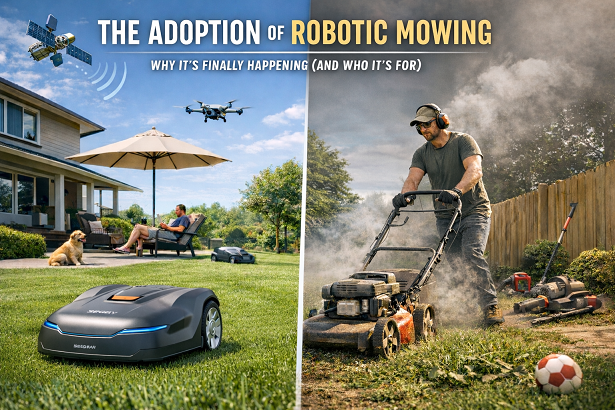
Robotic mowing is moving out of the “tech toy” phase and into the “this is obviously the future” phase—because the two biggest adoption killers are being solved:
-
Setup got easier (wire-free mapping is becoming normal).
-
The tech got smarter (better navigation + better obstacle detection).
You can see it in the market: major consumer-robot brands and big names keep launching new models and new lineups, including new wire-free options highlighted at CES 2026.
The real reason adoption is accelerating: mowing is a bad use of human life
Mowing is repetitive, time-consuming, loud, and dependent on labor that is getting harder to find and more expensive. And homeowners aren’t just paying money—they’re paying time, stress, and schedule friction.
Robotic mowing flips the whole idea:
-
Instead of “mow once a week and nuke the lawn,” it does frequent, light cutting.
-
The lawn stays consistently trimmed.
-
Clippings are tiny and mulch back in.
-
Your yard becomes something you enjoy, not something you manage like a second job.
What changed in the technology (aka: why robots are now credible)
Old robot mowing was mostly “buried perimeter wire and hope.” That worked, but it created resistance: install headaches, wire breaks, and complicated troubleshooting.
Now the industry is rapidly shifting toward wire-free or “virtual boundary” systems using combinations of RTK/GNSS, onboard vision, and LiDAR—designed to reduce setup pain and make the mower adaptable as landscapes change. Husqvarna’s EPOS is a clear example of that “virtual boundary” direction.
And the product category is exploding with new entrants and designs (including “drop and mow” concepts) that aim to eliminate perimeter wires and simplify mapping.
The silent driver nobody talks about: noise + emissions pressure
This isn’t just about convenience. Communities are paying more attention to noise and air quality, and regulations/incentives are pushing the outdoor power equipment world toward electric.
-
Gas tools are loud; robotic mowers are typically around “conversation level” quiet (often cited around ~60 dB), which changes when and how you can run them.
-
States and cities are tightening restrictions on gas-powered lawn equipment, and California has moved to phase out sales of new small off-road engines (which includes many lawn tools).
-
Air agencies routinely highlight that small engines contribute disproportionately to certain pollutants compared to their size.
Whether you care about that personally or not, it affects what products get developed, what inventory exists, and what becomes “normal.”
Who actually adopts robotic mowing first?
In the real world, the adopters tend to fall into a few buckets:
1) The Time-Starved Professional
Dual income, busy schedule, wants the lawn “handled” without more calendar meetings.
2) The “I’m Done Paying Forever” Homeowner
They’re tired of renting their lawn—paying every week, every year, forever.
3) The Quiet / Low-Drama Neighborhood Person
They hate the noise and love the idea of the lawn being maintained without the weekend roar.
4) The Tech-Forward Homeowner
If they’ve got smart thermostats, cameras, automations… this is an easy mental jump.
5) Property Managers and Commercial Sites
Not because they love gadgets—because they love predictable outcomes and reduced labor dependency.
The objections I hear all the time (and the honest answers)
“My yard has trees / weird shapes / obstacles.”
Some yards are easy. Some are not. Tree cover can challenge satellite-based systems, which is why many modern mowers lean on vision/LiDAR hybrids to stay reliable in real life.
“I don’t want a robot running around my kids/pets.”
Robotic mowers are designed around safety standards, and reputable models go through recognized safety testing frameworks for robotic mowers.
(Still: you set schedules. You control where it goes. You don’t “hope for the best.”)
“Robotic mowers are expensive.”
Yes—up front. But the comparison isn’t “robot vs one mow.” It’s “robot vs years of mowing cost + hassle.” For many households, the math starts looking different when you add up weekly mowing, seasonal edge-ups, and the hidden tax of your time.
“Will it stripe like a pro mower?”
Robots don’t exist to flex stripes. They exist to deliver consistency. That said, newer navigation and pattern controls are improving rapidly, and the “always maintained” look wins most people over.
The adoption playbook: how to do this without regret
If you’re thinking about it, here’s the practical approach:
-
Start with a property reality check
Slope, zones, narrow passages, tree cover, GPS visibility, and how you use the yard. -
Pick the right navigation type
Wired can still be great in certain installs. Wire-free can be amazing—when the property fits the tech. -
Treat setup like the investment step
The mower’s “relationship with your yard” is built in setup. Get that right and your life gets easier. -
Pair it with the things robots don’t do
Robots don’t fix soil, irrigation, compaction, or nutrient lockout. They maintain height. That’s it.
(And that’s why, in my world, robotic mowing is one leg of a bigger system—not the whole stool.)
The bottom line: robotic mowing is becoming normal
Robotic mowing isn’t a gimmick anymore. It’s moving into mainstream adoption for the same reason robot vacuums did: once people see it working, they stop debating it and start asking which one fits their situation.
If you’re the kind of homeowner who values time, consistency, and lower long-term friction, robotic mowing is no longer “early adopter stuff.” It’s just… smart ownership.