
Last Updated on September 29, 2025 by Brian Beck
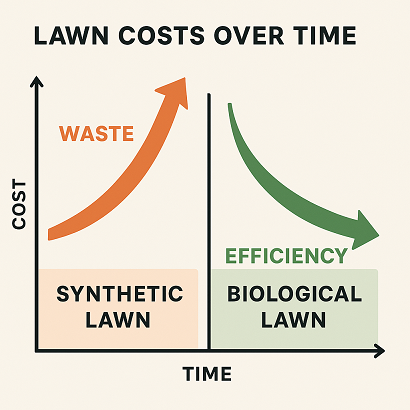
Most people think a beautiful, healthy lawn is a luxury they can’t afford. The truth is just the opposite: you can’t afford not to have one. When managed the right way—through a biological system—a lawn stops being a money drain and starts paying for itself through efficiency, balance, and reduced waste.
The Cost of Waste in the Synthetic Model
If you remain in the traditional, synthetic fertilizer model, you are locked into an expensive cycle of waste. Synthetic fertilizers force-feed plants, creating dependency while much of the product leaches away, volatilizes, or burns out microbes. That wasted input is money straight out of your pocket—and it doesn’t build long-term soil health.
On top of that, synthetic lawns need constant correction: more water to compensate for shallow roots, more chemicals to address weeds and fungus, and more labor to keep everything patched together. The costs compound every year.
The Biological System Pays for Itself
A biological lawn program takes a different path. By balancing the soil, reintroducing microbial life, and feeding biology rather than bypassing it, your lawn begins to regulate itself.
-
Water efficiency: Balanced soils with humus and living microbes can hold more water, reducing irrigation needs.
-
Nutrient cycling: Microbes unlock atmospheric nitrogen and recycle nutrients already present in your soil, cutting down on fertilizer costs.
-
Resilience: Healthy soils buffer pH swings, mineral excesses, and heat stress, so your lawn thrives without constant “emergency fixes.”
Once this engine of biology is running, the system becomes cheaper—not more expensive—because the soil is doing the work for you.
The Golf Course Misconception
Many homeowners look at pristine golf courses and assume that’s the standard of “a good lawn.” But golf courses are a false comparison. They are managed with heavy synthetic inputs, around-the-clock maintenance, and extremely high costs that make no sense for a homeowner.
A biological lawn, once balanced, is much more efficient to maintain. It isn’t about chasing perfection with endless inputs—it’s about building a system that sustains itself.
The Bottom Line
When you look at the numbers, the choice is clear:
-
Stick with synthetics, and you’ll pay more year after year because of inefficiency and waste.
-
Invest in biology, and you’ll build a self-sustaining system that pays for itself through efficiency and lower ongoing costs.
A beautiful lawn isn’t an indulgence—it’s the outcome of making the smarter, more affordable choice. You don’t need to ask if you can afford it. You need to ask if you can afford not to.
Read more:
https://www.linkedin.com/pulse/proven-3-layer-system-thats-reviving-dead-soils-rocky-mln6f/?trackingId=TkalUliQSjStWOhs%2FQ%2FOxg%3D%3D