
Last Updated on July 27, 2025 by Brian Beck
If humic acid were a superhero, it’d be the caped crusader of soil biology—quietly working behind the scenes to save your lawn, garden, and crops from lifeless dirt doom.
But unlike most miracle products that come with gimmicks and fine print, humic acid is the real deal. It’s not synthetic, it’s not new, and it doesn’t come from a lab. It’s ancient, complex, and incredibly effective. So, what is it? And why is every serious grower and turf manager obsessed with it?
Let’s dig in.
What Is Humic Acid, Really?
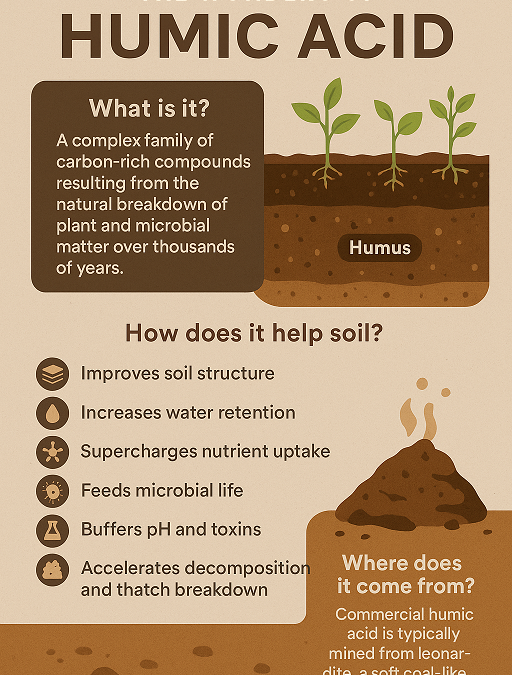
Humic acid isn’t actually a single substance. It’s a complex family of carbon-rich compounds that result from the natural breakdown of plant and microbial matter over thousands of years. This process creates a dark, spongy, organic material called humus—not to be confused with the chickpea spread.
When humus is further refined, it yields humic substances, which include:
-
Humic acid
-
Fulvic acid
-
Humin
Humic acid is the heavy hitter of the bunch—larger molecules that work best in the soil (not in the plant), where they act as a sponge, a stimulant, a buffer, and a courier all at once.
How Does Humic Acid Help Your Soil?
If your soil had a to-do list, humic acid would check off half of it before lunch. Here’s what it does:
✅ 1. Improves Soil Structure
Humic acid binds particles of sand, silt, and clay into a more stable, crumbly structure—what we call “good tilth.” This improves porosity, aeration, and root penetration.
✅ 2. Increases Water Retention
Its large molecular structure acts like a sponge, holding onto water and slowly releasing it to plants—especially helpful in sandy soils or drought-prone areas.
✅ 3. Supercharges Nutrient Uptake
Humic acid has a high cation exchange capacity (CEC), meaning it grabs onto nutrients like calcium, magnesium, and potassium and makes them more available to plant roots. It also chelates (binds to) micronutrients, keeping them in a plant-accessible form.
✅ 4. Feeds Microbial Life
Microbes LOVE humic acid. It provides carbon—the base energy source for soil biology—which supports a diverse and resilient microbial ecosystem. More microbes = better nutrient cycling, disease resistance, and overall plant health.
✅ 5. Buffers pH and Toxins
Humic acid acts as a buffer, moderating pH swings and binding toxic elements like aluminum, which can be harmful to plants in acidic soils.
✅ 6. Accelerates Decomposition and Thatch Breakdown
When combined with biological activity, humic acid helps stimulate microbial populations that digest dead plant material—transforming thatch into nutrient-rich organic matter.
Where Does It Come From?
Commercial humic acid is typically mined from leonardite, a soft coal-like substance that represents the ancient remains of forests and plant life. While not exactly renewable on a human timescale, it’s far less extractive or harmful than synthetic inputs.
How to Use It
-
Lawns: Apply with a hose-end sprayer or mix into your biological lawn treatment. Works synergistically with compost teas and biofertility programs.
-
Gardens: Mix into compost, drench vegetable beds, or apply during transplanting.
-
Agriculture: Used in fertigation systems or as a seed coat to enhance germination and early root vigor.