
Last Updated on September 7, 2026 by Brian Beck
Are We About to Repeat 2012? The Lawn-Water Cycle We Can Still Break Before 2027
If you lived through 2012 and 2013 along the Front Range, you probably remember the feeling.
Water restrictions. Hotter-than-normal temperatures. Brown lawns. Rising anxiety. Homeowners trying to keep a lawn alive while wondering whether they were using too much water, not enough water, the wrong fertilizer, or simply fighting a battle they could not win.
For many people, the response was predictable: water more, fertilize more, react faster, and hope something worked.
But that cycle did not solve the real problem.
It often made it worse.
I have been thinking a lot about those years because I recognize a pattern that deserves attention as we look toward 2027. I am not saying a repeat is guaranteed. Nobody can predict every weather event, water decision, or temperature swing years in advance. But it would be foolish to assume that water availability, heat, and the condition of our soils will somehow stop mattering.
The better question is this:
If another difficult water year comes, will your lawn be prepared—or will it be dependent on the same system that struggled before?
Brown is not the diagnosis
Everybody sees brown grass. Very few people ask what caused it.
Heat may pull the trigger, but the soil often determines where the damage shows up. A lawn can look acceptable during easy weather and then fall apart when heat, wind, water limits, or inconsistent rainfall expose the weaknesses underneath.
That is why simply blaming the weather misses the point.
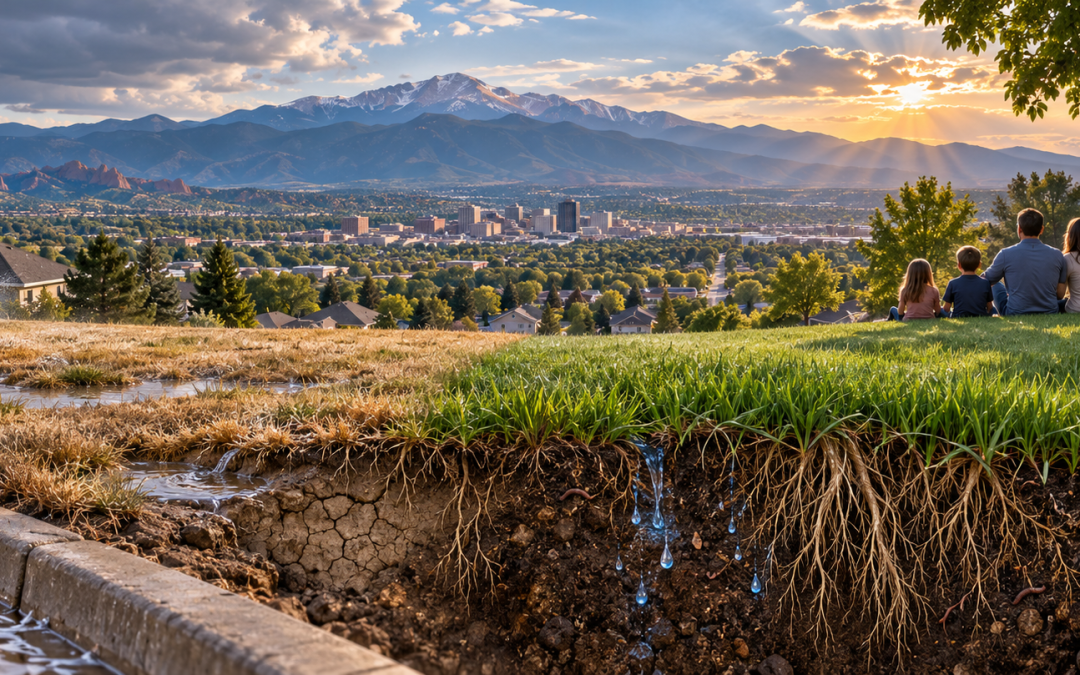
A compacted soil with low humus, poor biological activity, limited air movement, and weak water infiltration cannot make efficient use of the water it receives. Rain may hit the lawn. Irrigation may run. Yet much of that water can run off, evaporate, sit too shallowly, or fail to reach the root zone where it is needed.
Then comes the familiar reaction: “The lawn needs more water.”
Maybe. But often the lawn needs a better soil system.
The old lawn-care model has trained people to react
For decades, the status quo has been built around inputs and reactions:
- Lawn looks stressed? Add water.
- Lawn looks pale? Add fertilizer.
- Weeds appear? Spray them.
- Grass thins out? Throw down seed.
- Summer gets hot? Turn the controller up.
There is a place for thoughtful inputs. But treating every symptom as an emergency creates an expensive cycle of dependency. It can keep homeowners spending more money, using more water, and still wondering why the lawn is never truly resilient.
That is not health. That is survival.
A healthy lawn should not need to be carried through every difficult week by panic watering and guesswork. It should have the structure, biology, rooting depth, and mineral balance to use water intelligently.
We can rewrite what “a healthy lawn” means
A healthy lawn is not simply the darkest green lawn on the block during perfect weather.
A healthy lawn is one that can absorb water instead of shedding it. One that holds moisture longer because it has functioning organic matter and humus. One with soil biology helping cycle nutrients. One that has enough pore space for oxygen, roots, and water to move through the profile.
And just as importantly, a healthy lawn is efficient.
Efficiency belongs in the conversation about lawn health. It is not an afterthought or a sacrifice. A lawn that uses less water to remain functional, recovers more quickly from stress, and requires fewer emergency treatments is not settling for less. It is operating better.
This is especially important in Colorado Springs and across the Front Range, where weather volatility can expose weak systems quickly. We may receive rain, but if the soil cannot absorb and retain it, the lawn can still be functionally dehydrated. We may have irrigation available, but if we apply it shallowly and frequently to a compacted soil, we can train roots to stay near the surface and become more dependent on the next cycle.
That is not a water problem alone.
It is a soil-performance problem.
Soil testing is the foundation for progress
Every lawn is different. One yard may be tight and compacted. Another may have poor calcium-magnesium balance. Another may be low in sulfur, carbon, or biological activity. One lawn may be losing water because it cannot infiltrate; another may be losing it because it cannot hold it.
This is why generic lawn advice has limits.
Proper soil testing gives us specific data about your soil—not a guess based on what the neighbor is doing, a fertilizer bag, or a one-size-fits-all calendar. It gives us a staging ground for real progress: a way to identify what is limiting your lawn, prioritize corrections, and build a system that becomes more capable over time.
We do not guess with soil. We test it.
Then we observe the lawn, investigate the physical condition of the soil, and correct what the data tells us is wrong.
The opportunity is bigger than avoiding brown grass
The goal is not merely to survive the next dry spell.
The goal is to break free from a lawn-care cycle that has conditioned people to spend more, water more, and worry more—without ever addressing the foundation beneath their feet.
The years ahead may bring more pressure on water, more periods of unusual heat, and more reminders that the old way of managing lawns is not enough. But that does not have to be bad news. It can be the moment we finally start asking better questions.
What if your lawn could become more resilient instead of more dependent?
What if water restrictions did not automatically mean a lawn in crisis?
What if lawn care became less about reacting to symptoms and more about building a system that performs under pressure?
That is the paradigm worth breaking.
And the work starts below the grass.
Before you add more water, fertilizer, seed, or treatments, get the facts. Schedule a soil-based lawn evaluation and start building a lawn that is healthier, more efficient, and better prepared for whatever comes next.
Call 719-380-0136 or get started here: