
Last Updated on September 7, 2026 by Brian Beck
Automation Isn’t the Enemy. Waste Is.
For more than 30 years, I have watched the lawn-care industry try to solve the same problems with the same basic system: put people on trucks, move them from property to property, burn fuel, race the weather, and hope enough employees show up to complete every route on time.
That system is becoming harder to sustain.
America has a real shortage of people willing, available, and trained to do hands-on work. Mike Rowe has been talking about the shortage in the trades for years, and he is right to bring attention to it. We need skilled people. We need technicians, mechanics, irrigation specialists, electricians, plumbers, landscapers, and tradesmen who can solve real problems.
But we also need to be honest: there are simply not enough people to fill every repetitive, labor-intensive task that needs to be done.
That is where automation belongs.
Automation should not be viewed as a way to eliminate good workers. It should be viewed as a way to stop wasting good workers on work that a machine can consistently perform—so those people can focus on the parts of the job that require judgment, skill, diagnosis, craftsmanship, and personal responsibility.
Robotic mowing is one of the clearest examples.
The Old Route System Has Limits
Traditional mowing is route-based. A crew loads up equipment, drives across town, unloads, mows as much as possible, loads everything again, then fights traffic, rain, breakdowns, schedule changes, fuel costs, employee fatigue, and limited daylight.
The grass does not care about our route schedule.
It grows when it grows. Often, the lawn most needs attention during the same periods when crews are least able to get to every property: after rain, during rapid spring growth, or when heat and weather disruptions throw an entire week behind.
That is not a criticism of hardworking lawn-care employees. It is a criticism of an inefficient system that has been accepted as normal for too long.
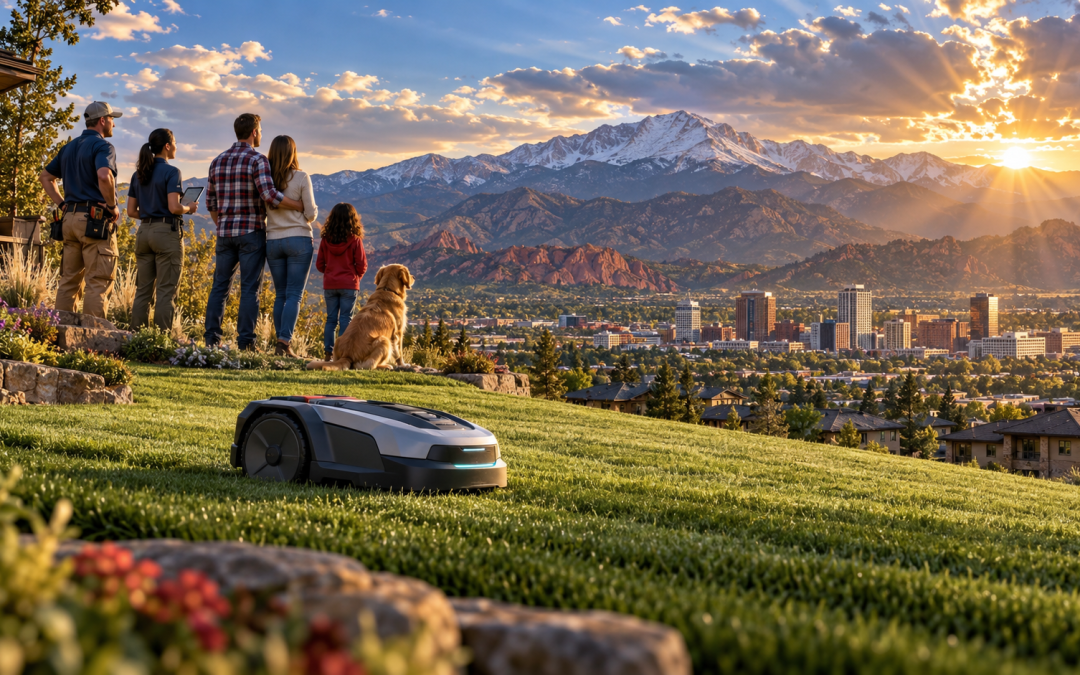
A robotic mower stays at the property. It does not need to be loaded onto a trailer, driven across town, or squeezed into a narrow mowing window. It can mow frequently and quietly, even when a human crew is busy elsewhere.
Better for the Lawn
The greatest benefit is not simply that a robot cuts grass. It is how it cuts grass.
Instead of allowing turf to grow tall and then taking a large amount off once a week, robotic mowing maintains the lawn through frequent, light trimming. The grass stays more consistent, cleaner, and less stressed.
That means:
- Less shock from removing too much leaf blade at one time
- Finer clippings returned to the lawn naturally
- A more uniform appearance throughout the week
- Less opportunity for the lawn to become shaggy between visits
- A lawn that is perpetually kept in that “Friday-mowed” condition
The result is not merely a better-looking lawn. It is a more stable lawn.
Better for the Customer
Customers should not have to wonder whether their mowing day will be delayed because of rain, staffing issues, equipment problems, or an overloaded route.
With an appropriately selected and installed robotic mower, there is no traditional mowing day. The lawn is maintained continuously.
There is also far less noise, no crew parked in front of the house for an extended period, and no gasoline mower roaring through the neighborhood. For many homeowners, especially those who work from home, that difference matters.
Robotic mowing does not make a property maintenance-free. Edges, detail work, seasonal cleanup, repairs, and the small idiosyncrasies of each yard still require a professional human touch.
But it changes the equation. Instead of sending people to repeatedly perform the most repetitive portion of the job, we can send trained professionals where they add the most value.
Better for the Employee
This is the part people often miss.
The future should not be about replacing workers. It should be about making each worker more productive, more valuable, and better able to focus on skilled work.
A robotic mower can handle the repetitive cutting cycle while a technician focuses on irrigation, turf health, diagnostics, trimming, detail work, automation maintenance, soil improvement, and customer service.
That is how we raise the level of the industry.
When we eliminate waste, we can create a more dependable service model, better working conditions, more opportunity for skilled employees, and a stronger path toward higher-value work. We do not need fewer good people. We need to stop asking good people to spend all day performing tasks that can now be automated.
This Is the Direction We Chose
At Front Range Autmow, we believe robotic mowing is not a gimmick. It is a practical answer to a real labor and productivity problem.
It helps overcome the shortcomings of the old route-based mowing system: weather delays, noise, fuel use, exhaust, fatigue, limited daylight, inconsistent schedules, and the ongoing difficulty of finding enough labor to meet demand.
More importantly, it improves all three sides of the equation:
- The customer receives a quieter, more consistent service.
- The lawn receives frequent, lighter mowing that supports better turf quality.
- The employee is freed to do the skilled work that technology cannot replace.
Automation is not the enemy. Waste is.
The lawn-care industry has operated with the same basic model for decades. We believe there is a better way forward—and robotic mowing is one of the mechanisms that will get us there.
If you would like to find out whether your property is a good fit for robotic mowing, contact Front Range Autmow at 719-380-0136 or request an assessment.