
Last Updated on July 9, 2025 by Brian Beck
“The Hidden Thief in Your Lawn: How Thatch Robs You Blind—and How Biology Saves the Day”
When people think of lawn problems, they often imagine things they can see: brown patches, weeds, or a struggling mower fighting its way through tall grass. But lurking beneath the surface of many lawns is a lesser-known culprit—thatch. And while it may seem harmless at first glance, excessive thatch is quietly robbing your lawn of water, nutrients, and dollars.
What Is Thatch, Anyway?
Thatch is the layer of dead and living organic matter—mostly made up of grass roots, stems, and debris—that accumulates between the green canopy of your lawn and the soil surface. A thin layer (½ inch or less) can actually be beneficial, helping with insulation and moisture retention. But once thatch exceeds that healthy threshold, things go downhill fast.
Why Overgrown Thatch Is a Problem
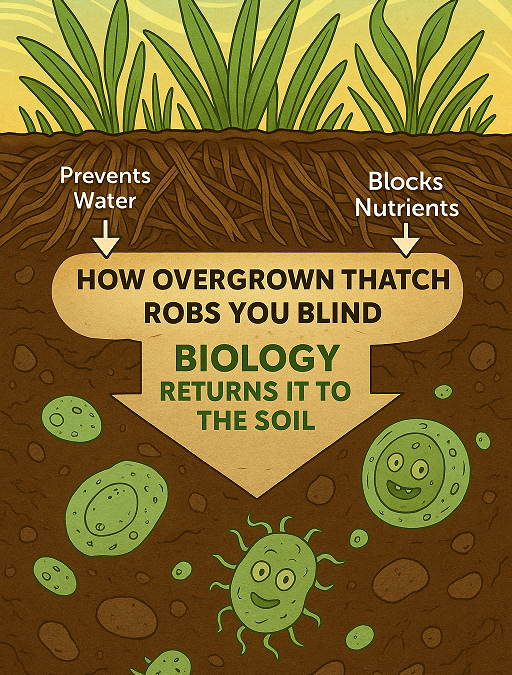
When thatch builds up excessively, it becomes a barrier. Water that should be nourishing roots gets held up in the thatch and evaporates. Fertilizers sit on top and never make it to the soil. Microbes and beneficial insects are stifled, and roots are forced to grow in the thatch itself—where they’re more vulnerable to drought, temperature swings, and pests.
It’s like trying to drink a glass of water through a sponge—most of it doesn’t make it to your mouth.
Symptoms of a thatch-heavy lawn:
-
Spongy or bouncy feel when walking
-
Dry spots that appear despite regular watering
-
Shallow root systems
-
Increased disease and insect activity
-
Water and fertilizer runoff
What Causes Excessive Thatch?
Conventional synthetic lawn care systems are one of the biggest offenders. They:
-
Suppress microbial activity
-
Promote shallow rooting
-
Create rapid, unnatural growth patterns
Without a healthy soil biology to break down organic matter naturally, thatch just keeps piling up. Add in heavy mowing and low soil oxygenation, and you’ve got a perfect recipe for a thick, suffocating thatch layer.
How Biology Fixes It Naturally
The good news? You don’t need to rent a power rake or tear up your lawn. The biological method offers a smarter, gentler, and more sustainable solution.
Biological systems:
-
Reintroduce microbes and fungi that decompose thatch into usable carbon and nutrients
-
Improve soil structure so roots can grow deep, not shallow
-
Increase populations of thatch-eating organisms like earthworms and beneficial bacteria
-
Break the dependency cycle of synthetic fertilizers
Instead of fighting thatch manually, biology turns it into an asset. It becomes fuel for soil regeneration—not a barrier to your lawn’s health.
Thatch Isn’t the Problem—It’s the Mismanagement
The presence of thatch is natural. The problem is how we manage it. When soil is dead and over-reliant on synthetic inputs, it can’t do its job. But with the right balance of carbon, minerals, and microbial life, your soil becomes the engine that powers everything.
So next time you hear someone say “that’s just part of lawn care,” remember—it doesn’t have to be. You can have a lawn that recycles its own waste, holds its own water, and grows stronger with time.
You don’t need more inputs—you need better systems. And biology is the system that always gives back.