
Last Updated on July 5, 2025 by Brian Beck
☀️ Why Your Lawn Struggles in Summer (And How Soil Can Save It)
It’s July.
The sun is blazing.
Your water bill is rising.
And despite all your effort, your lawn is… still struggling.
You’re not alone.
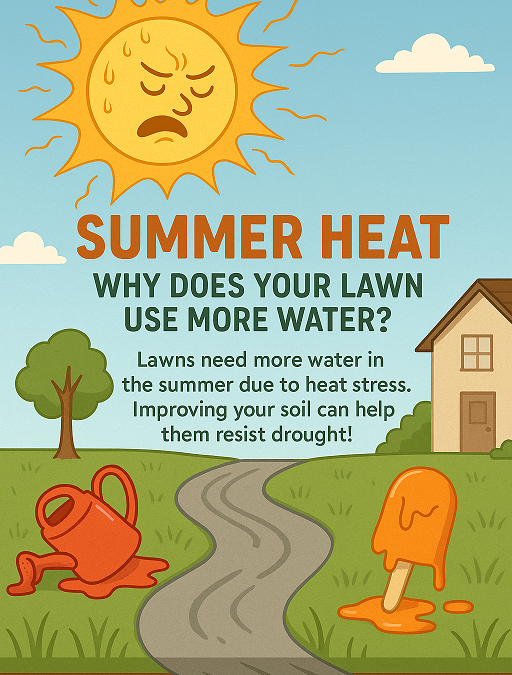
Summer stress is one of the most common and frustrating challenges for homeowners. But while most people assume that grass problems in summer are simply caused by heat, the truth runs much deeper—into the soil.
🌡️ Why Summer Is So Tough on Lawns
When temperatures rise and the sun bears down day after day, your grass is put to the test:
-
Increased transpiration: Grass loses more water through its leaves trying to stay cool.
-
Shallow roots struggle: If your roots are only a few inches deep, they dry out fast.
-
Heat compaction: Dry soils become hard and compacted, preventing water from soaking in.
-
Nutrient uptake slows down: High heat and low microbial activity mean the plant struggles to access nutrients, even if they’re present in the soil.
And what do most people do?
They water more. Sometimes daily. Sometimes desperately.
But without fixing the root causes, that water may never make it to where it’s needed—or worse, it evaporates or runs off entirely.
💧 More Water Isn’t Always the Answer
You can’t outwater bad soil.
If your soil is compacted, low in organic matter, or lacking microbial life, it’s like trying to water a sponge that’s turned to concrete. You end up wasting water without actually helping the lawn.
And here’s the kicker: most people using synthetic fertilizers are unintentionally making the problem worse.
-
Synthetic products kill off microbes
-
Dead microbes mean less natural soil aeration
-
No aeration = compacted soil = shallow roots
-
Shallow roots = more stress and more watering
-
More watering = higher bills, more runoff, more frustration
It’s a vicious cycle. And it’s expensive.
🌱 Healthy Soil = Resilient Lawn
Want a lawn that thrives in summer? Don’t just water—build the soil.
Here’s how to prepare your lawn for the heat naturally:
✅ Increase Organic Matter
Compost, topdress, or use carbon-rich biological amendments. Organic matter improves water holding capacity dramatically.
✅ Inoculate with Biology
Soil microbes create structure, digest thatch, unlock nutrients, and help your lawn stay hydrated longer.
✅ Balance Your Minerals
A soil test can show if you have pH issues or nutrient imbalances. Fixing calcium, magnesium, or sodium levels makes your soil more receptive to water.
✅ Deep, Infrequent Watering
Once the soil is healthy, you don’t have to water every day. Two deep soakings a week can be enough—reducing stress and costs.
✅ Ditch the Synthetics
Long-term reliance on synthetic fertilizers only masks the problem. A biological approach builds lasting strength.
🔄 Stop Fighting Nature—Work With It
You don’t need to choose between a healthy lawn and a sustainable lifestyle.
You don’t need to dump gallons of water every week just to keep your grass green.
If your lawn is suffering in the heat, the issue isn’t just above the ground—it’s below it.
And the good news is, soil health is 100% fixable. With the right plan, your lawn can become:
-
More drought-resistant
-
Less dependent on inputs
-
Cheaper to maintain
-
Healthier year-round
🌿 Ready to break the cycle?
Don’t pour another dollar into temporary fixes. Let’s test your soil, repair the biology, and build a lawn that actually works with the environment—not against it.
Your future lawn (and your water bill) will thank you.