
Last Updated on July 1, 2025 by Brian Beck
Why Big Fertilizer Won’t Go Biological—And Why You Should Care
There’s a quiet battle going on beneath your feet.
On one side: a new wave of regenerative lawn and land care, powered by soil biology, microbial intelligence, and sustainability.
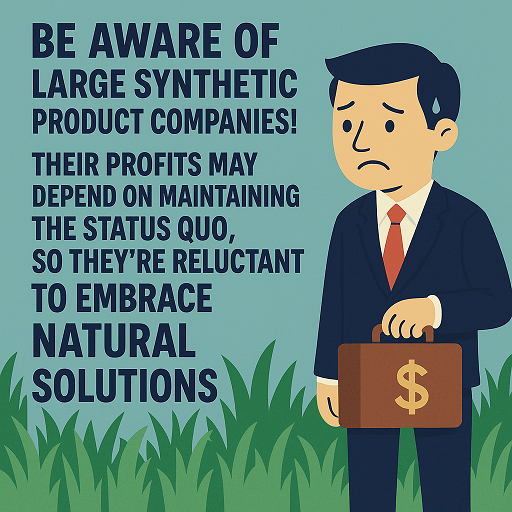
On the other: massive, traditional chemical companies clinging to the synthetic status quo.
And make no mistake—the big players don’t want to change.
But the question is: why not?
🏭 The Synthetic Industry Was Built for Repeat Dependence
Let’s start with the model.
The synthetic fertilizer industry was never designed to create lasting soil health. It was built on a cycle of quick results and repeated use.
-
High-salt products that bypass the soil
-
Nutrient blasts that create immediate green-up
-
Zero attention paid to microbial health or root development
It’s like giving your lawn an IV drip of steroids: impressive short-term color, but long-term weakness. And it works—for them, not for you.
Because the more your soil degrades, the more product you need.
The more you use it, the more you have to rely on it.
That’s not plant care. That’s addiction.
💰 There’s No Big Money in Self-Sufficiency
Biological systems—when properly nurtured—actually reduce the need for outside inputs over time.
-
Living soils start cycling nutrients on their own
-
Microbes fix nitrogen, solubilize phosphorus, and protect roots
-
Healthy turf builds its own resilience, requiring fewer treatments
That means fewer bags sold. Fewer scheduled applications. Fewer chemical refills.
For billion-dollar chemical conglomerates built on volume and frequency, that’s a serious threat. Switching to a biological model would require them to dismantle their own golden goose.
And that’s not something they’re willing to do—no matter how much science supports it.
⚠️ What You’re Not Being Told
Despite decades of soil microbiology research, regenerative trials, and case studies showing long-term benefits of biological programs, the big fertilizer industry remains largely silent.
Here’s what they’re NOT promoting:
-
Microbial inoculants
-
Soil carbon strategies
-
Organic matter restoration
-
Cation exchange capacity optimization
-
Fungal:bacterial ratios
Why? Because these approaches don’t fit into a bag and can’t be controlled by seasonal marketing cycles.
And when they do attempt “biological” products, it’s often watered down, greenwashed, or buried under layers of synthetic offerings.
🧠 Why You Need to Be Aware
As a homeowner, land manager, or steward of any green space, you have a choice. And that choice is being heavily influenced by big-brand marketing designed to:
-
Keep you dependent
-
Keep you reactive
-
Keep you unaware of the alternatives
But the tide is shifting. Independent lawn care professionals, regenerative farmers, and educated consumers are waking up to the truth:
The healthiest lawns aren’t fed more—they’re built better.
And that starts with soil biology, not synthetic band-aids.
🌿 The New Model: Biology Over Bottles
A biological approach to turf care:
-
Builds soil health with every season
-
Supports microbial life and biodiversity
-
Uses fewer inputs over time
-
Resists drought, disease, and pests naturally
-
Supports long-term sustainability—not short-term illusions
This model threatens the chemical industry, but it empowers you.
🔄 Don’t Wait for Big Fertilizer to Change—Start Without Them
The truth is, they may never change. Their business model depends on it.
But you can.
You can break the cycle.
You can work with nature, not against it.
You can grow something healthier—for your lawn, your environment, and your future.
Need help making the shift to biological turf care?
We specialize in soil-first programs that cut through the hype and build long-term health from the ground up. Let us show you what’s possible when you stop following the formula—and start following the biology.