
Last Updated on September 3, 2026 by Brian Beck
Most homeowners assume drought stress means one thing:
The lawn needs more water.
Sometimes that is true.
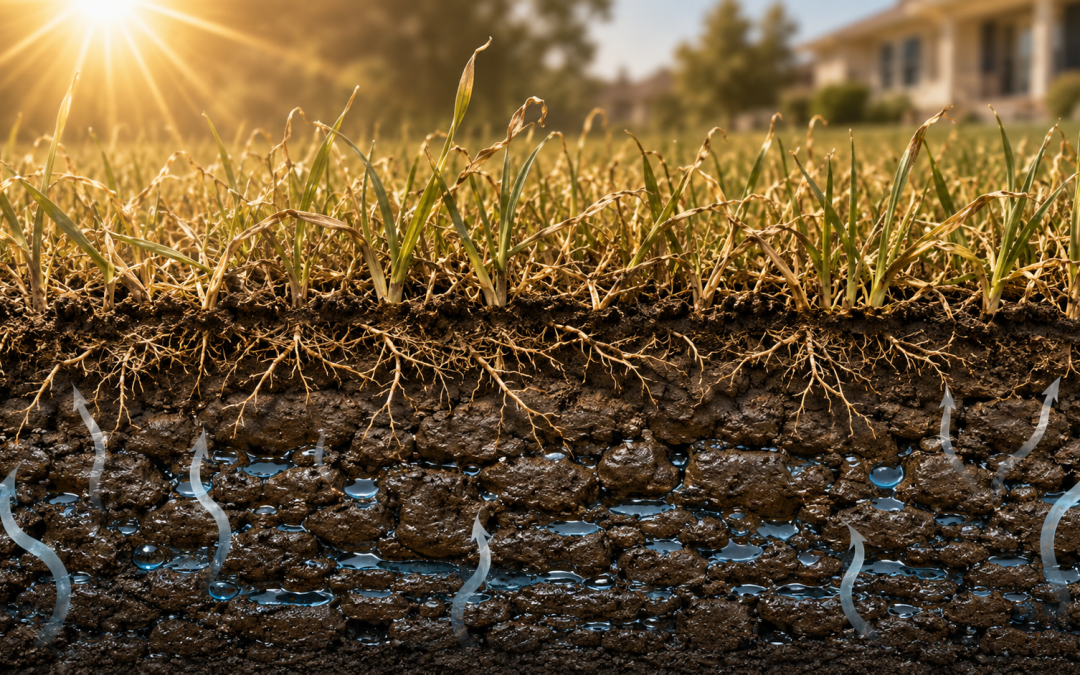
But sometimes the soil can already contain plenty of moisture and the lawn can still look wilted, dull, weak or drought-stressed.
That sounds contradictory, but it really isn’t.
A plant does not simply need water somewhere in the soil.
It needs a functioning root system, adequate oxygen, good soil structure and enough pore space to actually use that water.
That is a much different conversation.
Water in the Soil Does Not Mean Water Is Available to the Plant
Imagine placing a plant’s roots into a bucket of water.
There is no shortage of moisture.
But if the roots cannot get enough oxygen, they begin to struggle.
Roots are living tissue. They respire. They require oxygen to function.
This is why saturated or poorly aerated soil can create symptoms that look surprisingly similar to drought stress.
The grass may wilt.
Color may decline.
Growth may slow.
The lawn may struggle to recover during heat.
And the natural reaction is often:
Water it again.
That can make the problem worse.
The important question is not simply:
Is there water in the soil?
The better question is:
Can the plant actually access and use it?
Soil Needs Air and Water at the Same Time
Healthy soil contains pore space.
Those pores are incredibly important because they create room for both water and air.
Some pores retain moisture.
Larger pores allow drainage and oxygen movement.
When soil structure is healthy, the soil can maintain a useful balance between the two.
But when soil becomes heavily compacted or structurally degraded, those pore spaces can collapse.
Now water movement slows.
Oxygen movement slows.
Roots have a harder time growing.
Biological activity can become restricted.
And the soil may remain wet longer than it should.
That creates a strange situation:
The lawn can be surrounded by water while still functioning like it is under drought stress.
Compaction Can Be an Invisible Irrigation Problem
We often think of compaction as a problem that makes soil hard.
But compaction does much more than that.
It changes the entire physical environment around the root system.
When soil particles are pressed tightly together:
- water infiltration can decline
- oxygen movement can decline
- rooting depth can decrease
- biological activity can suffer
- drainage may become uneven
- water can perch near the surface
- roots may become concentrated in a shallow zone
The result is a lawn with very little margin for error.
During mild weather, that lawn may still look acceptable.
But when temperatures climb, the weakness becomes obvious.
The plant suddenly needs to move much more water through its system.
Its roots need to function efficiently.
Its soil needs to breathe.
Its vascular system needs to keep up.
If the structure underneath the lawn is poor, the entire system begins to struggle.
Heat exposes the dysfunction.
Transpiration Is Part of the Story
Grass does not simply absorb water and hold it.
Water is constantly moving through the plant.
Roots absorb it.
Water travels upward through the plant.
A portion is used in biological processes.
Much of it ultimately exits through microscopic openings in the leaves during a process called transpiration.
Transpiration is part of how the plant cools itself and moves nutrients.
But that movement depends on a functioning root system.
If roots are damaged, shallow, oxygen-starved or confined by compacted soil, the plant can struggle to keep up with atmospheric demand during hot weather.
This means a lawn might have moisture beneath it while the leaves above still experience water stress.
Again, the problem may not be the total amount of water.
It may be the lawn’s ability to move water through the system.
This Is Why Overwatering Can Look Like Underwatering
This is one of the most confusing things for homeowners.
A lawn looks stressed.
They increase irrigation.
The lawn still looks stressed.
So they increase irrigation again.
Eventually the soil becomes wetter and wetter while the grass continues to decline.
The homeowner concludes that the weather must simply be too extreme.
But sometimes the lawn is stuck in a feedback loop.
Poor structure limits oxygen.
Poor oxygen weakens roots.
Weak roots reduce water uptake.
Reduced water uptake causes stress.
Stress triggers more irrigation.
More irrigation further reduces oxygen.
Now the problem feeds itself.
That is why simply adding more water is not always the solution to drought-like symptoms.
A Moisture Meter Can Change the Diagnosis
This is where actual measurement becomes incredibly valuable.
If a struggling section of lawn appears dry, but a moisture reading shows adequate or even excessive water in the root zone, the investigation needs to change.
Instead of asking:
How do we add more water?
We should begin asking:
- Is the soil compacted?
- Is the irrigation uniform?
- Are roots shallow?
- Is the soil staying saturated too long?
- Is oxygen movement restricted?
- Is there adequate organic matter?
- Is biological activity weak?
- Is there poor aggregation?
- Is the root system functioning efficiently?
This is why we increasingly believe lawn care should involve diagnosis rather than assumption.
Irrigation Uniformity Matters Too
Not every stressed lawn has a soil biology problem.
Sometimes the issue is much simpler.
One part of the lawn may receive 30 percent more irrigation than another.
A sprinkler head may be partially blocked.
A slope may shed water.
One zone may have different sun exposure.
Wind may distort sprinkler distribution.
Different soil depths may exist across the property.
So when one part of a lawn responds and another does not, we should not immediately assume a treatment has failed.
We need to separate irrigation distribution problems from soil function problems.
Both can produce similar symptoms.
Heat Is the Stress Test
Hot weather is incredibly useful diagnostically.
It exposes weaknesses that may be invisible during easier conditions.
A lawn can look perfectly acceptable in spring.
Temperatures rise.
Atmospheric demand increases.
Now the difference between a functional root zone and a dysfunctional one becomes obvious.
A healthy, efficient lawn should generally recover relatively quickly after temporary heat or moisture stress once favorable conditions return.
If recovery takes several days or weeks, something deeper may be limiting the system.
That limitation might involve:
- structure
- gas exchange
- rooting depth
- irrigation distribution
- carbon
- biology
- mineral balance
- or some combination of them
This is why we see heat not merely as an enemy, but also as a diagnostic tool.
It reveals what the lawn can actually handle.

Structure Comes Before Fertility
This has changed how we think about biological lawn care.
For years, the industry has often approached struggling lawns by adding something.
More fertilizer.
More water.
Another treatment.
Another product.
But if the physical environment around the roots is dysfunctional, adding more fertility may not solve the real problem.
This is why our approach begins with a simple hierarchy:
Structure first.
Life second.
Nurture third.
Structure means the soil must physically function.
It needs pore space.
It needs gas exchange.
It needs infiltration.
It needs rooting capacity.
Then biological life can operate more effectively within that structure.
Then fertility and other inputs can be used intelligently to nurture the system instead of trying to force it to perform.
The Goal Is Not Just Wet Soil
This may be one of the biggest mindset changes homeowners can make.
The goal of irrigation is not to create wet dirt.
The goal is to maintain a functioning soil-plant system.
That system needs:
- adequate moisture
- adequate oxygen
- good soil structure
- functioning roots
- biological activity
- carbon
- mineral balance
- and intelligent irrigation
Water is only one piece.
And sometimes the best thing you can do for a drought-stressed lawn is not simply give it more water.
Sometimes the better question is:
Why isn’t the lawn able to use the water it already has?
That question can completely change how you manage a lawn.
Read the First Article
This blog is part of a larger discussion about building a lawn that uses water more efficiently.
If you haven’t read it yet, start with:
Soil Carbon, Humus and Fungi: How Healthy Soil Holds More Water
That article explains how carbon, organic matter, fungal networks, aggregation and root development help build the underground reservoir that makes a lawn more resilient.
Want to Know What Your Soil Is Actually Doing?
If your lawn constantly seems thirsty, struggles during heat or requires more and more irrigation to remain acceptable, simply increasing watering time may not solve the real problem.
Our biological lawn program is designed to look deeper.
We evaluate the lawn as a functioning system and work to identify the obstacles that are preventing it from becoming more efficient, resilient and self-supporting.
Structure. Life. Nurture.
Before adding more water, more fertilizer or more treatments, get better information.
We don’t guess with soil. We test it.