
Last Updated on September 19, 2025 by Brian Beck
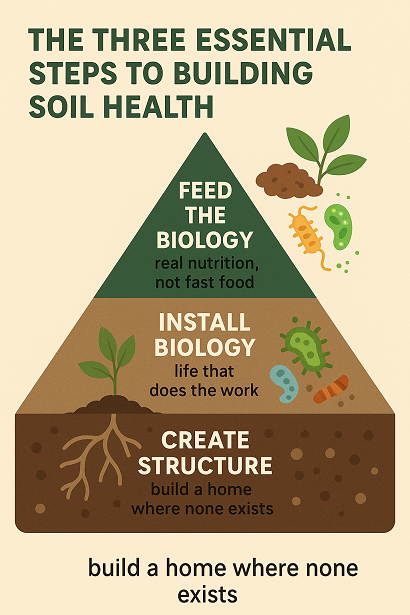
Healthy soil isn’t just dirt under your feet—it’s a living, breathing ecosystem that supports everything from backyard lawns to global food production. Unfortunately, most soils today are tired, compacted, and lifeless because of years of neglect or overuse of synthetic fertilizers. The good news? Soil health can be rebuilt. And the process is simpler than most people think. It comes down to three steps:
1. Create Structure: Build a Home Where None Exists
Soil without structure is like a house without walls—it can’t protect or support life. Structure means creating pores and channels in the soil where air, water, and roots can move freely. Compacted soils suffocate life; structured soils invite it in.
-
Why it matters: Structure gives microbes, fungi, and roots a place to live and thrive.
-
How to achieve it: Use organic matter (like humus) to glue soil particles into stable aggregates. Think of it as laying the foundation for everything else.
2. Install Biology: Life That Does the Work
Once you’ve created a home, it’s time to invite the residents. Soil biology is the workforce of the underground world—bacteria, fungi, protozoa, nematodes, and earthworms all have specialized jobs. They digest organic matter, recycle nutrients, build humus, fix nitrogen, and even protect plants from disease.
-
Why it matters: Healthy biology transforms soil from a static material into a dynamic living engine.
-
How to achieve it: Inoculate with diverse microbes, reduce chemical inputs that harm life, and create conditions that allow natural populations to grow. A living soil doesn’t just “look green”—it works behind the scenes to maintain balance.
3. Feed the Biology: Real Nutrition, Not Fast Food
Even the best workforce needs proper fuel. The mistake many make is feeding soil with synthetic “fast food” fertilizers—quick hits of soluble salts that might look good temporarily but starve biology over time. Instead, biology thrives on complex, carbon-rich materials that break down slowly and feed the system long-term.
-
Why it matters: Proper nutrition keeps microbes multiplying, plants thriving, and structure improving year after year.
-
How to achieve it: Use humic acids, trace minerals, and balanced organic inputs. These feed both the soil life and the plants in a sustainable cycle.
Final Thoughts
Soil health isn’t magic—it’s a process. Create the home, install the workers, and feed them well. When you follow these three steps, you unlock the natural capacity of soil to build resilience, reduce costs, and create vibrant landscapes that can stand the test of time.
Healthy soil is not just the foundation of a lawn or garden—it’s the foundation of life itself.
Read more: