
Last Updated on March 1, 2026 by Brian Beck
Somewhere along the way, modern lawn care started acting like biology is a trend.
Like microbes are a new invention. Like carbon is a “premium add-on.” Like nature was just sitting around for a few billion years, waiting for a 3-number label on a bag to show up and finally teach soil how to function.
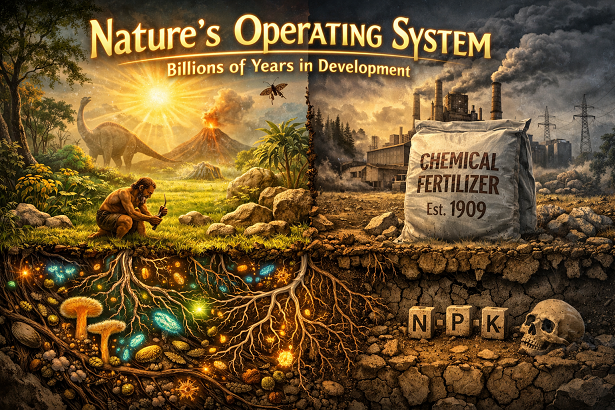
Here’s the uncomfortable truth: the biological program has been here since there has been dirt on Earth. Microbes were on the job long before we showed up with spreaders, sprayers, and opinions. They built soil. They cycle nutrients. They create structure. They store carbon. They regulate water. They are the quiet workforce underneath every healthy ecosystem—forest, prairie, pasture… and yes, your lawn.
Synthetic fertilizer—what most people now consider “normal”—is the new guy. The industrial ability to convert atmospheric nitrogen into ammonia (the foundation of modern synthetic nitrogen fertilizer) traces back to Fritz Haber’s breakthrough demonstration in 1909, and Carl Bosch’s industrial scale-up in 1913.
So if you’re wondering which approach is the gimmick… it’s not the one microbes have been running since before humans learned to sharpen rocks.
A Very Short History of “How Soil Worked” Before 1909
For basically all of human agriculture—and all ecosystems—fertility came from biology:
-
plant residues returning to the soil
-
animal manures
-
composting and decomposition
-
legumes partnering with microbes to fix nitrogen
-
diverse rotations and living roots
-
fungal networks trading nutrients for sugars
-
predators and decomposers keeping the whole system balanced
In other words: life fed life. Nutrients moved through organisms, not through factories.
Then we discovered how to manufacture a key nutrient on an industrial scale. It was brilliant chemistry. It also made it incredibly easy to bypass the biological engine and still get green growth on demand.
And that is exactly what we did.
What Synthetics Actually Do to Soil Biology (Not the Grass Blade)
Let’s say the quiet part out loud: synthetic fertilizer is designed to feed the plant, not the soil.
That’s not automatically evil. The problem is what happens when we make it the primary system for years.
1) Synthetic fertility can shrink and simplify the soil microbiome
When you repeatedly deliver nutrients in immediately available, high-concentration forms, you reduce the incentive for plants to “pay” microbes (with root exudates) to mine nutrients from organic matter and minerals. You can also change soil conditions (salts, pH, nutrient ratios) in ways that favor a narrower slice of microbial life.
Large bodies of research show conventional synthetic fertilization is associated with reduced microbial richness/diversity and reduced “soil multifunctionality” compared to systems that rebuild organic inputs.
So yes—you may get a greener lawn. You may also be slowly firing the workforce that keeps that lawn resilient.
2) Nitrogen programs can drive soil acidification (and chemistry problems follow)
Long-term nitrogen fertilization—especially ammonium-based pathways—commonly acidifies soil through nitrification (hydrogen ions are produced). This is not a theory; it’s measured. In long-term field research, sustained nitrogen inputs significantly lowered soil pH.
In turf, pH drift matters because it changes nutrient availability, microbial behavior, and the balance of calcium, magnesium, potassium, and micronutrients. The plant might still look “fine”… right up until it doesn’t.
3) Fertilizers add salts (because of course they do)
Many fertilizers increase the salt concentration in the soil solution. Higher salt concentration can pull water away from roots (osmotic stress) and can contribute to “burn” under the wrong conditions. This is why concepts like salt index exist, and why multiple extension/technical sources explicitly warn that fertilizers add salts and can worsen salinity issues.
So when someone says, “My lawn looks stressed, I’ll just fertilize it,” what they often mean is: “My lawn looks dehydrated, so I’m going to add salts.”
Bold strategy.
4) High nitrogen can increase disease pressure and thatch problems
Here’s another fun side effect of “green at all costs”: pushing growth can push vulnerability.
University turf disease references repeatedly note that high nitrogen can increase the severity of certain turf diseases.
And excessive nitrogen can promote thatch development by accelerating tissue production faster than the soil biology can decompose it.
So the lawn grows faster… and then you’re paying to mow more, dethatch more, treat fungus more, water more, and generally manage a plant that’s sprinting on a treadmill.
Environmental Costs: Where the “Invisible Bill” Goes
Synthetic fertility doesn’t just alter soil. It leaks.
Nutrient pollution and water quality
Nitrogen and phosphorus losses contribute to eutrophication—algal blooms, degraded water bodies, ecological damage. EPA guidance on nutrient pollution outlines how agricultural nutrients can move to waterways and the atmosphere, driving downstream impacts.
Greenhouse gases
Nitrogen management is closely tied to nitrous oxide emissions (N₂O), a powerful greenhouse gas. Loss pathways include direct soil emissions and indirect losses through leaching and volatilization.
None of that shows up on the fertilizer bag label. But it sure shows up in the real world.
The Pocketbook Costs: “Cheap” Up Front, Expensive Forever
Synthetics often feel cheaper because they produce a visible response quickly. That’s the sales pitch.
But the long-term economics can be brutal:
-
Dependency: if soil biology is weakened, you need more inputs to maintain the same look.
-
Water costs: shallow, pushy growth and weaker structure often means less efficient water use.
-
Repair costs: more disease pressure, more thatch, more compaction interventions, more “why is this lawn always on life support?”
-
Stacking products: fertilizer → fungus → insects → herbicides → wetting agents → dethatching → aeration → repeat.
It becomes a subscription model… except you’re the one paying for it.
What the Biological Program Actually Means (No Fairy Dust Included)
The biological program is not “no inputs.” It’s not wishful thinking. It’s not vibes.
It’s returning the soil to a state where the system becomes efficient again:
-
build structure (aggregation, infiltration, air exchange)
-
rebuild carbon/humus (buffering capacity, nutrient holding, drought tolerance)
-
re-establish microbial diversity (cycling, suppression, resilience)
-
stop forcing growth with quick hits that ignore the foundation
Organic inputs and biological strategies are repeatedly associated with improved aggregation, structure, and microbial function compared with purely chemical programs.
That’s not trendy. That’s how functional soil works.
The Bottom Line
If someone tells you “biology is a fad,” what they really mean is:
“I’m used to managing soil like it’s an inert sponge, and I’d rather not rethink that.”
Because once you admit the soil is alive, you can’t unsee the madness of trying to fix living systems with short-term chemical reactions and hoping there’s no long-term bill.
Microbes were here first. They are still here. And when you stop poisoning the process and start feeding the system, the lawn doesn’t just get greener—it gets cheaper to own, easier to manage, and harder to kill.
Which is exactly why we do what we do at Blade to Blade and Front Range Autmow.
If you want the shortcut, there are bags for that.
If you want the solution, we’ll rebuild the soil.
Engage with us: