
Last Updated on September 22, 2026 by Brian Beck
Spring Lawns Are Built in the Fall
Every spring, something predictable happens.
The weather begins to warm, homeowners step outside, and suddenly everyone becomes enthusiastic about their lawn again. Fertilizer is purchased. Sprinklers are turned on. Mowers are pulled from storage. People begin searching for something—anything—that will make the grass green as quickly as possible.
But by then, much of the opportunity has already been missed.
One of the greatest misunderstandings in lawn care is the belief that spring is when a great lawn is created. Spring is when you see the results. Much of the biological and structural work that determines those results should have begun the previous fall.
Unfortunately, enthusiasm for lawn care tends to follow the temperature. It rises in spring, peaks in early summer, and fades as fall approaches. By September and October, many homeowners have mentally checked out. The lawn is still growing, but football season has started, the days are getting shorter, and attention has shifted toward winter.
The lawn becomes an afterthought at precisely the time when some of its most important work is taking place.
Fall Is Not the End of the Lawn Season
Fall should not be viewed as the lawn’s slow march toward dormancy. It is a transition period during which the plant and the soil prepare for survival, recovery, and next year’s performance.
For cool-season grasses along Colorado’s Front Range, cooler soil and air temperatures can provide an important window for development. The plant is no longer fighting the same level of summer heat stress, but it can continue using sunlight to produce energy.
That energy can be directed toward:
- Developing and strengthening roots
- Storing carbohydrates for winter survival
- Repairing damage caused by summer heat and drought
- Supporting beneficial microbial activity
- Improving nutrient cycling
- Strengthening the relationship between plant roots and soil biology
- Preparing the plant for a faster, more efficient spring recovery
This is not about mowing grass later simply for the sake of mowing it. It is about understanding that the lawn is still alive and functioning—even when homeowners are no longer paying attention.
What Happens Below the Surface Matters Most
Most conventional lawn care focuses on what can be seen above ground: color, density, weeds, and growth.
A biological lawn-care system must look deeper.
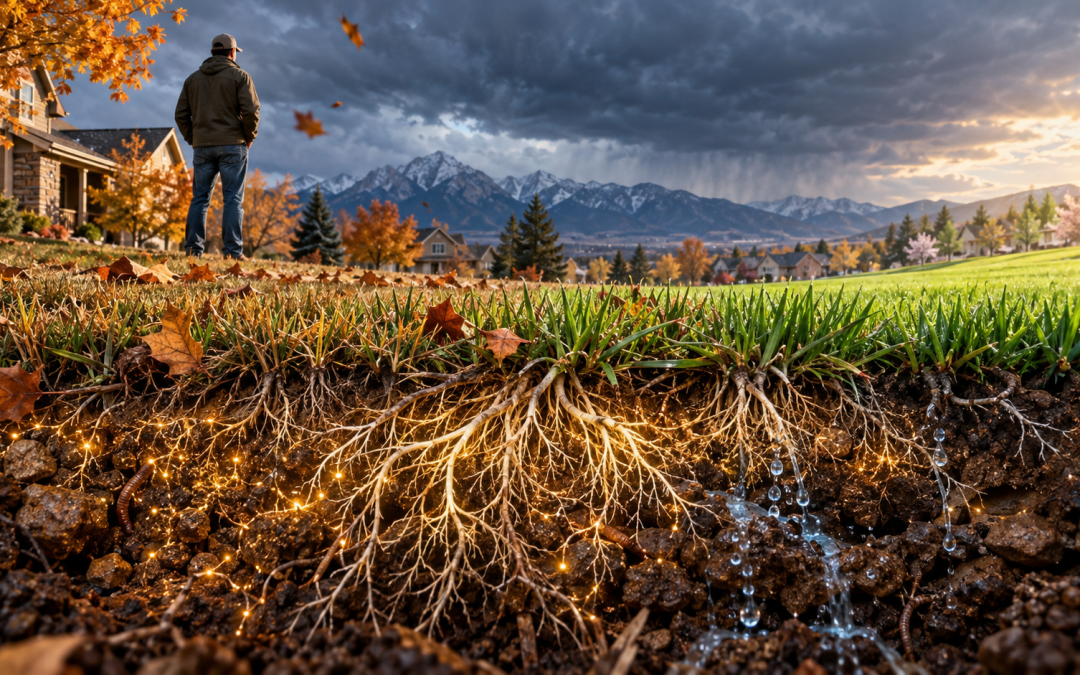
The strength of a lawn is largely determined by what is happening below the surface. Roots must be able to move through the soil. Water and oxygen must be able to enter it. Carbon must be present to support microbial life. Minerals must be available without being locked up by imbalance, compaction, or unfavorable soil chemistry.
Fall gives us an opportunity to improve this underground system without placing the lawn under the same environmental pressure it experiences during summer.
Root Development
Grass cannot be stronger than the root system supporting it.
A deeper, healthier root system gives the lawn access to a larger reservoir of water and minerals. It also increases the surface area available for biological interaction. When roots release carbon-rich compounds into the soil, they feed microorganisms living around the root zone. In return, those organisms help release and cycle nutrients that the plant can use.
This is one of the foundations of a self-supporting biological system.
A shallow-rooted lawn, by comparison, remains highly dependent on frequent watering and repeated applications of soluble nutrients. It may look attractive when everything is being supplied to it, but it has little ability to function independently when conditions become difficult.
Microbial Development
Beneficial bacteria and fungi do not exist merely because someone sprayed a biological product on the lawn. They require a suitable habitat.
That habitat depends on adequate moisture, oxygen, carbon, soil structure, and balanced mineral conditions. When those pieces are present, microorganisms can help decompose organic residues, cycle nutrients, build soil aggregates, manage thatch, and support healthier root development.
Fall can provide favorable conditions for strengthening this biological community. Cooler temperatures and more manageable moisture conditions reduce some of the environmental stress found during the hottest part of summer.
But biology cannot overcome every physical or chemical roadblock by itself. Compaction, poor gas exchange, low carbon, excessive salts, unfavorable pH, and mineral imbalance must also be identified and addressed.
That is why a soil test—and the correct interpretation of that test—is so important.
Are You Feeding the Lawn or Developing the System?
There is an important difference between feeding a lawn and developing a lawn.
Feeding usually means applying something intended to create a visible response. The grass becomes greener or grows faster, and the application is considered successful.
Developing the lawn means improving the system that produces the response.
That includes:
- Better soil structure
- More effective water infiltration
- Improved gas exchange
- Stronger roots
- Greater microbial activity
- More efficient mineral cycling
- Increased humus and carbon
- Better resilience during heat, drought, and winter
A biological program is not simply a different assortment of products. It is a different objective.
The goal is not to keep the lawn permanently dependent on outside intervention. The goal is to remove the dysfunction that prevents the soil and plant from performing more of their natural work.
Your Spring Green-Up Is a Report Card
Here is a blunt but useful way to evaluate the health of your lawn:
If your lawn is not beginning to green during the first part of April—and you must force it into action with heavy inputs in late April or May—you may not have a healthy lawn.
You may have a dependent lawn.
This does not mean every property must green up on exactly the same date. Elevation, exposure, shade, grass variety, soil temperature, irrigation, and weather all affect timing. But a healthy lawn should be capable of responding as favorable conditions return.
If it cannot function until it receives a substantial dose of soluble fertilizer, the application may be disguising the underlying problem rather than correcting it.
The lawn may turn green, but green does not automatically mean healthy.
A synthetic system often trains us to judge success by the speed and intensity of the color response. A biological system asks a more important question:
How well can the lawn function without constantly being rescued?
Independence Is the Real Goal
Imagine two lawns entering winter.
The first lawn has shallow roots, weak biological activity, compacted soil, limited carbon, poor gas exchange, and unresolved mineral imbalances. It survives largely because people continue supplying water and soluble nutrients.
The second lawn has better soil structure, stronger roots, active biology, improved mineral availability, and a growing reserve of stable organic matter.
Both lawns may become dormant. But they are not entering winter in the same condition—and they are unlikely to emerge from winter with the same strength.
A well-tuned biological lawn does not become completely maintenance-free. That is not a realistic promise. Grass will always need some level of water, mowing, nutrition, and management.
But it can become far less dependent.
It can cycle more of its own nutrients. It can use water more efficiently. It can develop a more functional root system. It can recover more effectively from stress. It can rely less on repeated rescue treatments designed to manufacture a temporary appearance.
When a lawn begins functioning as a living system instead of a chemically supported surface, it is a beautiful thing to watch.
Do Not Wait Until Spring to Think About Spring
The condition of next April’s lawn is being influenced right now.
Fall is when we evaluate what happened during the growing season. It is when we identify the roadblocks that limited the lawn during heat and drought. It is when we begin correcting the soil conditions that cannot be repaired with a quick spring application.
This may include improving soil structure, supporting biological activity, addressing mineral imbalance, strengthening roots, managing water more effectively, and increasing the soil’s ability to cycle nutrients.
The objective is not to push unnecessary top growth late into the season. The objective is to help the plant and soil enter winter with greater strength and emerge prepared to perform.
Spring should not be an emergency.
It should be the unveiling of the work that was done correctly the previous fall.
Build the Lawn Before You Need It
Most homeowners wait until they dislike what they see before taking action. By then, they are reacting to symptoms that may have been developing beneath the surface for years.
A biological approach gives us a different path.
We can test the soil, identify the underlying restrictions, correct the conditions limiting biology, and begin building a lawn that is more resilient, efficient, and independent.
The best time to prepare for next spring is not next spring.
It is now.
Ready to Prepare Your Lawn for a Stronger Spring?
Let us evaluate what may be holding your lawn back and determine whether our biological soil program is the right next step.