
Last Updated on September 20, 2026 by Brian Beck
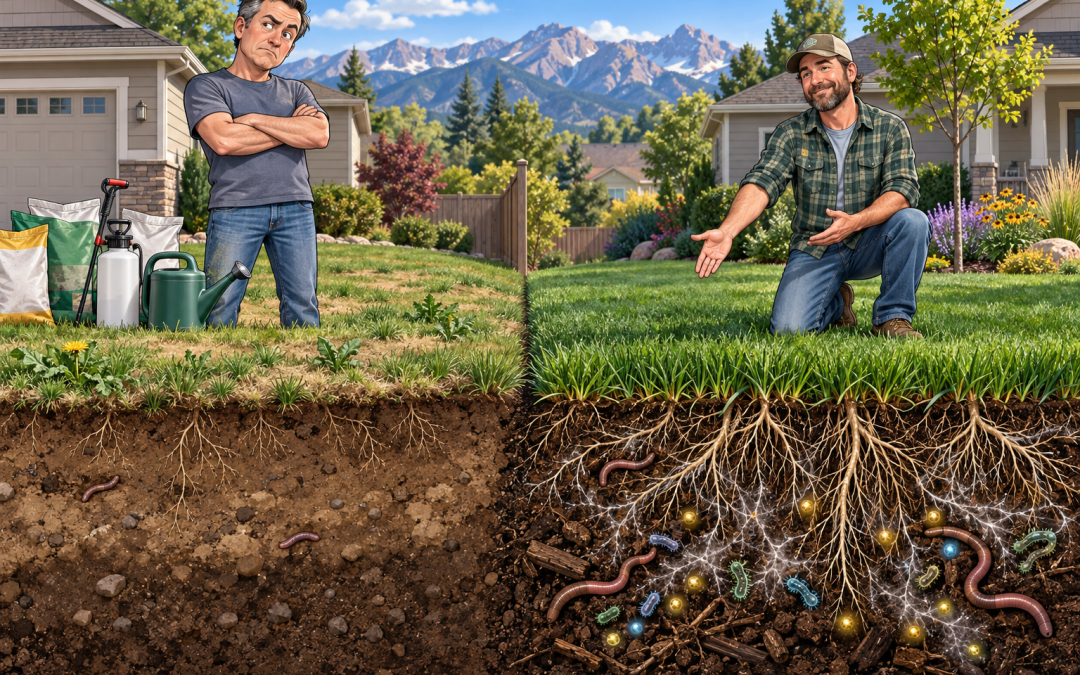
So, What Happens When the Biology Actually Works?
There is still plenty of skepticism surrounding biological lawn care.
Apparently, the idea that soil is a living system—and that healthy grass may require something more than repeatedly applying synthetic fertilizer—is still considered somewhat radical.
Biology feels foreign to many homeowners, but not because it lacks merit. Most people have simply never been encouraged to investigate what is actually happening beneath their lawns.
Instead, they have been taught to react to whatever they can see:
- The grass is pale, so apply nitrogen.
- Weeds appear, so spray them.
- The soil is hard, so aerate it—again.
- The lawn struggles in the heat, so add more water.
- The results fade, so repeat the entire process next year.
After enough years, doing the same thing over and over becomes a “proven lawn-care program.”
But what happens when we stop treating symptoms and begin identifying the conditions causing them?
First, We Discover the Real Problems
Our process begins with proper soil testing.
This is not a basic test performed solely to determine which fertilizer should be applied next. We examine how the soil is functioning as a complete system.
We look at soil structure and gas exchange, biological activity, mineral balance, nutrient availability, and the conditions affecting the soil’s ability to support healthy turf.
In other words, we ask the soil what it needs instead of assuming another bag of fertilizer will somehow settle the matter.
That distinction is important because unhealthy grass is often only the visible expression of a deeper problem.
A lawn can receive plenty of fertilizer and still be unable to use nutrients properly. It can receive more water while lacking the soil structure and humus necessary to manage that moisture efficiently. It can be sprayed repeatedly for weeds while the underlying soil conditions continue inviting those weeds back.
If the system remains dysfunctional, treating its symptoms does not correct the dysfunction.
It simply makes symptom management an annual expense.
Next Comes the Supercharge
When testing reveals significant soil dysfunction, routine maintenance alone may not be enough.
This is where our Supercharge comes into the process.
The Supercharge is not another standard lawn application. It is the corrective phase designed to begin addressing the obstacles that prevent the soil from functioning properly.
Our regular biological program is designed to maintain and improve a system capable of responding. It is not intended to single-handedly reengineer severely dysfunctional soil.
That would be a little like changing the oil in a vehicle with a damaged engine and wondering why it still runs poorly. Maintenance is valuable, but only after the larger mechanical problems have been addressed.
The Supercharge begins that foundational correction.
Once the soil’s major obstacles have been identified and addressed, the lawn can transition into our routine biological maintenance plan, known as the Silver Program.
That is where the system begins to mature.
Reaching the Balance Horizon
At a certain point in this process, many lawns reach what we call the Balance Horizon.
The Balance Horizon is the recognizable point when the soil begins functioning differently.
Biological activity improves. Nutrients begin cycling more effectively. The plant gains better access to what it needs. The soil begins behaving less like an inert growing medium and more like the living ecosystem it was always supposed to be.
The change may begin subtly, but it becomes increasingly noticeable.
The grass develops more consistent color. Growth becomes steadier and more balanced. The lawn begins responding better to water and nutrients. Resilience improves, and the constant cycle of chasing one visible problem after another begins to slow down.
This is usually when skepticism starts disappearing.
Funny how quickly biology becomes believable once people can see it working in their own yard.
The Foundation Comes Before the Appearance
Biological lawn care is not designed to produce an artificial cosmetic response while ignoring the condition of the soil underneath it.
The aesthetics come later because the foundation must come first.
That can be difficult in a world trained to expect a sudden flush of dark-green color following a synthetic fertilizer application. A quick response is easy to see, but quick does not necessarily mean healthy—and green does not automatically mean functional.
Our first objective is not to force the plant to perform.
It is to build the conditions that allow the plant to perform naturally.
Healthy grass is a reflection of functional soil. When the soil can breathe, support microbial life, cycle nutrients, manage moisture, and make minerals available to the plant, the grass has little choice but to respond favorably.
That response is not borrowed color created by another surge of soluble nitrogen. It is the visible result of a healthier system beginning to support itself.
Feeding the Grass Is Not the Same as Building the Soil
Traditional synthetic programs typically focus on feeding the grass directly.
That can produce a visible response, but it does not necessarily correct compaction, poor gas exchange, weak biological activity, mineral imbalances, low humus, or inefficient nutrient cycling.
The grass may become greener temporarily while the system supporting it remains unchanged.
Our biological approach is different.
We do not simply feed the grass and walk away. We work to restore the soil system responsible for supporting and feeding the grass.
That takes investigation. It takes correction. It takes an appropriate transition into biological maintenance. Most importantly, it takes enough time for a living system to respond.
But when it does respond, the results are built on something real.
So, What Happens When the Biology Works?
The soil becomes more functional.
Nutrients begin cycling more effectively.
The lawn becomes more resilient.
Water and other inputs are used more efficiently.
Recurring problems become less aggressive and easier to manage.
The homeowner stops chasing the lawn from one symptom to the next.
And, perhaps most importantly, the skeptic becomes a believer—not because we asked anyone to accept a theory, but because the lawn provided the evidence.
Biology does not require blind faith.
It requires proper investigation, appropriate corrections, consistent biological support, and enough time for the living system beneath the grass to begin doing the job it was designed to do.
Ready to Discover What Your Lawn Has Been Trying to Tell You?
If your lawn requires more fertilizer, more water, more weed control, and more intervention every year—but never seems to become genuinely healthier—it may be time to stop treating symptoms and investigate the system beneath them.
Front Range Biological & Lawn Automation can help you identify the conditions limiting your lawn, determine whether corrective work is needed, and create a path toward healthier, more functional soil.
Request information about our Biological Soil Program
Your lawn does not need another temporary reaction.
It needs a foundation capable of producing lasting results.