
Last Updated on February 1, 2026 by Brian Beck
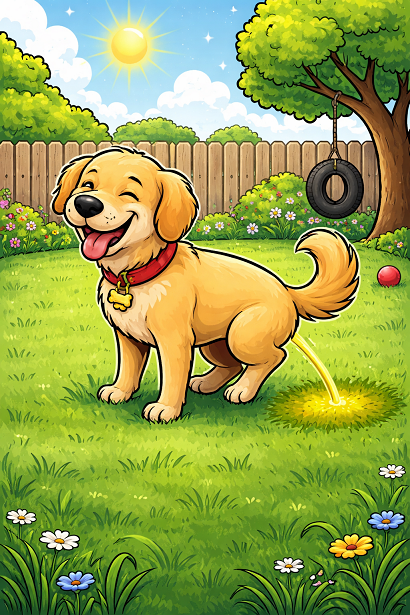
If you’ve owned a dog (or lived next to one), you’ve seen it: a random dark-green patch, sometimes with a crispy brown center, like your lawn got hit with a tiny, targeted “fertilizer shot.”
Most people repeat the same explanation:
“Dog urine greens the lawn because it’s basically nitrogen fertilizer.”
That’s part of the story… but it’s also where the misunderstanding starts.
Below is a “real-life” conversation I have with homeowners all the time—because once you understand what’s actually happening, you start seeing your lawn (and your soil) very differently.
A quick chat in the driveway
Homeowner: “So… my dog is fertilizing my lawn, right? Look how green that spot is.”
Me: “Your dog is dosing your lawn, yes. But ‘fertilizing’ makes it sound controlled. Dog urine is more like dumping a concentrated chemistry set onto a small target.”
Homeowner: “But it’s green. That means nitrogen.”
Me: “Nitrogen plays a role—especially in those dark green rings around the edge. Extension publications even point out that the darker green ring is commonly tied to nitrogen in the urine.”
Homeowner: “So the myth is true?”
Me: “The oversimplification is the myth. People act like it’s only nitrogen—and that misses the mechanism that explains the weird pattern: green edge… brown center… and why the same dog can ‘green’ one lawn and ‘burn’ another.”
What’s actually in dog urine that hits your turf?
Think of dog urine as three things arriving at once:
-
Nitrogen-containing compounds (commonly discussed as the “fertilizer” effect).
-
Associated salts/electrolytes (ions that change the soil solution immediately).
-
Acids/organic compounds that can directly injure turf—recent work points to lactic acid as a major culprit for turf death in some cases.
So yes—nitrogen matters. But your lawn’s reaction is often dictated by the electrical conductivity spike from electrolytes/salts plus the chemical stress response, not just “free fertilizer.”
The missing piece: Electrical Conductivity (EC)
Homeowner: “Electrical conductivity? Like… electricity?”
Me: “Close enough. In soils, EC is basically a measurement of how many dissolved ions are in the soil water—salts, nutrients, electrolytes—anything charged and dissolved.”
Urine is naturally high in dissolved ions. When that hits a small patch of soil, EC jumps fast because you’ve instantly increased the concentration of dissolved salts in the soil solution.
Homeowner: “And that greens it up?”
Me: “It can speed up movement and exchange of ions in the short term—because you’ve just changed the soil solution chemistry. But it’s a double-edged sword.”
Here’s why:
-
Higher EC means more dissolved ions in solution. In some contexts, higher EC is associated with greater nutrient presence/availability in the soil solution—up to a point.
-
But too high an EC creates osmotic stress—the plant struggles to pull water in because the soil solution is “too salty.” That stress can show up as burn/brown-out, similar to what happens with salt-based fertilizer spills.
So the “green spot” isn’t just “nitrogen feeding the plant.” It’s often a short-lived chemistry acceleration—a conductivity spike—followed by stress if the dose is hot enough.
That’s why you’ll often see this pattern:
-
Outer ring = dark green (a lower dose zone where nitrogen/ions stimulate growth)
-
Center = brown/dead (the highest concentration zone—EC stress + chemical injury)
Why the same dog creates totally different results on different lawns
Homeowner: “My neighbor’s lawn gets green spots. Mine gets dead spots.”
Me: “Exactly—and that’s the giveaway that this is a soil system problem, not just a ‘nitrogen’ story.”
A lawn with:
-
better infiltration,
-
higher organic matter,
-
stronger microbial buffering,
-
and more balanced soil chemistry
…dilutes and processes that urine event faster.
A lawn with:
-
compaction,
-
low biological activity,
-
poor water movement,
-
and weak buffering
…holds that salty/acidic/ionic load in one place longer, so the EC spike and tissue stress last longer.
The reality check: dog urine is a diagnostic tool (not a lawn hack)
If you want the “takeaway” in one line, here it is:
Dog urine isn’t a fertilizer strategy—it’s a stress test.
It reveals how your soil handles:
-
concentrated nutrients
-
electrolytes (EC spikes)
-
microbial processing
-
water movement
And the test results show up in living color: green, yellow, brown.
What to do about it (without overcomplicating your life)
-
Dilute quickly when possible. Watering soon after urination reduces concentration and lowers the EC spike effect in that tiny area. (This is why “flush the spot” is common advice.)
-
Stop thinking “I need more nitrogen.” If dog spots are the greenest thing in your yard, that doesn’t automatically mean “apply more N.” It often means your lawn is inconsistent in nutrient cycling and soil function.
-
Build a soil that buffers. The long-term solution isn’t chasing spots—it’s building a soil that can absorb inputs, cycle nutrients, and keep growth steady.
Bottom line
Yes, dog urine contains nitrogen compounds that can green turf at the edges.
But the “green-up” story people tell is incomplete—because the electrolytes/salts in urine spike EC, altering nutrient movement and water relations instantly, and that’s a huge part of why you get the classic green-ring/brown-center pattern.
And depending on conditions, lactic acid can be a major driver of the actual turf death, not just “too much salt.”
If your lawn is constantly “telling on itself” with dog spots, that’s your cue: the soil needs to be made more resilient—so your turf performs consistently without needing random chemistry events to wake it up.
Engage with us: