
Last Updated on September 15, 2026 by Brian Beck
Colorado homeowners hear a lot about saving water.
Usually, the advice is familiar: replace the lawn, let it turn brown, install artificial turf, or spend thousands of dollars changing the landscape.
Those are not the only choices.
Before removing the lawn, homeowners should ask a simpler question:
Is the water currently being applied actually reaching the roots—or is much of it being lost near the surface?
You can begin reducing water waste without purchasing a product or completely rebuilding your landscape. The first step is changing how you water.
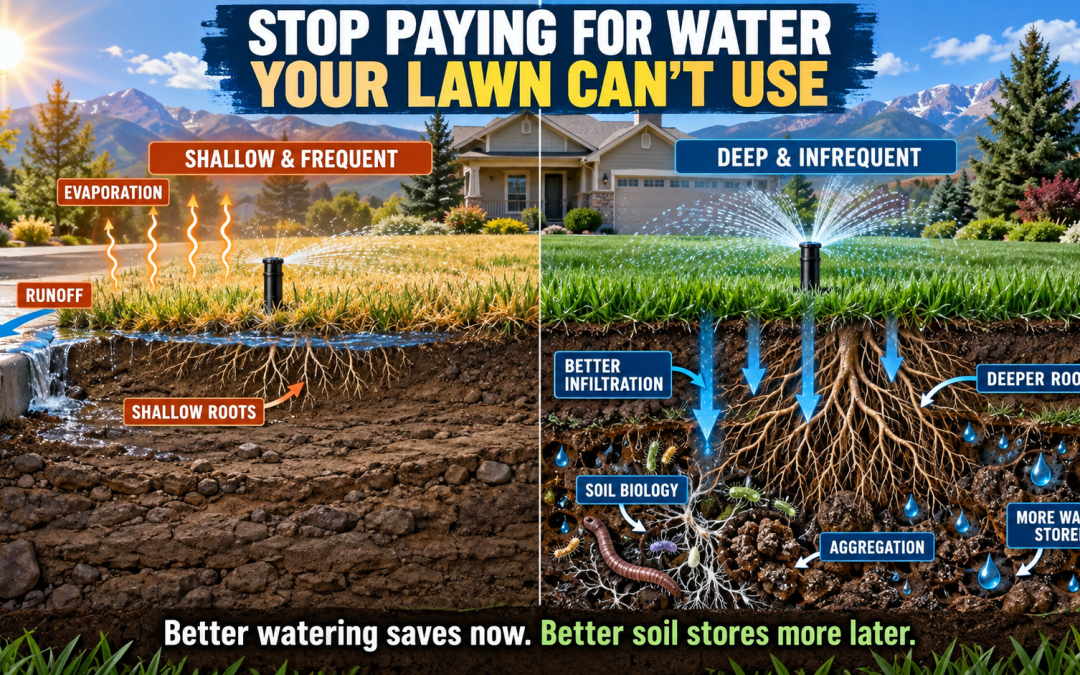
The Immediate Improvement Water Deeper and Less Frequently
Many irrigation controllers are programmed to water three or more days each week. The system runs for a relatively short period, wets the surface, and shuts off.
The lawn may look temporarily refreshed, but much of that water remains in the upper portion of the soil. It can evaporate quickly during hot, dry, and windy Colorado weather.
Frequent surface watering can also train the lawn to depend on frequent irrigation. When the upper soil dries, shallow roots experience stress even though moisture may still exist farther down.
Under the right circumstances, moving from frequent shallow watering to deeper, less frequent watering can reduce waste and may lower the water bill.
A practical starting point for many Colorado lawns during the growing season is to move from three shallow watering days toward two deeper watering days. However, this is not a rigid schedule. Soil type, temperature, exposure, slope, sprinkler performance, and municipal watering rules must all be considered.
The objective is not simply to run the sprinklers longer. The objective is to move water deeper into the root zone—ideally reaching approximately six to eight inches where conditions allow.
Deep Watering Does Not Mean Creating Runoff
Colorado Springs has many compacted and clay-heavy soils. Applying a large amount of water continuously may cause it to run down the sidewalk before it penetrates deeply.
That is where cycle-and-soak watering becomes useful.
Instead of running a zone continuously for 45 minutes, the controller might divide that time into three 15-minute cycles with soaking periods between them. The pause gives the water time to move into the soil before the next cycle begins.
The total runtime may be similar, but the result can be very different:
- Less runoff
- Less surface evaporation
- More water entering the root zone
- Greater encouragement of deeper rooting
- More time between irrigation events
Do not assume that the controller’s current schedule is correct simply because it was programmed by an installer. Irrigation schedules are often based on convenience and standard settings rather than the actual condition of the lawn and soil.
You can test the result with a soil probe, long screwdriver, or small core sample after watering. The goal is to determine how deeply the moisture traveled—not merely whether the surface looks wet.
Better Watering Is the Beginning Not the Entire Solution
Changing irrigation technique can produce an immediate improvement, but it cannot completely overcome dysfunctional soil.
If the soil is compacted, poorly aggregated, low in biological activity, or unable to exchange air effectively, water may still have difficulty entering and moving through it.
This is where biological lawn management becomes important.
A healthy soil is not simply dirt containing fertilizer. It is a living system. Bacteria, fungi, roots, organic compounds, minerals, air, and water must work together.
As biological activity improves, it can contribute to the formation of soil aggregates. Aggregates are small, stable groupings of soil particles held together through root activity, fungal networks, microbial compounds, and organic matter.
Better aggregation creates pore spaces within the soil.
Those pore spaces provide pathways for:
- Water infiltration
- Air movement
- Root development
- Microbial activity
- Nutrient movement
- Water storage
This creates an important cycle.
Better watering supports deeper and more functional roots. Those roots move carbon into the soil. Carbon helps support biological activity. Biology contributes to aggregation. Aggregation improves porosity and infiltration. Improved soil structure allows more water to enter and remain within the root zone.
The result can become a self-reinforcing system.
What About Compost
Many homeowners are told that the fastest way to improve soil is to spread a large quantity of compost over the lawn.
Compost can be useful, but more is not automatically better.
The quality, maturity, carbon-to-nitrogen ratio, salt content, nutrient content, particle size, and application depth all matter. Heavy or inappropriate topdressing can bury turf crowns, introduce excessive nutrients or salts, create a surface layer, or temporarily disrupt nitrogen availability if the material contains large amounts of fresh, high-carbon material.
Fresh carbon does not literally remove nitrogen from existence. However, microorganisms need nitrogen while decomposing carbon. If a material contains abundant biologically active carbon but insufficient nitrogen, microbes may temporarily immobilize plant-available nitrogen while processing it.
Stable humus behaves differently.
Humus is the relatively stable portion of soil organic matter. It can help the soil hold water and nutrients while supporting aggregation and biological habitat. Unfortunately, applying meaningful quantities of high-quality humus can become expensive.
The good news is that a healthy lawn can gradually help build its own organic matter.
Your Lawn Is Already a Carbon-Producing System
Grass captures carbon dioxide through photosynthesis. Some of that carbon is sent belowground through:
- Living roots
- Root exudates
- Root turnover
- Properly processed grass clippings
- Microbial biomass
- Fungal activity
With the right management, the lawn can gradually manufacture and retain more of the carbon compounds that support stable organic matter and humus development.
This is slower than dumping a truckload of material onto the lawn, but it builds a more functional system instead of merely adding material to the surface.
It also means water conservation is not a single treatment.
It is a progression:
- Apply water correctly.
- Encourage deeper roots.
- Improve biological activity.
- Build aggregation and pore space.
- Develop and retain soil organic matter.
- Increase the soil’s ability to accept and store water.
- Allow the lawn to remain functional longer between irrigation events.
A Healthy Lawn Should Use Water More Effectively
No responsible lawn professional should promise that every property can immediately cut its water use by an arbitrary percentage. Soil texture, plant demand, irrigation efficiency, weather, exposure, and existing soil condition all influence the result.
However, most homeowners can begin by asking better questions:
- How deeply is my irrigation water penetrating?
- Is water running off the property?
- Am I watering because the lawn needs it or because the controller is scheduled to run?
- Is compaction preventing infiltration?
- Does the soil contain enough carbon and biological activity to build stable structure?
- Can the lawn remain functional for longer between watering events?
A lawn should not merely survive because water and fertilizer are repeatedly applied to it. It should gradually become better at using and storing the resources it receives.
We Can Help You Build That System
At Front Range Biological & Lawn Automation, we do more than apply lawn treatments. We study how the soil, roots, biology, minerals, irrigation, and environmental conditions are working together.
We can help identify where water is being wasted, why the soil is not accepting or retaining it properly, and what steps can improve the system over time.
You can begin immediately by examining your irrigation schedule and moving away from frequent surface watering. But if you want to go beyond changing the controller—and begin improving the soil’s actual water-handling capacity—we can help you develop that process.
We do not guess with soil. We test it, understand it, and build from there.
Contact us to learn more about the Biological Soil Program
Stop Paying for Water Your Lawn Cannot Use
Changing your watering schedule is a good first step. But if compacted, poorly functioning soil cannot absorb, move, and retain that water, adjusting the controller will only accomplish so much.
Our Biological Soil Program addresses the system beneath the grass—soil structure, biological activity, nutrient movement, root development, aggregation, and water-holding capacity.
Let us help you turn your lawn into soil that captures more of the water you are already paying for.
Request information about the Biological Soil Program
If the button does not open, copy and paste this address into your browser: