
Last Updated on August 11, 2026 by Brian Beck
I need to rant about weeds.
Because when people talk about “weeds,” they tend to lump everything together.
They shouldn’t.
There are really two completely different universes of weeds:
The weeds growing in your lawn.
And the weeds growing in your rocks.
Before we go any further, let’s define a weed. A weed is basically a plant growing somewhere you don’t want it.
Simple enough.
But the reason that plant is growing there can tell us a lot.
Lawn Weeds Aren’t Always the Enemy
Believe it or not, I don’t hate lawn weeds nearly as much as you might think.
Lawn weeds can actually be useful indicators.
They can tell us something about the environment underneath the grass.
Compaction. Poor soil structure. Moisture problems. Weak turf density. Nutrient imbalances. Biological dysfunction.
In other words, sometimes the weed isn’t really the problem.
It’s the messenger.
If you understand what conditions are allowing a particular weed to outperform your turf, you can start correcting those conditions instead of endlessly attacking the symptom.
That is one of the fundamental ideas behind our biological approach to lawn care.
Improve the soil.
Improve the biology.
Improve nutrient cycling.
Build stronger turf.
Make the environment less favorable to weeds and more favorable to grass.
The goal isn’t simply to kill something.
The goal is to figure out why it was winning in the first place.
And then…
There are weeds in rocks.
These things are different.
Rock Weeds Are the Mongol Horde
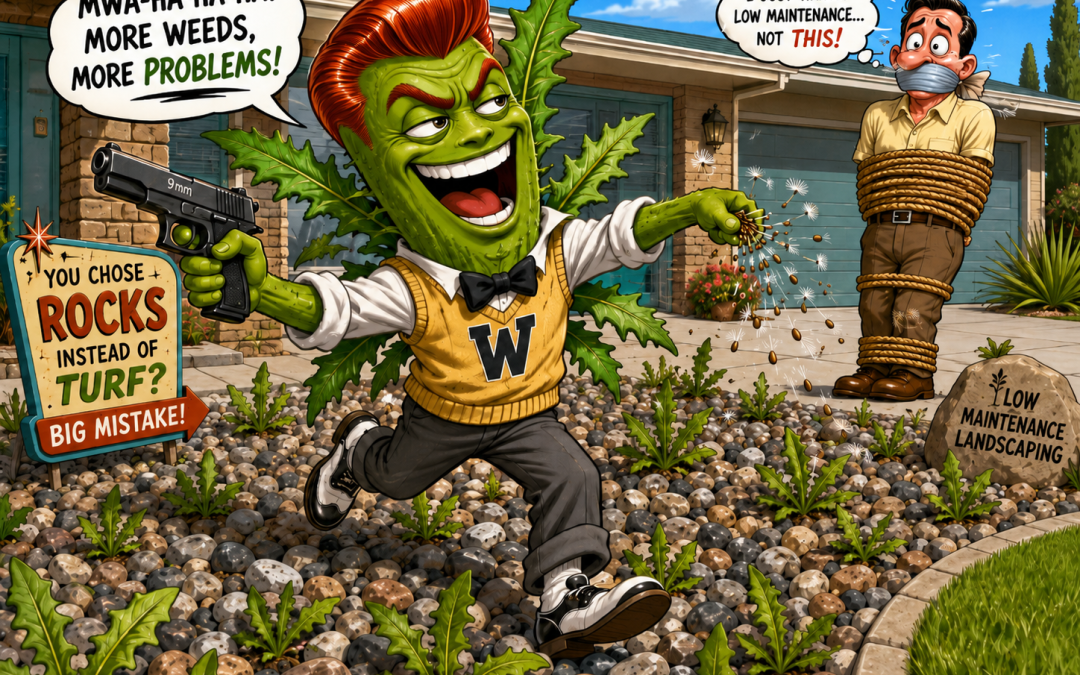
Rock weeds are the mother of all landscape problems.
They are the Mongol Horde coming over the hill to destroy your homeland.
They are the carjacking that doesn’t even go anywhere.
They are Eddie Haskell trying to get himself written into your will.
They are the red-headed stepchild of landscaping.
Can you tell yet that I don’t particularly like weeds in rocks?
These things have one mission in life:
Grow. Reproduce. Spread seeds. Ruin your Saturday.
Pull them today and you can swear an entirely new civilization has appeared by next weekend.
Spray them.
Pull them.
Threaten them.
Insult their mothers.
They don’t care.
Short of napalm and nuclear weapons, weeds are survivors.
Turn your back for five minutes and I’m convinced they hold a meeting.
“Okay boys, he went inside. Everybody germinate!”
But I Thought Rocks Were Low Maintenance?
And here is where I may hurt a few feelings.
People install rock because they believe they are creating a low-maintenance landscape.
Sometimes they are.
But sometimes what they have really created is a giant inorganic nursery for weeds.
Seeds blow in.
Dust settles between the rocks.
Leaves break down.
Organic debris accumulates.
Moisture arrives.
And eventually there is enough material between those rocks for something to grow.
Congratulations.
You have provided the weeds with a bed, a warm blanket, and apparently room service.
Once moisture hits and conditions become favorable, some weed seeds can germinate remarkably quickly.
You clean everything up.
It rains.
You turn around.
And suddenly the misery begins again.
Nature Has Other Plans for Your Rocks
This is one of the realities nobody really likes talking about.
Nature wants things growing.
You can cover the ground with several tons of decorative rock and declare victory, but nature never actually signed that agreement.
Eventually dust, soil, seeds, organic matter, and moisture begin accumulating.
Nature looks at your beautiful sterile rock bed and essentially says:
“Challenge accepted.”
This is why I have always preferred using rock as an accent rather than making it the entire canvas of the landscape.
There is absolutely a place for rock.
But acres of decorative stone surrounding a house can eventually become something very different from the maintenance-free paradise people imagined.
My Advice?
Use rock strategically.
Keep it to a reasonable minimum where practical.
Consider mulch and living plant material in areas where they make sense.
And understand that replacing turf with rock does not necessarily eliminate maintenance.
Sometimes you are simply trading mowing for spending your vacation on your hands and knees pulling weeds while reconsidering every landscaping decision you have ever made.
Yes, I admit it.
I have my biases.
My allegiance is to turf.
Sue me.
But there is an important reason.
With turf, we can actually work on the underlying ecosystem.
We can improve soil structure.
We can improve biological activity.
We can address compaction and nutrient availability.
We can encourage dense, healthy grass that occupies space and competes with weeds.
That means the lawn itself can become part of the weed-control strategy.
Instead of constantly fighting nature, we try to create conditions where the grass has the advantage.
Rock beds don’t provide us with that same biological defense.
They just sit there…
Waiting.
Plotting.
Preparing the next generation.
So that’s my two cents.
This wasn’t really intended to give you the magic solution for rock weeds.
It was mostly intended as a public-service announcement for anyone considering turning half their property into decorative stone because somebody told them it would be “maintenance free.”
Good luck with that.
If you’d rather understand what your lawn and soil are actually telling you—and learn how biological soil management can help you build a healthier, more resilient landscape—we’d love to help.
Front Range Biological & Lawn Automation
👉 Learn more or contact us here:
https://my.serviceautopilot.com/viewform.html?rk=ca7c62a1-42a8-4278-9d40-996a10f4c3da&Type=new&Source=web