
Last Updated on August 6, 2026 by Brian Beck
Some lawns are difficult.
Others force you to rethink everything you thought you understood.
This is the story of one of the most challenging lawns—and soils—we have ever encountered. We are intentionally hiding the identity of the property because this is not about criticizing the homeowner. It is about sharing what we learned and helping other homeowners recognize what may be happening beneath their own grass.
This lawn was not simply lacking fertilizer.
The soil system itself had almost stopped functioning.
The Soil Was Nearly Devoid of Life
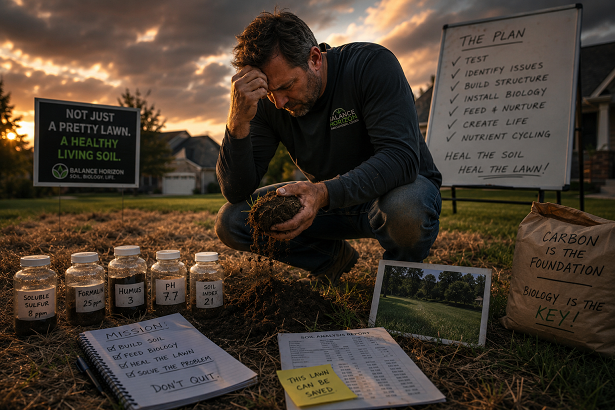
The soil test came back with a Soil Index of only 21.
Humus measured just 3, compared with the laboratory’s desired range of 30–40. Biological activity, measured by Formazan, was only 25 ppm, while the target was 600 ppm. The pH was 7.7, sulfur measured only 8 ppm against a target of 30 ppm, and organic matter was just 1.16%.
Those numbers told us something important:
This was not merely weak grass. This was a broken soil system.
Healthy soil is alive. It contains bacteria, fungi and other organisms that process organic matter, release nutrients and help plants withstand heat, drought and environmental stress.
In this soil, that biological workforce was almost nonexistent.
We could apply nutrients, carbon and other materials, but without enough active biology, the soil could not efficiently process or cycle them.
It was like filling a warehouse with supplies while having almost nobody available to unload, organize or distribute them.
Humus Was Almost Missing
Humus is the long-term carbon reserve of the soil.
It helps hold water, retain nutrients, improve structure and create the air spaces roots and microorganisms need. It also gives the soil resilience during heat, drought and irrigation problems.
This soil had almost none.
With a humus reading of only 3, the lawn had very little ability to store water, manage nutrients or recover from stress. The soil lacked the structure and reserve capacity needed to support a healthy lawn.
High pH Was Locking Nutrients Out
The soil pH was 7.7, considerably above the laboratory target of 6.5.
At higher pH levels, nutrients may still be present in the soil, but the plant may not be able to access them efficiently.
That distinction matters.
A soil test can show that a nutrient exists, but that does not mean the plant can use it. Adding more fertilizer does not automatically solve the problem. In some cases, it simply adds more material to a system that is already unable to function properly.
Sulfur Was a Major Missing Piece
Sulfur measured only 8 ppm, compared with the desired level of 30 ppm.
Sulfur supports chlorophyll production, proteins, enzymes and biological activity. It also plays a role in nutrient use and calcium function.
The calcium numbers were especially revealing.
Calcium occupied 82.7% of the soil’s base saturation, above the desired range of 60–70%.
This did not mean the solution was simply to add more calcium. Calcium was already dominating the exchange system, but the soil was not using nutrients properly.
High pH, inadequate sulfur, low humus and severely depleted biology had combined to create dysfunction.
Where We Fell Short
I want to be honest about this lawn.
We were committed to solving it.
I applied approximately $700 worth of material at full retail value without charging the customer because I believed we could push through the problem.
But we were focusing too heavily on carbon.
Carbon is essential because it helps build structure and creates a habitat for biology. However, we were not adequately feeding the biology itself.
We were building the house, but we were not providing enough food for the workers living inside it.
Unfortunately, we had not fully recognized that missing piece before the customer decided to stop.
The Lawn That Helped Us Find the Answer
At nearly the same time, we were fighting another extremely difficult lawn.
On that property, we began noticing an unexpected improvement connected to a biological product we had started using the previous year. We had misunderstood its potential.
Once we saw what was happening, the pieces began to come together.
The product was not merely adding more carbon. It was helping us adequately feed and support the biology.
Once the organisms had the food and support they needed, nutrient cycling began to improve.
The lawn started looking better—but visible improvement was only the beginning.
True healing requires us to:
- Build soil structure with carbon
- Install beneficial biology
- Feed that biology
- Nurture it over time
- Allow nutrient cycling to become established
That discovery changed our approach.
Did We Fail?
We did not solve the problem quickly enough to keep that particular customer.
We accept that.
But I do not believe the experience was a complete failure.
We had not reached the solution before the customer gave up. The lawn was exceptional, and its soil was among the worst we had ever seen.
What we learned from it helped us improve our process, better understand the relationship between carbon and biology, and push through other difficult lawns.
We have never failed to create progress with a properly supported Supercharge.
Most homeowners do not have soil this severely damaged.
That should give you hope.
Your Lawn May Not Need More Fertilizer
A struggling lawn does not always need another bag of fertilizer.
It may need someone to determine why the soil cannot efficiently use the nutrients, water and organic matter already present.
Our Balance Horizon Soil Consultation and Supercharge Program are designed to move beyond guesswork.
We test the soil, identify the obstacles and begin rebuilding the system beneath the grass.
Stop spending money on symptoms while the real problem remains underground.
If you have watered more, fertilized more and spent more without understanding why your lawn continues to struggle, it may be time to look beneath the surface.