
Last Updated on July 3, 2026 by Brian Beck
Good Intentions Are Not a Soil Program
There is a huge difference between intelligence and information.
A homeowner can be smart, successful, hard-working, responsible, and still be operating from a lawn care model that is incomplete. That is not an insult. That is reality. Most people were never taught the whole equation.
They were taught the Saturday afternoon version of lawn care.
Rip open the bag.
Fill the spreader.
Make the lawn green.
Feel like progress was made.
And on the surface, it makes sense. The lawn looks hungry. The bag says it feeds the lawn. The neighbor does it. The big companies do it. The store shelves are filled with it. So the average homeowner assumes this must be the responsible thing to do.
That is what I call the Forrest Gump mindset in lawn care.
Not because people are dumb. Not because they are careless. Not because they do not care about their homes, families, pets, or neighborhoods.
It is because they are well-intentioned people following a simple script they were handed, without ever being shown what is happening on the other side of the equation.
And that is where the problem begins.
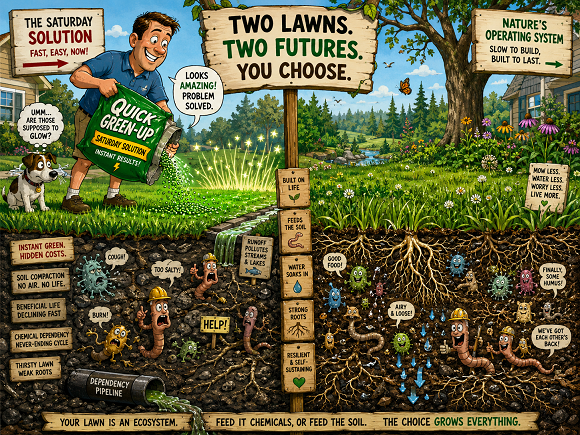
The synthetic model teaches people to look at the lawn from the top down. Is it green? Is it growing? Are the weeds dying? Did the fertilizer work?
But nature does not operate from the top down. Nature operates from the soil up.
A lawn is not just a green carpet. It is a living system. Underneath that grass is structure, air, water movement, roots, minerals, humus, fungi, bacteria, nutrient cycling, and biological intelligence that most homeowners never see and were never taught to consider.
That missing half of the equation matters.
Because when we ignore the soil and only chase the visible symptom, we usually create a new problem while believing we solved the old one.
That is the hidden weakness of the synthetic model.
It can create the appearance of success while quietly building dependency.
The lawn greens up, but the soil does not necessarily improve. The grass responds, but the system may become less resilient. The homeowner feels like they did the right thing, but over time the lawn may need more water, more fertilizer, more weed control, more disease control, more intervention, and more rescue.
That is not ownership. That is dependency.
And dependency gets expensive.
The synthetic approach often trains homeowners to believe that every problem requires another product. A weed problem needs a weed killer. A color problem needs nitrogen. A disease problem needs a fungicide. A dry lawn needs more water. A struggling lawn needs another application.
But what if the real problem is not a lack of products?
What if the real problem is that the soil has lost its ability to function?
That is the question the synthetic model rarely asks, because the answer does not lead back to another bag on the shelf. It leads back to soil structure, biology, humus, oxygen, mineral balance, and water efficiency.
In other words, it leads back to nature’s operating system.
This system has been here since dirt has been on the Earth. If you believe in Creation, it was present at Creation. If you simply observe nature, the conclusion is still the same: forests, prairies, meadows, and grasslands were functioning long before anyone invented a fertilizer spreader.
Nobody fertilizes the forest every six weeks.
Nobody runs around the prairie with a weed control program.
Nobody applies synthetic nitrogen to native grasslands to keep them alive.
Yet those systems build soil, cycle nutrients, manage water, support biology, and grow plants without anyone standing over them with a bag and a calendar.
That should make us pause.
Because the more intelligent system is not the one that requires constant human rescue. The more intelligent system is the one that continues to work when we are nowhere to be found.
That is what healthy soil is supposed to do.
The USDA Natural Resources Conservation Service describes healthy soil as being tied to a functioning soil food web, where microbes are fed by roots, organic matter, and plant residues, and those microbes help cycle nutrients plants need to grow.
That is a very different model than simply feeding the plant from the outside and hoping the soil can absorb the abuse.
The problem with synthetics is not that every product is evil or that every homeowner who uses them is irresponsible. That kind of language is not helpful, and it is not fair.
The problem is that the synthetic model is usually sold without a full explanation of the side effects.
Homeowners are told what the product is supposed to do. They are not always told what repeated use can do to soil biology, soil structure, nutrient balance, water movement, or long-term lawn dependency.
They are sold the green-up.
They are not always sold the aftermath.
And the aftermath matters.
Excess nitrogen and phosphorus can move from soil into waterways through runoff or leaching, contributing to nutrient pollution, algae blooms, and oxygen-depleted water systems. The EPA also notes that lawn and landscape practices can reduce runoff of pollutants and reduce pesticide exposure risk to children, adults, pets, and wildlife.
That does not mean every homeowner is poisoning the planet on purpose.
It means the model has consequences.
It means what we do on a lawn does not always stay on the lawn.
It can move into the soil.
It can move into the water.
It can affect pets.
It can affect children.
It can affect wildlife.
It can affect the larger environment.
And for what?
A quick green-up?
A temporary sense of control?
A lawn that looks good for a moment but becomes more fragile over time?
At some point, we have to ask whether we are managing the lawn or simply feeding an addiction to green.
That may sound strong, but it is honest.
Because green is not always healthy.
A lawn can be green and still be weak.
A lawn can be green and still be compacted.
A lawn can be green and still be biologically dead.
A lawn can be green and still waste water.
A lawn can be green and still be headed in the wrong direction.
The synthetic model trained people to judge lawns by color. Nature judges them by function.
Can the soil hold water?
Can roots breathe?
Can biology cycle nutrients?
Can the plant handle stress?
Can the lawn recover without constant rescue?
Can the system improve over time instead of decline?
Those are better questions.
And they require a better mindset.
The biological model is not about doing nothing. It is about doing the right things so nature can do more of the work.
That means we stop asking, “What product can I apply to force a response?”
And we start asking, “What is preventing this soil from functioning?”
That question changes everything.
Because once the soil begins to function, the lawn does not need to be micromanaged the same way. Water becomes more efficient. Roots become stronger. Nutrients cycle better. Stress tolerance improves. The lawn becomes less dependent on constant correction.
That is real intelligence.
Not because it is complicated for the sake of being complicated, but because it respects the complexity that was already there.
The old model says, “Feed the lawn.”
The better model says, “Build the system that feeds the lawn.”
The old model says, “Kill the symptom.”
The better model says, “Find out why the symptom showed up.”
The old model says, “Apply more.”
The better model says, “Remove the obstacles.”
The old model says, “Keep chasing green.”
The better model says, “Build health, and the green will follow.”
That is the shift homeowners need to understand.
This is not about making people feel foolish for what they did in the past. Most people did what they were taught. Most people trusted the model that was put in front of them. Most people believed they were being responsible.
But good intentions are not the same as good consequences.
At some point, a responsible homeowner has to be willing to ask a better question:
“Is my lawn actually getting healthier, or am I just keeping it alive with inputs?”
That question separates appearance from function.
And once you see the difference, it is hard to unsee it.
The future of lawn care is not more dependency. It is not more synthetic rescue. It is not more water, more chemicals, more fertilizer, more anxiety, and more expense.
The future is soil intelligence.
It is biology.
It is balance.
It is structure.
It is oxygen.
It is humus.
It is nutrient cycling.
It is water efficiency.
It is nature’s operating system doing what it was designed to do.
And the best part is this: when that system starts working, you do not have to be standing there every Saturday afternoon trying to force life into your lawn.
The soil starts carrying more of the load.
That is the difference between renting your lawn and owning it.
If you are tired of guessing, tired of chasing symptoms, tired of pouring money into a lawn that keeps needing rescue, then it may be time to stop asking what product your lawn needs next.
It may be time to find out what your soil has been trying to tell you all along.
At Blade to Blade, we help homeowners move beyond the synthetic treadmill and into a biological soil program designed to build long-term lawn health, reduce dependency, and create a lawn that works with nature instead of against it.
Because the smartest lawn care system is not the one that requires the most products.
It is the one that learns how to let nature do what nature has always done best.
Ready to Stop Guessing What Your Lawn Needs?
If your lawn keeps needing more water, more fertilizer, more weed control, and more rescue every year, the problem may not be your effort.
It may be the system you are stuck in.
At Blade to Blade, we help homeowners move beyond the synthetic treadmill and start building a lawn from the soil up. Our biological soil program is designed to identify the hidden obstacles in your soil, improve long-term function, reduce dependency, and help your lawn work with nature instead of constantly fighting against it.
Before you rip open another bag and hope for a different result, find out what your soil has been trying to tell you.
Schedule a soil consultation with Blade to Blade and take the first step toward owning your lawn instead of renting it from the next product on the shelf.
Engage with us: