
Last Updated on July 7, 2025 by Brian Beck
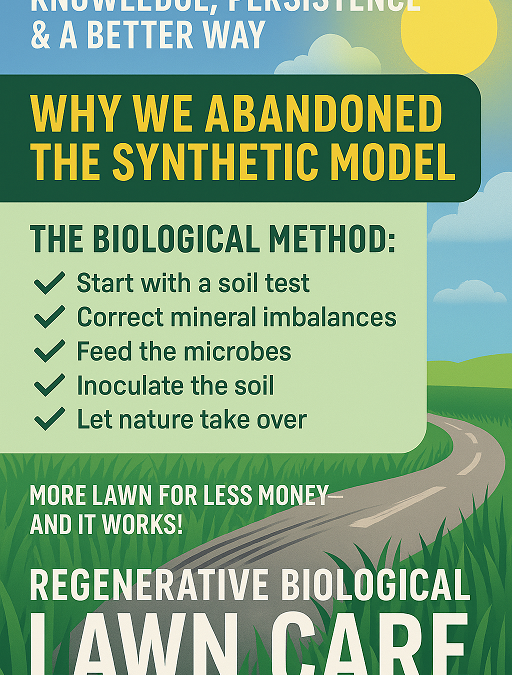
🌱 Knowledge, Persistence & A Better Way: Why We Abandoned the Synthetic Lawn Care Model
Back in 2017, I set out on a mission: to fundamentally change how we manage lawns. I walked away from the synthetic fertility model—not because it was trendy, but because I saw clearly how broken it truly was.
What I discovered was alarming: our soils were depleted, the industry was asleep at the wheel, and homeowners were left holding the bag—paying for a problem they never created.
And no one was talking about it.
🧠 What I’ve Learned
After nearly two decades in this business, I had to face a humbling truth: I only knew what everyone else knew—and it wasn’t nearly enough. The past few years have been the most transformative of my 30-year career, contributing to 90% of the real understanding I now have. That’s how dramatic the shift has been.
The traditional lawn care industry, as it stands today, is built on dependency and the management of dysfunction. It thrives on short-term fixes that lead to long-term problems. It’s not just ineffective—it’s completely backwards.
🚫 The Synthetic Trap
Here’s the uncomfortable truth about synthetic fertilizers:
They use water-soluble, inorganic salts that bypass the plant’s natural systems—the fine feeder roots and the microbial networks in the soil. In doing so, they actually damage both.
What happens next?
-
Microbial life collapses
-
Feeder roots shrink or die
-
Soil compacts (hence your need for mechanical aeration)
-
Carbon loss reduces the soil’s ability to hold water
-
The lawn becomes chemically dependent—needing more and more inputs just to maintain appearances
-
Insect and disease outbreaks increase due to unnatural, weak tissue growth
-
And once you slow down those synthetic inputs? The whole system begins to fail.
It’s a vicious cycle that leads to more stress, more cost, and more work—all to sustain the illusion of a healthy lawn.
We’ve completely abandoned this model—and once you see what comes next, you’ll understand why.
✅ The Biological Method: A Smarter, Sustainable Future
The biological method flips everything on its head. Here’s how it works:
-
We start with a soil test—because guessing is not a strategy.
-
We correct mineral imbalances based on data, not hope.
-
We feed the microbes, both short and long term.
-
We inoculate the soil with targeted microbial life that decomposes organic matter and unlocks nutrients already present in your soil.
Once the biology takes hold, nature takes over. Your lawn begins to act like it’s supposed to—resilient, efficient, and self-sustaining.
💚 What You Can Expect
Here’s what happened in my own yard—and what you can look forward to when you join us:
-
Early spring green-up—in April, with zero intervention.
-
Soft, aerated soil—no plugs, no machines.
-
Significantly reduced water use—because the soil holds and utilizes moisture better.
-
Richer, deeper color—thanks to natural nutrient cycling.
-
Free nitrogen! Yes, nitrogen-fixing bacteria now pull it from the air.
-
Fewer weeds—because weeds grow in stressed, imbalanced soil.
-
Lower stress and disease resistance—even in high summer heat.
-
Stable, consistent growth—no rollercoaster effect.
-
Lush color well into early winter.
-
And most importantly: your soil works with you, not against you.
💡 The Bottom Line
With the biological system, you get more lawn for less money—and it actually works.
No gimmicks. No dependency. No short-term illusions.
Just healthy soil, thriving grass, and a smarter way to care for what’s under your feet.
It’s not just lawn care anymore. It’s land stewardship.
And it’s never too late to start.