
Last Updated on January 1, 2026 by Brian Beck
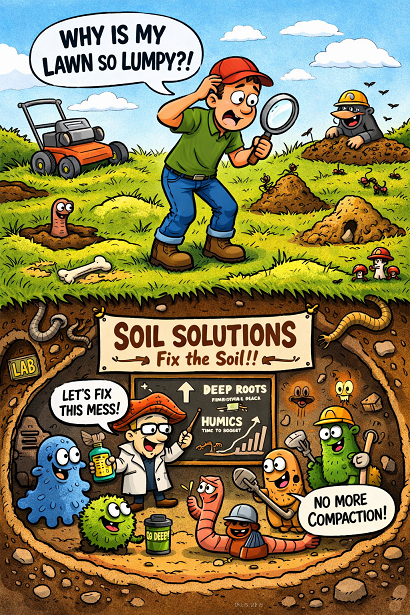
If your lawn feels like you’re walking across a cheap mattress—high spots, low spots, little ankle-twisters everywhere—you’re not crazy. A “lumpy” or “bumpy” lawn is one of the most common complaints I hear.
But here’s the key: most lumpy lawns aren’t a grass problem. They’re a soil-structure problem. And the fix isn’t automatically “core aerate and topdress the whole yard.” In many cases, those are blunt tools that can create new problems while trying to solve the old ones.
What you actually want is a smoother surface and a stronger foundation—built through soil health, microbial life, and smart, targeted corrections.
What “lumpy” really means
A bumpy lawn is usually caused by uneven soil movement under the turf. That movement happens when certain areas:
-
Swell and shrink at different rates (clay behavior, moisture swings)
-
Heave from freeze–thaw (wet soil + winter expansion)
-
Settle over time (organic debris decomposing, weak structure collapsing)
-
Develop hard zones next to soft zones (compaction beside spongy layers)
-
Get pushed around by critters (moles, voles, ants) or earthworm castings
The grass is the carpet. The lumps are in the floor.
The most common causes of a lumpy lawn
1) Compaction and uneven settling
Compaction creates tight, oxygen-poor soil that drains unevenly. Some areas become hard “plates,” while other areas slump or collapse over time.
Clue: a screwdriver is hard to push in on the highs and hard zones.
2) Freeze–thaw heaving
If the surface layer stays too wet going into cold weather, freezing expands the soil and pushes it upward—often unevenly.
Clue: the lawn feels worse after winter, and the bumps don’t match mowing lines.
3) Thatch and spongy layers
A thick thatch layer can create a bouncy, uneven feel even when the soil underneath isn’t wildly unlevel.
Clue: it feels springy, not firm.
4) Buried debris, old roots, construction leftovers
Old tree roots, rocks, chunks of concrete, buried wood—these can cause random highs now and sinkholes later.
Clue: localized bumps that don’t correspond to irrigation coverage.
5) Critters and “soil engineers”
Moles/voles create runs and ridges. Ants mound. Worm castings create tiny bumps.
Clue: visible tunnels, mounds, or fresh soil on the surface.
The soil-health explanation: bumps happen when structure is weak
Smooth lawns come from stable soil structure—the crumb-like aggregation that holds your surface together evenly and resists swelling, collapsing, and heaving.
That structure is built by living systems:
-
roots (the rebar)
-
fungi (the webbing)
-
bacteria and their byproducts (the glue)
-
humus and carbon (the sponge)
When the biology is weak or constantly disrupted, you get soils that behave like:
-
bricks (compacted, tight, lifeless), or
-
powder/mush (collapses, crusts, slumps)
Either one creates uneven ground over time.
Why I avoid core aeration as a default solution
Core aeration is often treated like a universal answer, but it comes with tradeoffs that most people never talk about.
Here’s why I’m cautious with it:
-
It disrupts fungal networks.
Fungal webs matter. They help build aggregation, move nutrients, and stabilize structure. Punching thousands of holes is not “free.” -
It increases soil surface exposure.
More exposed internal surface area can accelerate dehydration and drive carbon loss through oxidation, especially in already stressed soils. -
It can become an endless cycle.
If you aerate but don’t rebuild biology and structure, you often need to aerate again… and again… because the underlying problem never changes.
That doesn’t mean there’s never a place for mechanical disruption—but it shouldn’t be the automatic reflex.
Why I don’t love wall-to-wall compost topdressing either
Topdressing is another popular “one-size-fits-all” recommendation, but blanket compost applications can create issues:
-
Nitrogen tie-up / N-drop: Compost breakdown is biology-driven. If the material isn’t appropriate, or if conditions aren’t right, microbes can temporarily immobilize nitrogen while decomposing carbon-heavy inputs.
-
Crude inputs don’t equal precision: Compost varies wildly. You can accidentally introduce imbalance, salts, weed seeds, or inconsistent results.
-
Slow conversion: A lot of compost has to be processed before it becomes stable humus and structure, and that timeline doesn’t always match the homeowner’s expectations.
My preference: spot topdressing, done infrequently and intentionally, to correct specific low areas—not to smear compost across the entire yard like peanut butter.
The better path: smooth the lawn while building structure biologically
Step 1: Fix the “why” first, not just the “shape”
Do a simple diagnosis:
-
Probe the soil in multiple spots (screwdriver test)
-
Identify wet zones vs dry zones (sprinkler coverage + drainage)
-
Check for thatch thickness
-
Look for tunneling/mounding activity
The dominant cause determines the best correction.
Step 2: Level only what needs leveling (spot corrections)
If the lawn is truly uneven, you do need to physically address low areas—but you can do that without a full-yard overhaul.
-
Spot fill low spots with a thin leveling mix
-
Keep applications modest and controlled
-
Allow grass to recover and knit in
This solves the “ankle-twister” problem without creating a biological disruption event across the whole property.
Step 3: Use “humic aeration” instead of mechanical assault
If your real goal is improved structure, higher CEC performance, and nutrient efficiency, I’d rather lean on humic substances and biology-driven aggregation than punch holes everywhere.
Humics can help:
-
improve CEC dynamics (how the soil holds and exchanges nutrients)
-
buffer nutrient behavior (less leaching and volatility)
-
support microbial habitat and aggregation over time
-
improve soil “tilth” without tearing up fungal architecture
This is the “build the sponge” approach.
Step 4: Target nutrient inputs with precision
Instead of crude, blanket compost inputs, nutrients can be delivered intentionally:
-
correct what’s limiting (based on a soil test when possible)
-
feed the plant without disrupting the system
-
support biology with carbon-based stimulants rather than bulk material
This is especially important in lawns that are already overfed, salt-stressed, or trapped in shallow-root cycles.
Step 5: Fix water behavior (because water creates lumps)
Many lawn bumps are a water-management problem in disguise.
A healthier pattern is typically:
-
deep, infrequent irrigation
-
dry-down between cycles
-
avoid constant surface saturation
This reduces:
-
freeze–thaw heaving
-
surface collapse
-
shallow rooting
-
patchy swelling/shrinking
Step 6: Let mowing become part of the soil program
Consistent mowing with clippings returned is a gentle carbon trickle that supports microbial life without shocking the system.
It’s one reason automation pairs so well with soil health: frequent micro-mulching, steady biology support, fewer spikes.
The mindset shift: Stop “treating” the lawn and start building it
A smooth lawn isn’t a one-time event. It’s a structural outcome.
If you want the ground to stay level, you need soil that:
-
holds water evenly
-
drains evenly
-
grows roots deeply
-
maintains aggregates
-
protects carbon
That’s a biological system. And biological systems respond best to targeted corrections, minimal disruption, and consistent support—not periodic demolition.
Quick FAQ
So what if my lawn is severely compacted?
Then we talk about why it got that way and what correction gives the best outcome with the least disruption. Sometimes disruption is necessary—but it should be strategic, not automatic.
How long until it improves?
Surface spot leveling can improve quickly. True structure and stability build over a season (and get better each season you stop resetting the biology).
Will humics “level” the lawn by themselves?
No—humics don’t magically move dirt. But they do help soil behave better so it stops shifting, heaving, collapsing, and creating new lumps.
Bottom line
A lumpy lawn is a symptom of unstable soil behavior. You can chase it forever with mechanical disruption and blanket compost—or you can solve it at the source:
Build soil structure biologically. Protect fungal networks. Use humic aeration for CEC advancement. Level only where needed. Target nutrients precisely. Fix watering so the soil stops moving.
That’s how you get a lawn that feels good underfoot—and stays that way.
If you want, I’ll also write a short companion checklist: “Lumpy Lawn Diagnosis: Find the Cause in 10 Minutes (and the Correct Fix)” tailored to Colorado conditions.
Read more here: