
Last Updated on September 23, 2025 by Brian Beck
When most people think about water waste in lawns, their minds jump straight to sprinklers running at the wrong time of day, broken irrigation heads, or neighbors who water sidewalks instead of grass. While those things are certainly part of the problem, the real issue runs much deeper—literally.
The biggest driver of water waste in lawns is not surface habits alone, but what’s happening (or failing to happen) in the soil beneath our feet.
The Hidden Role of Carbon in Soil
Healthy soil is alive. At its best, it’s a rich mix of minerals, microbes, organic matter, and—most importantly—carbon. Carbon is the backbone of soil life, the scaffolding upon which humus forms. Humus is the dark, sponge-like material that allows soil to hold onto water and nutrients.
When humus is present in the right amounts, soil behaves like a reservoir. It soaks up rainfall and irrigation, then slowly releases it back to plants. This reduces the need for frequent watering and creates a buffer against heat and drought.
How Synthetics Accelerate Carbon Loss
Unfortunately, the widespread use of synthetic fertilizers and chemical lawn care programs accelerates the breakdown of soil carbon rather than building it. Here’s why:
-
Microbial disruption – Synthetic fertilizers feed plants directly but starve soil microbes, the very organisms responsible for turning organic matter into humus.
-
Accelerated oxidation – Heavy nitrogen salts increase soil respiration, which burns through stored carbon faster, releasing it into the atmosphere instead of keeping it in the ground.
-
Shallow rooting – Plants treated with synthetics often develop shallow, dependent root systems. Without strong roots pushing carbon downward, the soil loses depth, structure, and resilience.
Over time, this system strips carbon out of the soil faster than it can be replaced, leaving the ground dry, compacted, and lifeless.
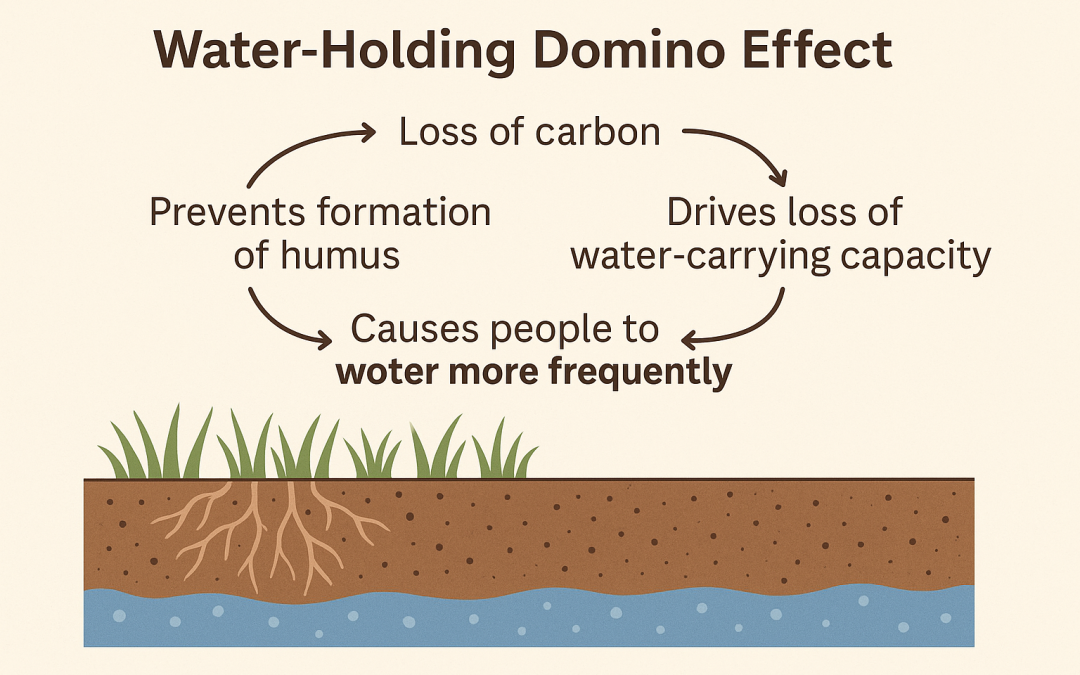
The Water-Holding Domino Effect
When carbon is lost, humus levels drop. Without humus, soil loses its sponge-like quality. Without that sponge, water drains or evaporates instead of being stored. And when water isn’t stored, grass suffers stress more quickly.
What do most people do when their lawn looks thirsty?
They turn up the sprinklers.
It’s a vicious cycle:
-
Synthetics burn carbon →
-
Carbon loss reduces humus →
-
Humus loss reduces water storage →
-
Soil dries out faster →
-
People water more often →
-
More money and water wasted.
The Path Forward
Breaking this cycle requires rethinking lawn care from the ground up. Instead of focusing on quick fixes from a bag, the solution lies in restoring soil biology and rebuilding carbon reserves.
This means:
-
Incorporating organic matter and biological treatments that feed microbes, not just plants.
-
Encouraging root growth and density through proper mowing and hydration practices.
-
Allowing time for the soil to rebuild humus, increasing its natural water-holding capacity.
When soil is biologically active and carbon-rich, lawns need far less water, resist stress more effectively, and thrive without becoming dependent on constant human intervention.
Closing Thought
Water waste isn’t really a watering problem—it’s a soil problem. Until we acknowledge the central role of carbon in soil health, we’ll keep throwing more water on lawns that simply can’t hold it. But by shifting away from synthetics and toward biological fertility, we can restore humus, rebuild resilience, and finally stop treating water waste as inevitable.