
Last Updated on November 6, 2025 by Brian Beck
💧 1. The Biological Engine: Carbon and Oxygen Balance
Soil carbon — humus, microbial biomass, and root exudates — is the fuel microbes burn to generate energy (CO₂, enzymes, organic acids, etc.).
For that carbon to build up rather than burn off, two things must stay in balance:
-
Aeration (oxygen): microbes need some to respire.
-
Moisture: keeps the system reduced enough to conserve carbon rather than combust it.
When the soil dries out near the surface, it exposes that carbon to excess oxygen and heat, which accelerates oxidation — basically like turning the compost pile.
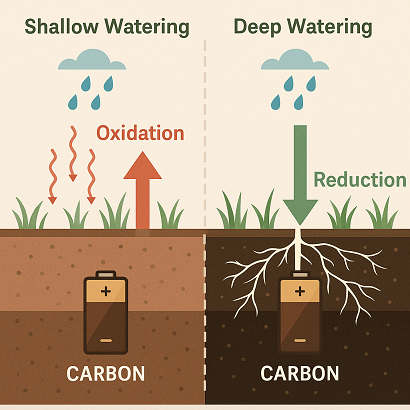
🔥 2. Shallow Watering = Surface Oxidation
When irrigation only wets the top 1–2 inches:
-
The surface cycles repeatedly between wet and dry.
-
Each dry cycle pulls oxygen deeper and releases CO₂ upward.
-
That rapid oxidation “burns off” active carbon (microbial food) instead of letting it polymerize into humus.
So, rather than carbon storing electrons (stable organic matter), it becomes CO₂ gas — gone into the atmosphere.
This is the same reaction that makes compost steam when you turn it: oxygen + moisture + carbon = oxidation and CO₂.
🧠 3. The Microbial Effect
In a shallow-wet environment:
-
Fast-breathing aerobes dominate, consuming carbon quickly.
-
Fungal and anaerobic carbon-stabilizing species can’t survive.
-
Each drying phase kills off microflora that can’t sporulate quickly.
This causes a “boom and bust” microbial cycle, where biology flares up after each watering, consumes remaining carbon, and then dies — leaving less each time.
🌱 4. The Structural Consequence
Without steady moisture deep in the profile:
-
Roots stay shallow, concentrating respiration near the surface.
-
Carbon cycling and aggregation happen only in that thin zone.
-
The deeper soil remains biologically inactive and compacted, so infiltration declines — making shallow watering even more frequent and destructive.
This creates a feedback loop of:
Shallow water → oxidation → carbon loss → compaction → poorer infiltration → shallower roots → repeat.
⚖️ 5. The Fix
Deep, infrequent irrigation (¾–1 inch once every 5–7 days) keeps oxygen and moisture in equilibrium:
-
The soil stays slightly reduced (electron-rich) deeper down.
-
Microbes shift from burning carbon to building humus.
-
Fungal networks extend and stabilize aggregates.
The result is net carbon gain — the soil becomes a battery again, storing energy rather than discharging it.
Read more: