
Last Updated on November 29, 2025 by Brian Beck
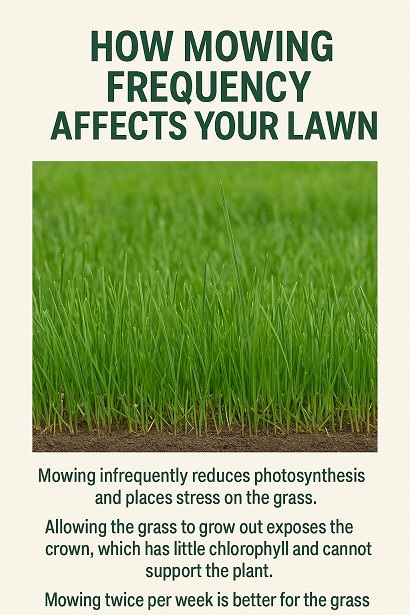
Most people assume mowing is a simple chore: cut it once a week, every ten days if you’re “busy,” and call it good. The problem? Turfgrass doesn’t operate on your schedule. It operates on biology, physics, and the rules of photosynthesis—rules that don’t care about your weekends, your vacations, or your to-do list.
If you want a healthy, resilient, low-cost lawn, you need to understand what actually happens inside the plant when you stretch out your mowing intervals. Spoiler: what looks like harmless procrastination is actually one of the fastest ways to sabotage root depth, water efficiency, turf density, and overall plant strength.
Let’s break it down.
1. Photosynthesis Runs the Show — And Infrequent Mowing Disrupts It
The entire energy system of turfgrass is driven by photosynthesis. The leaf blade is the plant’s solar panel. When you allow the grass to grow too tall and then scalpel-shave it during a heavy cut, you’re removing a huge percentage of the plant’s energy-producing tissue.
When you cut off too much leaf tissue:
-
The plant suddenly loses a massive portion of its daily energy supply
-
Photosynthesis drops sharply
-
The plant is thrown into crisis mode
Without that solar energy, the plant must pull stored carbohydrates from the roots to replace the energy lost from the missing leaf tissue.
That means…
2. Infrequent Mowing = Root Dieback
When you mow every 10–14 days, the grass doesn’t get a gentle trim—it gets amputated. Removing too much leaf surface forces the plant to steal carbohydrates from the root system to support emergency regrowth.
This leads to:
-
Shallow roots
-
Reduced drought tolerance
-
Higher water usage
-
Less nutrient uptake
-
Thatch buildup
-
Weak plants inviting weeds & disease
Over time, the roots shrink because they’re being cannibalized to fuel the top growth you chopped off. This is why lawns that are mowed infrequently always struggle under heat, drought, or stress—there’s simply no root mass left to support the system.
3. Overgrown Grass Exposes the Crown — and That’s a Big Problem
The crown of the plant (the whiteish, low-chlorophyll area near the base of the leaf) is not built to support long-term energy production. Its job is structural, not photosynthetic.
When the lawn is allowed to grow too tall:
-
The crown elongates
-
It emerges above the soil surface
-
It becomes exposed to sun and mower blades
-
It takes damage it was never designed to handle
Now combine that with a heavy mowing event that removes the energy-rich blade above it. The crown has almost no chlorophyll, meaning it cannot feed the plant on its own.
This is where turf begins its downward spiral:
-
Loss of photosynthetic tissue
-
Crown exposed and compromised
-
Carbohydrate reserves drained
-
Roots die back
-
Turf weakens
-
Stress absorbs more resources
-
More dieback
This is how lawns decline even when homeowners think they’re “taking good care of it.”
4. The Once-Per-Week Paradigm is Outdated
The traditional once-a-week mowing schedule was invented for human convenience, not biological correctness.
Grass doesn’t grow in weekly increments—it grows daily, and when conditions are right, aggressively.
Weekly mowing still removes too much leaf surface in a single pass, which:
-
Still stresses the plant
-
Still impacts photosynthesis
-
Still drains carbohydrates
-
Still leads to weaker roots
Is weekly mowing better than biweekly? Of course.
Is it optimal turf management? Not even close.
5. The Gold Standard: Twice Per Week
Cutting twice per week keeps the grass in a stable, low-stress rhythm:
-
You remove far less leaf tissue per mow
-
Photosynthesis remains consistent
-
Carbohydrate reserves remain intact
-
Root depth increases
-
Turf density improves
-
Water usage drops
-
Stress levels stay low
Twice-weekly mowing mimics how turf actually wants to grow and aligns with the biology of the plant. This is how golf courses, athletic fields, and high-performance lawns achieve density and resilience.
But most homeowners can’t commit to that schedule.
Which brings us to…
6. The Perfect Solution: Automation & Robotic Mowing
This is exactly why robotic mowing is exploding in popularity and why it fits so perfectly within Blade to Blade’s Trinity system.
Robotic mowers:
-
Cut every day or every other day
-
Remove only millimeters of growth at a time
-
Keep the plant’s energy system stable
-
Maintain dense, fine turf
-
Reduce stress to almost zero
-
Encourage deep roots
-
Improve water efficiency
-
Eliminate the “scalping” cycle completely
Daily micro-mowing is—by far—the healthiest mowing frequency nature allows.
Robotics give the grass exactly what it biologically needs while:
-
Saving you time
-
Reducing labor costs
-
Lowering fuel and emissions
-
Increasing turf quality more than any human schedule ever could
This is why the future of turf management is not the once-per-week paradigm…
It’s consistent, automated, biological mowing.
Final Thoughts: A Turf Revolution Begins With Frequency
If you want:
-
Deeper roots
-
Stronger turf
-
Fewer weeds
-
Lower water usage
-
Lower stress
-
Higher performance
…stop letting the grass overgrow, and stop removing huge chunks of leaf blade at once.
Mowing frequency is turf health.
And if twice a week isn’t realistic, that’s the perfect time to talk about automation. Robotic mowing gives your lawn exactly what biology demands — no stress, no guesswork, no compromise.
Your lawn will thank you.
Your water bill will thank you.
Your schedule will thank you.
Read more about the history of mowing:
https://www.springslawns.com/learn-how-world-war-ii-formed-how-you-cut-your-lawn/