
Last Updated on September 23, 2025 by Brian Beck
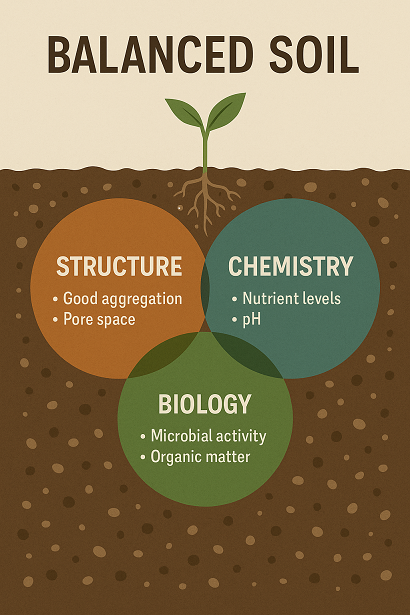
When most people think of soil, they picture plain brown dirt—just a medium to hold plants in place. But soil is a living engine. It’s a dynamic, biological, chemical, and physical system, and when it’s “balanced,” that engine hums with efficiency. Balanced soil isn’t about throwing down more fertilizer or watering harder. It’s about creating harmony among the three key elements: structure, chemistry, and biology.
1. Structure: The Foundation of Balance
Soil structure is how the particles of sand, silt, and clay arrange themselves into aggregates. A healthy structure has pore space—tiny highways for air and water to flow. This space also creates homes for microbes and roots.
Compacted soil is unbalanced. It chokes off oxygen, restricts water infiltration, and forces roots to fight for survival. By contrast, soil with good aggregation allows plants to expand their root systems, access nutrients more easily, and resist stress. Think of structure as the frame of a house: without it, nothing else can stand properly.
2. Chemistry: The Nutrient Equation
Balanced soil chemistry is not about piling on more nutrients—it’s about keeping them in the right ratios and forms.
-
pH must be buffered: too acidic or too alkaline, and nutrients lock up.
-
Calcium, magnesium, and sulfur need to be in proportion, because their relationship directly affects nutrient flow and soil tilth.
-
Macronutrients (N, P, K) and micronutrients (iron, zinc, copper, boron, etc.) must be available in the right amounts without creating antagonisms—where too much of one element blocks another.
Excess is just as damaging as deficiency. Balanced chemistry means nutrients are present, accessible, and not fighting each other.
3. Biology: The Living Workforce
Even perfect chemistry and structure mean little without biology. Soil microbes are the workers that actually unlock nutrients, build humus, fix atmospheric nitrogen, and aerate the soil naturally. They transform raw ingredients into plant-available food while also stabilizing carbon and improving water-holding capacity.
But microbes can’t thrive without the right environment. They need oxygen (structure), balanced chemistry (not too many toxins or excess salts), and food (organic matter). With these in place, the biological engine comes alive.
What Balanced Soil Looks Like in Action
When soil is balanced:
-
Water infiltrates deeply and stays longer, reducing irrigation costs.
-
Roots grow down, not sideways, anchoring turf and plants.
-
Nutrients flow efficiently, without expensive inputs being wasted.
-
Microbes multiply, creating humus that further improves balance.
-
The lawn or landscape resists stress from heat, drought, and disease.
In short: balanced soil creates a self-sustaining cycle where each part supports the others. It’s not a quick chemical reaction—it’s a slow, steady development of an ecosystem that will outlast any short-term fix.
Why It Matters for Your Lawn
A lawn growing on unbalanced soil is like a car with three flat tires—you can keep pouring in fuel (synthetic fertilizer, more water, more labor), but you’ll never get efficiency. Balance restores function. It lowers the cost of ownership, builds resilience, and ultimately produces a lawn that looks good because it is good, not because it’s been artificially propped up.
👉 The next time someone tells you their lawn is struggling, the answer probably isn’t “more.” It’s balance.