
Last Updated on July 28, 2025 by Brian Beck
If you’ve spent any time digging into the world of soil health, you’ve probably heard the word humus thrown around like it’s some kind of magic ingredient. Spoiler alert: it kind of is. But what exactly is humus—and how does it form?
Let’s dig in (pun absolutely intended).
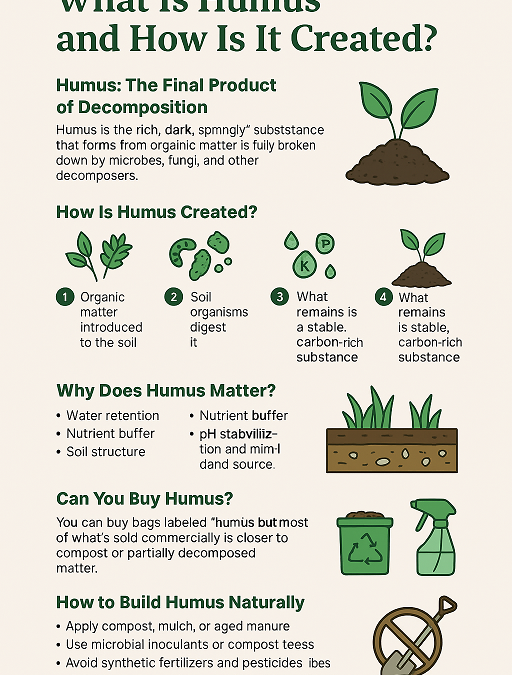
Humus: The Final Product of Decomposition
Humus is the rich, dark, spongy substance that results after organic matter has been fully broken down by microbes, fungi, and other decomposers. It’s not just compost. It’s the end goal of compost. While compost still contains partially decomposed materials, humus is what’s left when nature has finished the job.
Think of compost as the ingredients and baking process, and humus as the finished loaf of bread—nutritious, complex, and long-lasting.
How Is Humus Created?
The formation of humus is a biological masterpiece that follows a natural, multi-step process:
-
Organic matter—like leaves, grass clippings, dead roots, or manure—is introduced to the soil.
-
Soil organisms such as bacteria, fungi, and earthworms begin digesting it.
-
These organisms break down the material into simpler forms—sugars, amino acids, lignin, etc.
-
After the feast is over, what remains is a stable, carbon-rich substance that resists further decomposition: humus.
It’s not an overnight process. Depending on the conditions (like moisture, temperature, and biological activity), it can take months to years to form true humus.
Why Does Humus Matter?
Humus is the soil’s equivalent of gold. Here’s why:
-
Water Retention: Acts like a sponge, holding up to 90% of its weight in water, reducing irrigation needs.
-
Nutrient Buffer: Holds nutrients in the root zone and prevents leaching, especially nitrogen and phosphorus.
-
Soil Structure: Binds soil particles into aggregates, improving aeration, porosity, and root penetration.
-
pH Stabilization: Helps buffer soil pH and neutralize harmful toxins.
-
Microbial Food Source: Serves as a long-term energy supply for beneficial soil microbes.
In short, the more humus your soil has, the healthier and more resilient your lawn or garden will be.
Can You Buy Humus?
Yes—and no.
You can buy bags labeled “humus,” but most of what’s sold commercially is closer to compost or partially decomposed organic matter. True humus is the result of long-term microbial digestion and isn’t something you can bag and tag easily.
How to Build Humus Naturally
If you want the real deal, the best approach is to feed the soil biology and let it do the work. Here’s how:
-
Apply compost, mulch, or aged manure to supply food for microbes.
-
Use microbial inoculants or compost teas to boost soil life.
-
Avoid synthetic fertilizers and pesticides that harm beneficial organisms.
-
Maintain proper moisture to keep fungi and bacteria active (deep, infrequent watering is best).
-
Minimize disturbance—no tilling or over-aerating. Let fungi build networks undisturbed.