
Last Updated on August 13, 2025 by Brian Beck
If you’ve ever dug into soil science or lawn care, you may have come across the term C.E.C., which stands for Cation Exchange Capacity. While it sounds complicated, C.E.C. is one of the most important factors in determining how healthy and productive your soil is — and it can even affect how much money you spend on lawn care and gardening.
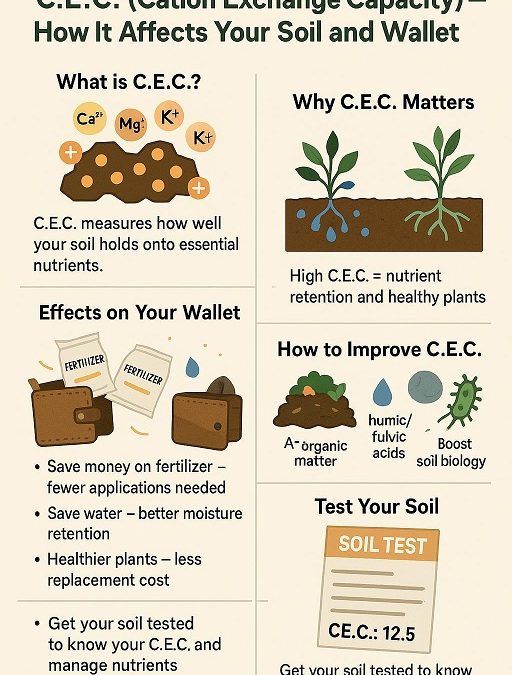
What is C.E.C.?
C.E.C. measures your soil’s ability to hold and exchange positively charged nutrient ions (called cations) like calcium, magnesium, potassium, and ammonium. Think of it as your soil’s “bank” for nutrients — the higher the C.E.C., the more nutrients your soil can store and make available to plants.
Soils with high C.E.C. are like well-stocked pantries. They hold onto nutrients tightly but also release them as plants need them. Soils with low C.E.C. are like empty shelves — nutrients easily wash away with watering or rain, leaving plants hungry and forcing you to add more fertilizers frequently.
Why Does C.E.C. Matter?
-
Nutrient Retention: High C.E.C. soils hold nutrients longer, reducing nutrient loss through leaching or runoff. This means plants get a steady supply of food.
-
Soil Health: Soils with good C.E.C. usually have higher organic matter and better structure, which helps with moisture retention and root growth.
-
Fertilizer Efficiency: When your soil can hold nutrients better, fertilizers are used more efficiently. You won’t have to apply as much fertilizer, and what you do apply lasts longer.
-
Environmental Impact: Less fertilizer runoff means less pollution in nearby waterways, supporting cleaner ecosystems.
How Does C.E.C. Affect Your Wallet?
Believe it or not, C.E.C. can have a big impact on your lawn and garden budget:
-
Lower Fertilizer Costs: Soils with higher C.E.C. reduce how often and how much fertilizer you need to apply. This means less money spent on fertilizers over time.
-
Reduced Water Usage: Because nutrient-rich soils also tend to retain moisture better, you might find yourself watering less frequently, which saves on water bills.
-
Fewer Soil Amendments: Healthy soil with balanced nutrient holding capacity requires fewer expensive amendments like lime or gypsum.
-
Better Plant Growth = Less Replacement: Plants grow healthier and stronger in balanced soils, meaning fewer plants die and need replacement—saving you money on plants and labor.
How to Improve Your Soil’s C.E.C.
If your soil test shows low C.E.C., don’t worry! There are natural and effective ways to improve it:
-
Add Organic Matter: Compost, aged manure, and cover crops boost organic matter, which increases C.E.C.
-
Use Humic and Fulvic Acids: These natural soil conditioners help improve nutrient-holding capacity.
-
Apply Clay or Clay-Based Amendments: Clay particles have a high C.E.C., so adding certain types of clay can help.
-
Biological Soil Amendments: Beneficial microbes and fungi can improve soil structure and organic matter breakdown.
Testing Your Soil’s C.E.C.
A proper soil test will tell you your soil’s C.E.C. along with pH and nutrient levels. Knowing this number helps you tailor your soil management practices precisely — no guesswork, no wasted money.
Final Thoughts
Cation Exchange Capacity is a hidden hero in soil science that directly affects plant health and your wallet. By understanding and improving your soil’s C.E.C., you can reduce fertilizer costs, improve plant growth, conserve water, and build a more resilient, sustainable garden or lawn.
Take the time to test your soil, understand its C.E.C., and invest in building your soil’s capacity to hold nutrients. Your plants — and your budget — will thank you.