
Last Updated on January 27, 2026 by Brian Beck
Homeowners don’t usually fail because they don’t care.
They fail because they upgrade one piece of the lawn system… and expect it to override the other two pieces that are still broken.
So they buy a robotic mower.
Or they install a “smart” irrigation controller.
Or they jump into a biological soil program.
And when the lawn doesn’t transform on an Instagram timetable, they conclude the upgrade was hype.
It wasn’t hype.
It was incomplete.
A lawn is a system.
And systems don’t improve from one isolated upgrade. They improve when the parts match.
That’s why Trinity exists.
The hard truth: one upgrade usually makes the other problems MORE obvious
This is the part most companies won’t say out loud, because it slows down the sale.
Upgrade #1: Robotic mowing… without hydration + soil
Robotic mowing is a force-multiplier. It creates consistency, density, and reduces stress from “weekly scalping.”
But if your soil won’t infiltrate water, or your hydration habits are broken, robotic mowing can’t fix:
-
hydrophobic soil
-
compacted clay
-
nutrient lockout
-
shallow roots from frequent shallow watering
So what happens?
Your lawn looks more consistent… but still struggles in heat or drought.
The mower didn’t fail. The system failed.
Upgrade #2: Smart irrigation… without soil + mowing
A controller can schedule water.
It cannot:
-
fix runoff
-
fix compaction
-
fix a soil that can’t hold moisture
-
fix a thin canopy that bakes the surface
So what happens?
You “water smarter,” but the lawn still dries too fast because the soil is a brick and the canopy is thin.
The controller didn’t fail. The system failed.
Upgrade #3: Biological soil program… without mowing + hydration
Biology needs two things to work:
-
consistent moisture
-
consistent inputs and stability above ground
If you’re mowing once a week (big stress cuts) and watering randomly (or shallow), biology can’t build momentum. It’s like trying to start a campfire with wet wood and no airflow.
So what happens?
You say, “I tried biology. It didn’t work.”
No—you tried biology inside a system that kept resetting it back to zero.
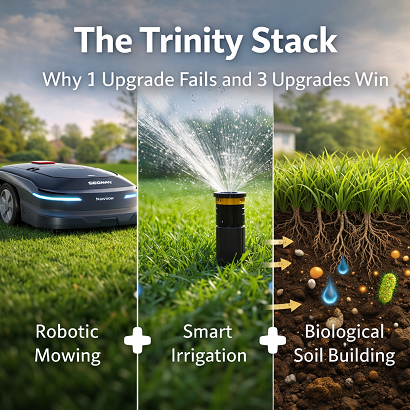
The Trinity Stack: why 3 upgrades win
Trinity is simple:
1) Robotic mowing stabilizes the canopy
-
frequent micro-cuts
-
less stress
-
more density
-
clippings returned as food
-
cooler soil surface (less evaporation)
2) Smart irrigation stabilizes moisture
-
deeper rooting behavior
-
fewer stress spikes
-
less runoff
-
fewer disease cycles
-
stop “timer religion” and start managing moisture
3) Biological soil building stabilizes nutrient flow and structure
-
better infiltration
-
better aggregation
-
better nutrient cycling
-
lower long-term inputs
-
a lawn that gets easier to maintain over time
When you stack them, each one supports the other two.
Mowing protects moisture.
Moisture unlocks biology.
Biology improves infiltration and nutrient flow.
That creates thicker turf, which then protects moisture even more.
That’s compounding.
That’s why the Trinity stack wins.
The bottleneck rule: your lawn is only as good as its worst constraint
People love to chase “the best upgrade.”
But lawns don’t respond to the best upgrade. They respond to the biggest constraint.
Common constraints (especially in Colorado):
-
low humus / low carbon buffering
-
clay issues + poor structure
-
poor Ca:Mg balance that tightens soil
-
high pH lockout
-
inconsistent watering and dry pockets
-
weekly mow stress and scalping
If you don’t address the worst constraint, everything else becomes expensive effort with weak returns.
Trinity isn’t “more stuff.”
It’s removing bottlenecks in the correct order.
What you’ll notice first (and what you won’t)
Here’s the expectation reset that saves people from quitting too early:
Visible turf change is often last.
First come the invisible wins:
-
improved infiltration
-
less runoff
-
more stable moisture
-
better nutrient movement
-
fewer stress spikes
-
roots start behaving differently
Then the lawn starts looking like it “suddenly” got better.
It wasn’t sudden. It was the system finally functioning.
The 90-day Trinity transition (simple version)
Days 1–14: Stabilize
-
stop the big weekly mow stress (micro-mowing begins)
-
stop shallow watering and random schedules
-
identify the real soil constraints (soil test + site realities)
Days 15–45: Correct
-
address structure (often split applications, spaced out)
-
build carbon/humus engine
-
feed microbes with short + long-term food sources
-
refine irrigation timing to maintain consistent moisture
Days 46–90: Compound
-
density improves
-
weeds lose footholds
-
moisture stabilizes
-
nutrient flow becomes smoother
-
the lawn becomes less needy and more predictable
The real payoff: lower cost of ownership and less drama
The synthetic/weekly paradigm keeps you paying forever:
-
more water
-
more inputs
-
more “rescues”
-
more weeds
-
more frustration
Trinity is designed to do the opposite:
-
reduce ownership cost over time
-
reduce toxic exposure
-
reduce friction and weekend stress
-
increase lawn performance with less drama
That’s the upgrade nobody talks about.
Call to action
If you’ve tried one upgrade and felt disappointed, odds are you weren’t wrong—you were incomplete.
If you want the lawn that feels like it runs itself, you need the stack.
Reach out and we’ll tell you if your property qualifies, what your biggest constraint is, and the most efficient path to Trinity results—without the treadmill.