
Last Updated on January 19, 2026 by Brian Beck
Every year it happens.
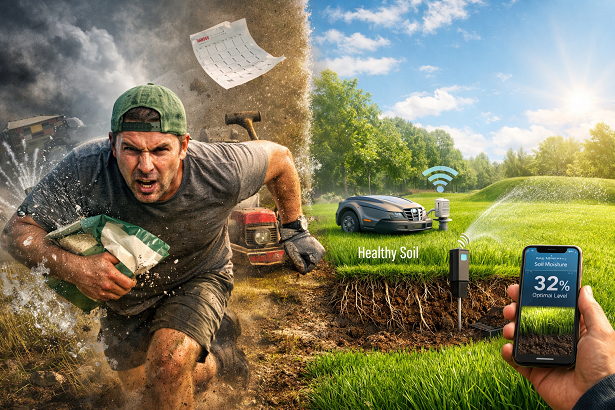
The calendar flips, the holidays clear out, and suddenly otherwise normal adults become lawn sprinters. You know the type—maybe you are the type. The first decent day of the year hits and it’s like a starter pistol goes off:
-
“I need to scalp it.”
-
“I should fertilize early.”
-
“Maybe I should water more.”
-
“Where’s my pre-emergent?”
-
“I’m behind.”
And off we go—a ritualistic mad dash that people repeat like a tradition handed down through generations. Some folks practically break their neck getting the lawn “going” because they believe if they don’t hit it hard early, they’ll spend the entire year chasing the dream of that perfect green carpet.
Here’s the sad part:
Most people never actually get there.
They get close enough to post a photo. They get just green enough to stop worrying. They get good enough to tolerate.
But deep down, they know the truth: it still feels fragile.
It still needs constant babysitting.
It still punishes them the second they miss a week or the weather turns.
And the reason isn’t that you’re lazy or “don’t care enough.” The reason is far bigger than effort.
The “Perceived Condition” Trap
Most lawns are managed like a cosmetic project.
People chase a look—color, thickness, uniformity—without realizing those are late-stage symptoms, not foundations. It’s like trying to make a person look healthy by putting makeup on them while they’re living on energy drinks and no sleep.
Your lawn isn’t failing because you didn’t sprint hard enough in March.
It’s failing because most homeowners are unknowingly running a system that cannot produce stable health, no matter how much money, time, or stress they throw at it.
And yes—lawn health can be measured. Not guessed. Not “felt.” Measured.
If your soil can’t move nutrients efficiently, if your mowing approach is inconsistent, and if your watering is based on vibes and sprinklers-on-a-timer… then the annual January sprint isn’t a plan.
It’s panic management.
The Systemic Problem No One Sees
Most lawn programs are built on a broken assumption:
“If I feed the grass enough, it will behave.”
That’s backwards. Grass behaves when the system underneath it is functioning.
That system has three pillars—three areas where modern lawns are finally catching up with reality:
-
A biological soil that enables fast nutrient flow
-
Robotic mowing that enables early start, consistent effort, and an end on your choosing
-
Smart irrigation that measures and maintains soil moisture instead of guessing
This is the difference between “trying harder” and changing the operating system.
Let’s break it down.
Pillar #1: Biological Soil = Fast Nutrient Flow (And Less Desperation)
If your soil biology is weak, everything becomes harder:
-
Fertilizer efficiency drops
-
Water infiltration slows
-
Roots stay shallow
-
Stress increases
-
Disease pressure rises
-
Weeds show up like unpaid interns
You can’t out-hustle bad soil.
A biologically active soil is what makes nutrients move, not just “exist.” It’s what turns your lawn from a dependent patient into a functioning organism that can handle weather swings without melting down.
What “health” looks like (measurably)
Here are things you can actually track:
-
Infiltration: Does water soak in quickly or sit on the surface?
-
Root depth: Are roots shallow and angry, or deep and stable?
-
Thatch breakdown: Is thatch building up, or being digested?
-
Color stability: Does it stay green without constant inputs?
-
Recovery time: How fast does it bounce back after stress?
Biology isn’t some woo-woo concept. It’s the workforce that runs the system. When the workforce is absent, you have to do everything manually—and that’s why people sprint.
Pillar #2: Robotic Mowing = Early Start + Consistency + Control
Here’s a truth most people never consider:
Most lawns aren’t “maintained.” They’re “recovered” once a week.
That once-per-week mowing paradigm is a compromise. Always has been. It’s based on labor schedules, not plant health.
Robotic mowing flips the equation because it delivers what grass actually wants:
-
Consistent cutting
-
Small clippings returned
-
Less shock
-
More density over time
-
A lawn that stays “caught up” by default
The underrated January benefit: you start when you want
Robotic mowing also changes the beginning-of-year psychology. Instead of waiting until the lawn is tall enough to justify “a mow” and then hacking it down like you’re clearing a field…
You can start earlier, lighter, and smoother—without the drama.
And here’s the best part nobody talks about:
You get to decide when you’re done.
Not because the lawn is dying and you’re burnt out.
But because the system is stable enough that you can step back without everything collapsing.
That’s freedom.
Pillar #3: Smart Irrigation = Stop Guessing, Start Managing Moisture
Water is either a tool—or a tax.
Most people water like this:
-
“It’s been dry… I should run it.”
-
“It looks a little dull… I’ll add time.”
-
“It’s hot… I’ll do more days.”
That’s not management. That’s reacting.
Smart irrigation (especially when paired with soil moisture measurement) changes watering from superstition into precision.
Instead of guessing, you can maintain a target soil moisture range that supports:
-
deeper roots
-
better nutrient uptake
-
less disease pressure
-
fewer wasted cycles
-
fewer “oh crap” recoveries
Your lawn doesn’t need more water.
It needs the right moisture at the right time.
The Real Reason You Sprint Every Year
You sprint because your lawn is unstable.
Instability forces emergency inputs:
-
big fertilizer hits
-
heavy watering
-
harsh corrections
-
frantic mowing
-
constant “fixes”
A stable system doesn’t need a dramatic beginning-of-year ritual. It needs a smooth ramp-up.
And the difference between panic and progress is this:
Stop asking, “How do I make it look good fast?”
Start asking, “How do I make it function well consistently?”
That’s the shift.
The New Ritual: A Calm Start That Actually Works
If you want a beginning-of-year approach that doesn’t feel like a self-inflicted stress test, here’s the better order of operations:
-
Measure and build soil function
-
prioritize biology and the conditions that allow it to work
-
-
Mow for plant health, not convenience
-
consistency beats intensity
-
-
Water with feedback
-
maintain moisture, don’t chase symptoms
-
When those three are in place, the “rush” disappears—because you’re no longer trying to force results out of a system that can’t deliver them.
If You Want the Shortcut, Here It Is
The shortcut isn’t another product.
It isn’t a new bag of something.
It isn’t a harder sprint.
The shortcut is installing the right operating system:
-
Biological soil for nutrient flow
-
Robotic mowing for consistency and control
-
Smart irrigation for measurable moisture management
That’s how you stop living in the yearly cycle of “almost there.”
If you want help building this as a unified system, start with the simplest step: get the soil measured. Once you know what’s happening under the surface, everything else gets easy to prioritize—and you’ll finally stop wasting an entire season trying to buy health with effort.
Your lawn doesn’t need another mad dash.
It needs a system.