Last Updated on October 17, 2025 by Brian Beck
When you look at a lawn, it’s easy to focus on what you can see — the green color, the bare patches, the weeds, or the uneven growth. But the real story of your lawn isn’t written on the surface. It’s happening below, in the soil.
Your soil is the engine that drives everything above it. Every blade of grass, every drop of water, and every ounce of fertilizer depends on what’s going on beneath your feet. And for most lawns, that engine is running on fumes.
The Hidden Cost of Neglecting Your Soil
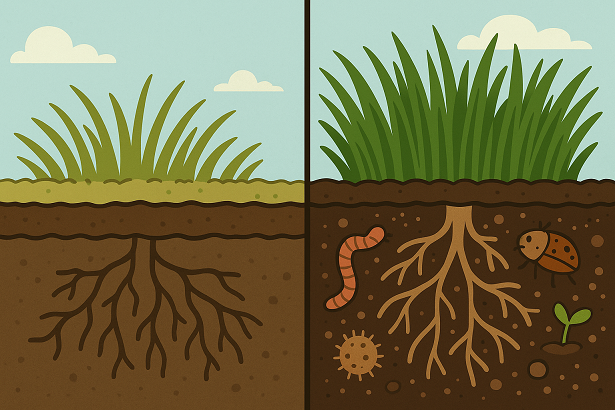
Years of synthetic fertilizers, salt-based treatments, and chemical quick fixes have stripped away the life that makes soil function. The living biology that used to break down nutrients, hold water, and protect roots has been slowly starved and replaced by chemical dependency.
The results are all too familiar:
-
Lawns that never stay green for long.
-
Hard, compacted soil that sheds water instead of absorbing it.
-
A cycle of constant fertilizer use and watering that gets more expensive every year.
-
Weeds and diseases that just keep coming back.
This isn’t bad luck — it’s a broken system. Synthetic products create short-term color but destroy the very biology that gives your soil the power to sustain itself.
Why Soil Testing Is the First Step
Soil testing is like a health checkup for your lawn. It shows us what’s out of balance — where nutrients are excessive, missing, or locked up — and allows us to correct those issues with precision rather than guesswork.
When we bring a soil back into balance biologically, everything starts to work again. Microbes return. Roots grow deeper. Water begins to soak in instead of running off. The soil begins to feed the grass naturally, just as nature intended.
A Living System That Pays You Back
Healthy soil isn’t just about looks — it’s about efficiency.
When the soil is alive and balanced, every drop of water and every nutrient is used to its fullest potential. That means fewer inputs, lower water bills, and a lawn that takes care of itself instead of relying on constant rescue treatments.
The shift from a chemical system to a biological one doesn’t just restore the lawn — it restores balance, sustainability, and long-term savings. The lawn looks better, yes, but it also works better.
The Takeaway
If your lawn feels like an uphill battle — constant treatments, dry spots, or weeds that never quit — the problem isn’t you. It’s your soil.
Testing your soil is the first step toward understanding it, fixing it, and restoring its natural ability to sustain life. Once you do that, you’ll never see lawn care the same way again.